


Age Verification on Gaming Platforms: How Technology Protects Young People in 2026
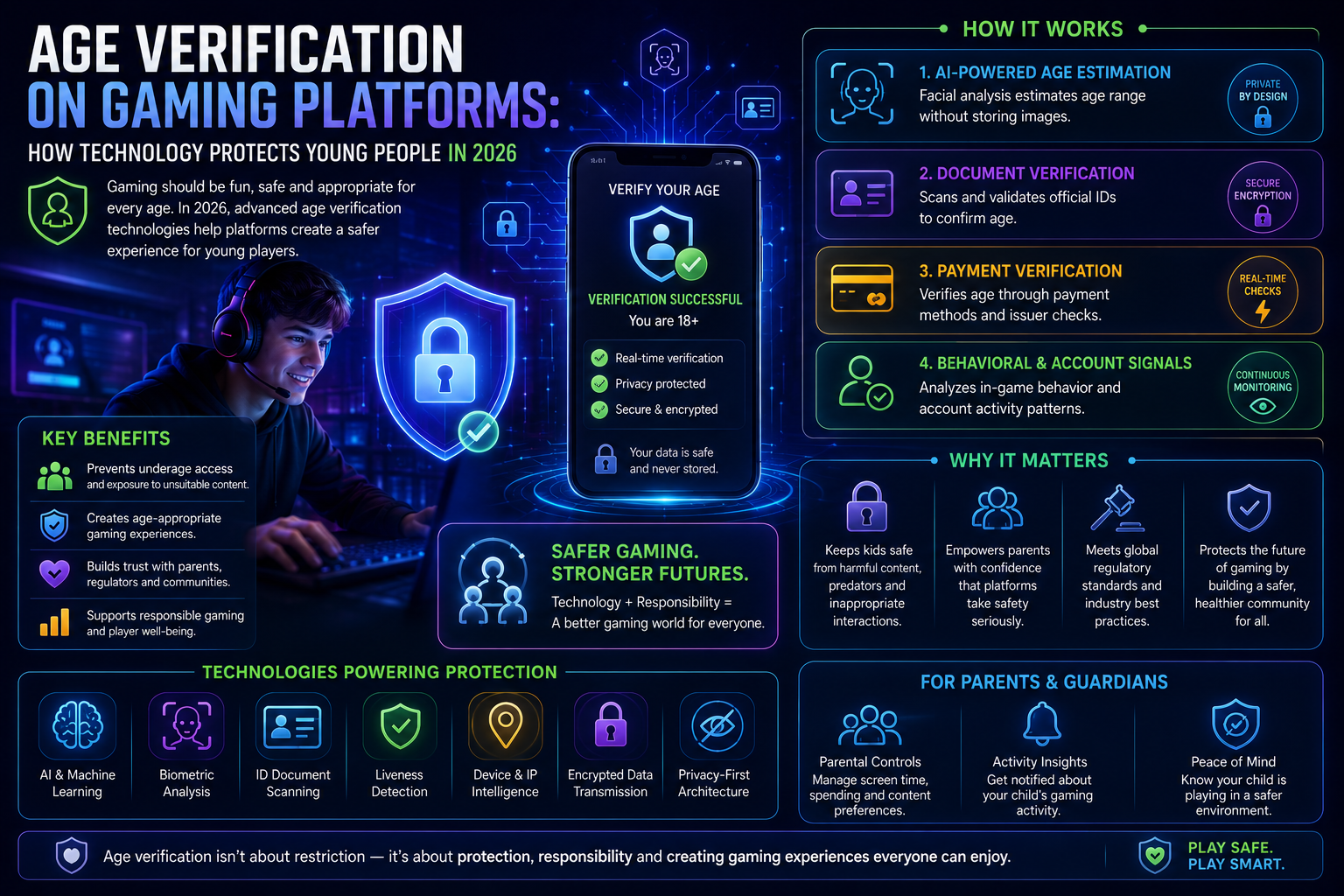
Online gaming platforms that involve real-money transactions are for adults only. This is not merely a platform policy preference — it is a legal requirement in every jurisdiction where these platforms operate, and it is a genuine welfare imperative. The combination of financial risk, competitive pressure, and habitual engagement patterns that characterise real-money gaming makes it inappropriate for people who have not yet developed the emotional and financial maturity that adulthood is presumed to confer.
Age verification is the technical and procedural system that enforces this adult-only requirement. In 2026, age verification has become significantly more sophisticated than the historical norm of a checkbox declaration ("I confirm I am over 18"), incorporating identity document verification, biometric liveness checking, and database cross-referencing into processes that genuinely confirm age rather than merely recording a declaration.
Lords exchange id verification architecture incorporates state-of-the-art age verification as an integral component of the broader identity management system, treating it as a genuine protective mechanism rather than a compliance checkbox.
Why Simple Age Declarations Are Insufficient
The inadequacy of age declarations — checkboxes, date-of-birth entry fields — as age verification is well established. Young people who wish to circumvent these controls face no genuine barrier: a date of birth can be entered incorrectly in seconds, and no consequence falls on the platform or the minor unless more robust verification is in place.
Effective age verification requires confirming age through evidence that cannot be trivially falsified:
Identity document verification — Documents issued by government authorities include date of birth as a verified attribute. A passport, Aadhaar card, or driving licence whose date of birth is verified through automated document authentication provides genuine age confirmation rather than a self-declaration.
Database cross-referencing — Date of birth information can be cross-referenced against authoritative databases (where available and legally accessible) to confirm consistency between the presented document and official records.
Biometric liveness checking — Ensuring that the person presenting the document is the same person whose photograph appears on it, and that the selfie being taken is of a live person rather than a photograph, prevents the use of a parent's or older sibling's documents.
Lords exchange id verification incorporates all three elements, producing an age verification outcome that is grounded in genuine evidence rather than declaration.
How Lords Exchange Id Age Verification Works
The lords exchange id verification process confirms age through a sequence that makes circumvention genuinely difficult rather than merely nominally prohibited.
Document submission — Players submit a government-issued photo ID. Every valid document in the accepted set (Aadhaar, passport, PAN, driving licence) includes date of birth as a verified field. Automated document verification extracts and validates the date of birth from the submitted document.
Face matching — A selfie is captured and compared biometrically to the photograph on the submitted ID. This confirmation that the person submitting the document is the person to whom it was issued prevents the use of documents belonging to older family members.
Liveness detection — The liveness verification sequence (turn head, blink, or similar action) confirms that the selfie is of a live person in real time rather than a static photograph of the document holder, preventing the use of a photograph of an older person's ID.
Age calculation and confirmation — The date of birth extracted from the verified document is compared to the current date. If the calculated age is below 18, account creation is rejected with appropriate guidance. If the age is 18 or above, verification proceeds.
Ongoing verification integrity — The lords exchange id record maintains a complete verification audit trail. Any attempt to modify date of birth information after verification triggers a re-verification requirement, preventing post-verification manipulation.
Protecting Young People Beyond Age Gating
Age verification is the primary technical protection mechanism, but comprehensive protection for young people requires additional dimensions beyond the gatekeeping function.
Family account separation — Lords exchange explicitly prohibits account sharing, which prevents verified adult accounts from being used by younger family members. The KYC and lords exchange id architecture ensures that the verified individual's identity is tied to the account in a way that is not easily transferred.
Responsible gaming tool availability — For players approaching the age threshold who have just turned 18, responsible gaming tools (deposit limits, session limits, self-exclusion) provide an additional safety net during the transition period when some platform participants may still be developing the financial maturity that responsible gaming requires.
Customer service age safeguarding — Customer service agents are trained to escalate interactions where indicators suggest a player may be younger than their verification suggests (unusual language patterns, apparent naivety about financial concepts, communications suggesting parental involvement). These escalations trigger enhanced account review.
Parental control integration — For households where adult account holders are parents, lords exchange supports integration with device-level parental controls that can restrict access to the app during periods when children have device access. This is supplementary protection that operates at the device level rather than the account level.
The Role of Technology Partners in Age Verification
Age verification technology has advanced substantially through specialised third-party providers who focus exclusively on this domain. Lords exchange partners with leading KYC and age verification technology providers to access:
Machine learning document authentication — AI-powered document verification that detects sophisticated document forgeries that rule-based systems cannot identify, trained on extensive databases of genuine and forged documents across all document types accepted in India.
Real-time liveness detection — Biometric liveness technology that detects increasingly sophisticated spoofing attempts, including deepfake video submissions that simple motion-detection systems cannot identify.
Cross-border document support — Verification capabilities for international travel documents, allowing lords exchange to serve players from outside India who present foreign government-issued identification while maintaining equivalent age verification confidence.
The technology partnership approach ensures that lords exchange's age verification keeps pace with advancing circumvention techniques through continuous platform provider updates rather than requiring the platform to build and maintain specialised biometric AI capabilities independently.
What Happens When Age Verification Is Declined
When age verification cannot confirm that a player is 18 or over, lords exchange handles the outcome through a defined process that is protective rather than punitive.
Clear communication — The player receives a clear explanation of why verification was unsuccessful and what steps, if any, can be taken to resolve the issue (resubmitting clearer document images, providing alternative acceptable documents).
Balance protection — If a player who has made deposits before verification was required (some platforms allow limited play before full verification) fails age verification, funds are returned to the deposit source rather than forfeited.
No adverse data retention — The fact of a failed age verification due to confirmed underage status is retained for fraud prevention purposes but is not shared outside the platform's compliance function.
Referral to appropriate resources — Communication acknowledging a declined verification for underage status includes referral to age-appropriate gaming alternatives that are designed for and appropriate to younger users.
Frequently Asked Questions
Why does lords exchange require identity documents for age verification rather than just a date of birth?
Date of birth declaration cannot be verified and can be trivially falsified. Government-issued document verification, combined with biometric face matching, provides genuinely reliable age confirmation that protects young people rather than merely recording a declaration that can be ignored.
What documents are accepted for age verification on lords exchange?
Aadhaar card, PAN card, passport, voter ID, and driving licence are all accepted. Each document includes date of birth as a verified attribute. Lords exchange admin recommends Aadhaar for the fastest processing due to its QR code-based data extraction capability.
Can a player use a family member's ID to bypass age verification?
The biometric face matching step compares the selfie to the document photograph, confirming that the person submitting the document is the document holder. Using a family member's document will typically fail at the face matching stage because the faces will not match.
What happens if I am 18 but my document was issued before my 18th birthday?
All accepted documents include date of birth rather than an age calculation at issuance time. Age is calculated from the date of birth on the document at the time of verification, not from any other date reference on the document.
Conclusion
Age verification is among the most important protective functions that gaming platforms perform, and lords exchange's implementation reflects a genuine commitment to this protection rather than minimum-viable compliance. The lords exchange id verification architecture — document authentication, biometric face matching, liveness detection, and ongoing integrity monitoring — creates genuine age confirmation that protects young people from environments inappropriate for their developmental stage. For adult players, this rigorous verification is the process that makes a trusted gaming environment possible: one where every participant has been confirmed to meet the maturity threshold that real-money competition requires.

 Arabic
 French
 Spanish
 Portuguese
 Deutsch
 Turkish
 Dutch
Dutch
 Italiano
 Russian
 Romaian
 Portuguese (Brazil)
 Greek
Greek