


Docbyte Vault: Secure Storage for Long-Term Business Records
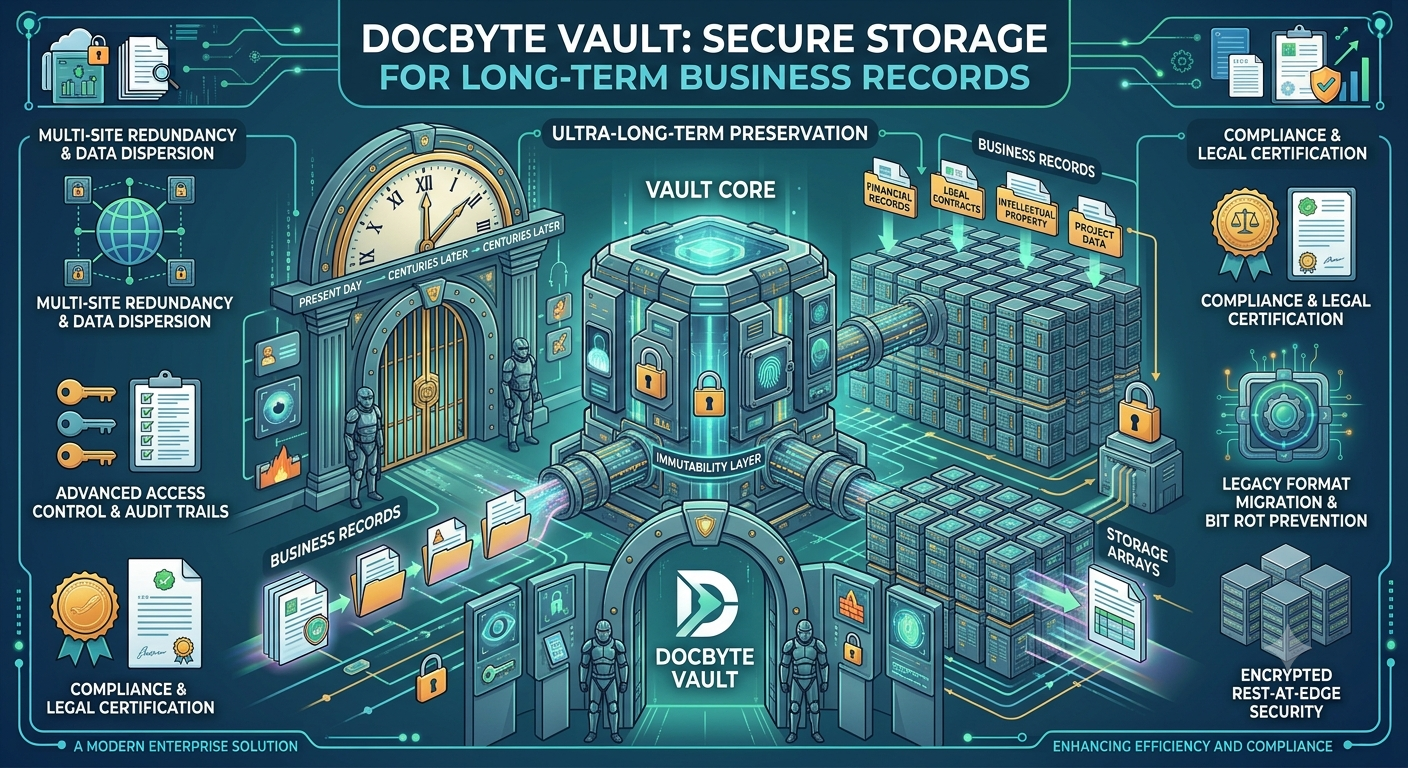
Business records often need to remain available long after employees, applications, and storage systems have changed. Contracts, financial records, customer files, regulatory documents, HR records, and signed agreements may need to be retained for years or even decades.
Keeping these files in cloud folders or backup systems does not automatically preserve their long-term value. Formats can become obsolete, metadata can disappear, and electronic signatures can become difficult to verify.
Docbyte Vault provides a secure digital archiving environment designed to preserve important business records over extended retention periods. It combines secure storage with integrity controls, retention management, audit trails, format preservation, and controlled access. The aim is to keep records readable, searchable, and trustworthy throughout their complete lifecycle.
Why Long-Term Records Need More Than Storage
Traditional storage systems are useful for documents that employees actively create, edit, and share. They are not always designed for records that must remain unchanged and verifiable over long periods.
A normal storage platform may show where a file is located, but it may not provide clear evidence of:
- Where the record originated
- When it entered the archive
- Whether its content has changed
- Which retention rule applies
- Who accessed or exported it
- Whether its format remains readable
- Whether a digital signature can still be validated
Backups serve another purpose. They help organisations restore systems after accidental deletion, hardware failure, cyberattacks, or data corruption. They are not normally designed to provide governed retention, legal holds, preservation metadata, or long-term evidence.
Docbyte Vault is built around active digital preservation rather than passive file storage. It is designed to protect both the record and the information required to understand and verify it later.
Controlled Document Ingestion
Secure archiving begins when a record enters the system.
Documents may come from business applications, shared folders, scanners, email systems, external portals, document management platforms, or legacy software. During ingestion, the archive must capture the file together with its origin and business context.
Docbyte Vault treats ingestion as part of the document’s trust chain. It records provenance, integrity information, metadata, and the context surrounding each submission. This creates a reliable starting point for the record’s long-term lifecycle.
Relevant metadata may include:
- Document type
- Creation date
- Source system
- Author or submitting party
- Customer or case number
- Department
- Retention category
- Access classification
This information makes archived records easier to search and understand. It also prevents files from becoming disconnected from the processes that originally created them.
Protecting Record Integrity
A long-term archive must detect unauthorised changes and accidental corruption.
Docbyte Vault uses cryptographic hashing and fixity controls to support integrity verification. A hash creates a digital fingerprint for a file. If the file changes, its fingerprint changes as well.
Regular integrity checks can identify problems caused by storage failure, system errors, or tampering. Audit records can then show when the issue was detected and which action was taken.
Docbyte Vault also uses evidence records and trusted timestamping to establish when information existed and whether it has remained unchanged. These controls help create a verifiable history that can remain useful as technology and cryptographic standards evolve. (DOCBYTE)
This is particularly important for contracts, financial reports, regulatory submissions, legal documents, and other records that may later be reviewed during an audit, inspection, or dispute.
Keeping Files Readable as Formats Change
Secure storage is not useful when a file can no longer be opened.
Older records may depend on discontinued software, proprietary formats, outdated operating systems, unsupported fonts, or obsolete encryption methods. The file may still exist, but its contents may become inaccessible.
Docbyte Vault applies an active preservation lifecycle that includes format identification, risk monitoring, normalisation, and controlled migration. When a format becomes unsafe or difficult to support, the archive can create a readable representation in a more sustainable format. (DOCBYTE)
The original record can remain preserved alongside the newer representation. The archive can also document:
- Why the migration was required
- Which tool performed the conversion
- When the conversion occurred
- Whether the output was verified
- How the new representation relates to the original
This allows an organisation to maintain access without losing the record’s history or authenticity.
Retention and Lifecycle Governance
Different business records require different retention periods.
An invoice may need to be kept for a defined number of years, while a contract, clinical record, employee file, or government document may follow another schedule. Retaining everything forever creates privacy, cost, and governance risks.
Docbyte Vault supports policy-based retention based on document type, metadata, classification, and business context. Once assigned, these rules can be applied consistently across large volumes of archived information. (DOCBYTE)
A retention policy can define:
- When the retention period begins
- How long the record must remain available
- Which legal or business rule applies
- Whether the period can be extended
- Who must approve disposal
- What evidence of deletion must be retained
Legal holds can suspend normal deletion when records are relevant to litigation, regulatory reviews, audits, or internal investigations.
This controlled approach helps businesses retain required information while supporting defensible deletion when records no longer have a valid purpose.
Secure Access and Auditability
Long-term business records frequently contain confidential, personal, commercial, or regulated information. Access must therefore be limited to authorised users.
Docbyte Vault supports controlled permissions, searchable indexes, provenance records, and audit trails. These controls help organisations understand who accessed a record, what action was performed, and when it occurred. (DOCBYTE)
Access controls can be based on role, department, record category, business purpose, or case involvement. Organisations can also provide controlled access to auditors or inspectors without exposing unrelated records or the original source system.
Auditability is especially important when an organisation must show that documented procedures were followed. A complete history of ingestion, access, preservation, retention, migration, and disposal provides stronger evidence than a file stored without context.
Preserving Digitally Signed Records
Electronic signatures introduce another long-term risk.
A signature may be valid when applied, but its supporting certificate will eventually expire. Validation services may disappear, and older cryptographic algorithms may become weak.
Docbyte Vault can preserve signed records together with timestamps, certificate information, validation evidence, and related evidence records. This supports future verification even after the original certificate or technical environment has changed. (DOCBYTE)
This capability is relevant for signed contracts, HR documents, regulatory filings, approvals, and other records whose value depends on verifiable electronic signatures or seals.
Conclusion
Docbyte Vault combines controlled ingestion, integrity verification, preservation metadata, format monitoring, retention governance, secure access, and audit trails. It also supports the long-term readability of records and the preservation of evidence connected to digitally signed documents.
By managing records as governed information rather than isolated files, organisations can keep important business documents accessible and trustworthy as systems, formats, and regulatory requirements change.
This approach helps businesses reduce dependence on outdated technology while maintaining reliable access to the records they may need for operations, compliance, audits, and legal review.

 English
 Arabic
 French
 Spanish
 Portuguese
 Deutsch
 Turkish
 Dutch
Dutch
 Italiano
 Russian
 Portuguese (Brazil)
 Greek
Greek