


The Importance of Conversion Tracking in Successful Performance Marketing Campaigns
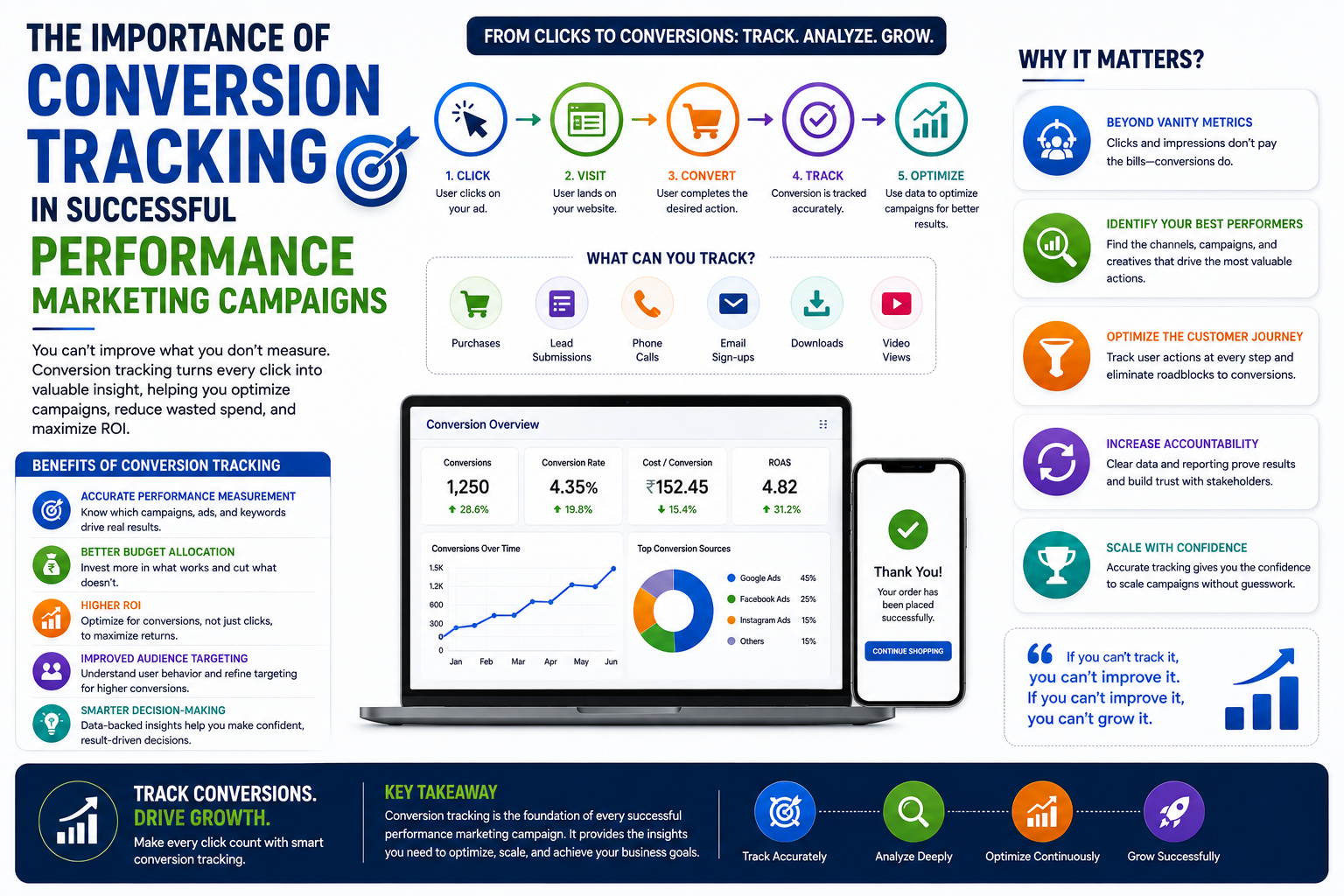
Digital advertising can generate clicks, website visits, and impressions, but these numbers alone do not show whether a campaign is actually helping a business grow. To understand the real impact of advertising, businesses need to know what happens after someone clicks an ad. This is where conversion tracking becomes essential. A professional performance marketing agency uses conversion tracking to measure actions such as purchases, enquiries, calls, registrations, and bookings, helping businesses connect advertising spend with meaningful outcomes.
Without accurate conversion data, campaigns may appear successful simply because they attract traffic. In reality, that traffic may not be generating customers or revenue. Conversion tracking gives marketers the information required to identify profitable campaigns, reduce wasted spending, and make better optimisation decisions.
What Is Conversion Tracking?
Conversion tracking is the process of measuring specific actions users complete after interacting with a digital advertisement.
A conversion can vary depending on the business and campaign objective. Common examples include:
-
Online purchases
-
Contact form submissions
-
Phone calls
-
WhatsApp enquiries
-
Appointment bookings
-
App installations
-
Newsletter sign-ups
-
Trial registrations
-
Add-to-cart actions
-
Completed checkouts
A performance marketing agency sets up tracking so these actions can be connected with specific campaigns, advertisements, keywords, audiences, and platforms.
This allows businesses to move beyond surface-level metrics and understand which marketing activities actually contribute to customer acquisition and revenue.
Why Clicks Alone Are Not Enough
Clicks can indicate that an advertisement is attracting attention, but they do not necessarily represent business success.
For example, two campaigns may each generate 1,000 clicks. The first may produce 50 sales, while the second generates only five. If the business evaluates performance only through traffic, both campaigns may appear equally successful.
A performance marketing agency in Delhi can use conversion tracking to identify these differences and allocate more budget towards the campaign generating stronger outcomes.
This makes campaign evaluation more accurate because businesses can focus on metrics such as conversion rate, cost per lead, cost per acquisition, and revenue rather than simply the number of visitors.
Measuring the True Cost of Customer Acquisition
One of the most important advantages of conversion tracking is the ability to calculate how much it costs to generate a lead or acquire a customer.
A performance marketing company in Delhi may analyse:
-
Advertising spend
-
Number of conversions
-
Cost per conversion
-
Number of qualified leads
-
Sales completed
-
Customer acquisition cost
Suppose a business spends ₹50,000 on a campaign and generates 100 qualified leads. The average cost per lead would be ₹500. If another campaign generates similar-quality leads at a lower cost, the agency may choose to increase investment in that campaign.
Tracking allows businesses to compare performance objectively and understand whether advertising costs are commercially sustainable.
Identifying High-Performing Campaigns
Businesses often run multiple campaigns across platforms such as Google Ads, Meta Ads, LinkedIn, YouTube, and display networks.
Companies offering performance marketing services in India use conversion tracking to compare how these different campaigns perform.
Tracking may reveal:
-
Which platform generates more sales
-
Which campaign produces better leads
-
Which audience converts more frequently
-
Which keyword delivers stronger results
-
Which creative encourages more actions
-
Which location produces lower acquisition costs
These insights make budget allocation more effective.
Instead of spreading advertising expenditure equally, businesses can invest more heavily in campaigns that consistently contribute to their objectives.
Improving Keyword Strategy
Conversion tracking is particularly valuable in paid search campaigns.
A performance marketing company in India can compare keywords not only by clicks and cost but also by the number and quality of conversions they generate.
For example, a broad keyword may produce significant traffic but few enquiries. A more specific keyword may receive fewer clicks but generate a higher percentage of customers.
By understanding this difference, agencies can:
-
Increase bids on profitable keywords
-
Reduce spending on weak keywords
-
Add irrelevant queries as negative keywords
-
Identify high-intent search terms
-
Create more focused ad groups
This improves campaign efficiency because budgets are directed towards search terms that contribute to measurable business results.
Understanding Which Audiences Convert
Different audience groups can respond very differently to the same campaign.
Agencies providing performance marketing services in Delhi may use conversion data to compare performance based on:
-
Age
-
Location
-
Interests
-
Device
-
Profession
-
Previous website activity
-
Customer status
-
Online behaviour
For example, users from one city may generate many clicks but few purchases, while customers in another city may have a significantly higher conversion rate.
Conversion tracking helps agencies identify these patterns and refine targeting accordingly.
This reduces wasted impressions and allows businesses to focus on audiences with stronger commercial potential.
Optimizing Landing Pages With Conversion Data
Paid campaigns may attract relevant users, but weak landing pages can still reduce results.
A performance marketing agency in India can use conversion tracking alongside website analytics to understand how visitors behave after clicking an advertisement.
The agency may review:
-
Form completion rates
-
Checkout completion
-
Page exits
-
Button clicks
-
Mobile conversions
-
Product purchases
-
Appointment bookings
If many visitors reach a page but very few complete the intended action, the landing page may require improvement.
Potential changes may include:
-
Stronger headlines
-
Clearer calls to action
-
Shorter enquiry forms
-
Faster page loading
-
Better mobile usability
-
More visible trust signals
-
Clearer product or service information
Improving conversion rates allows businesses to generate more value from existing traffic instead of simply increasing advertising spend.
Supporting Accurate Budget Allocation
One of the biggest strengths of performance marketing services is the ability to adjust campaigns based on real performance.
Conversion data helps agencies determine where budgets should be increased, reduced, or redirected.
For example, if one campaign generates conversions at ₹700 each while another produces similar conversions at ₹350, the agency can investigate the difference and allocate more budget towards the stronger campaign.
However, conversion cost should not be viewed in isolation.
A higher-cost campaign may still be more valuable if it generates customers with a higher average purchase value or stronger lifetime value.
This is why experienced marketers evaluate conversions alongside broader business data.
Measuring Lead Quality, Not Just Lead Volume
Generating a large number of leads may look impressive, but it does not always result in revenue growth.
A campaign could generate hundreds of enquiries that are irrelevant or unlikely to become customers.
Conversion tracking becomes more useful when advertising data is connected with sales information.
Businesses can then evaluate:
-
Qualified leads
-
Sales conversions
-
Revenue per lead
-
Average order value
-
Customer acquisition cost
-
Repeat purchases
For example, one campaign may generate 150 leads and produce 10 sales, while another generates only 80 leads but produces 25 sales.
The second campaign may provide significantly greater value despite its lower lead volume.
Businesses evaluating agencies such as DI Infotech can consider how effectively the agency connects advertising conversions with lead quality, customer acquisition, and revenue rather than focusing only on campaign-level numbers.
Improving Remarketing Campaigns
Conversion tracking also plays an important role in remarketing.
Businesses can identify users who completed or did not complete specific actions and create appropriate audience groups.
For example:
-
Visitors who viewed a product but did not purchase
-
Users who added products to the cart but did not checkout
-
People who visited a service page without submitting a form
-
Existing customers who completed a purchase
These users can receive different advertisements based on their previous actions.
Once someone converts, they can also be excluded from certain campaigns to prevent unnecessary advertising expenditure.
This makes remarketing more relevant and cost-efficient.
Helping Automated Systems Make Better Decisions
Modern advertising platforms increasingly use automation and machine learning to optimise campaigns.
Automated bidding systems may adjust bids based on the estimated likelihood of conversion.
However, these systems depend heavily on accurate data.
If conversion tracking is incomplete or incorrectly configured, automated campaigns may optimise towards the wrong actions.
For instance, if a business tracks simple page visits as its main conversion instead of actual enquiries or purchases, the advertising platform may prioritise users who visit pages rather than users who become customers.
A professional performance marketing agency reviews conversion settings regularly to ensure that automation is working towards commercially meaningful goals.
Supporting A/B Testing
Conversion tracking makes campaign testing more reliable.
Agencies can compare different versions of:
-
Advertisements
-
Headlines
-
Images
-
Videos
-
Offers
-
Calls to action
-
Landing pages
Instead of selecting a winner based only on clicks, marketers can evaluate which version generates more conversions or revenue.
For example, one advertisement may receive a higher click-through rate, while another produces more purchases.
If the objective is sales, the second advertisement may be more valuable even if it receives fewer clicks.
This is why conversion-based testing provides a clearer measure of real campaign effectiveness.
Creating More Transparent Performance Reports
Businesses need reports that show more than impressions and traffic.
Conversion tracking enables agencies to provide reports containing meaningful performance indicators such as:
-
Total conversions
-
Cost per conversion
-
Conversion rate
-
Qualified leads
-
Sales generated
-
Customer acquisition cost
-
Revenue
-
Return on advertising spend
This creates greater transparency and accountability.
Business owners can see how advertising expenditure contributes to measurable results and make more informed decisions about future budgets.
Conclusion
Conversion tracking is one of the foundations of successful performance marketing. Without it, businesses may know how many people clicked an advertisement but remain uncertain about how many became leads, customers, or sources of revenue.
A reliable performance marketing agency uses conversion

 Arabic
 French
 Spanish
 Portuguese
 Deutsch
 Turkish
 Dutch
Dutch
 Italiano
 Russian
 Romaian
 Portuguese (Brazil)
 Greek
Greek