


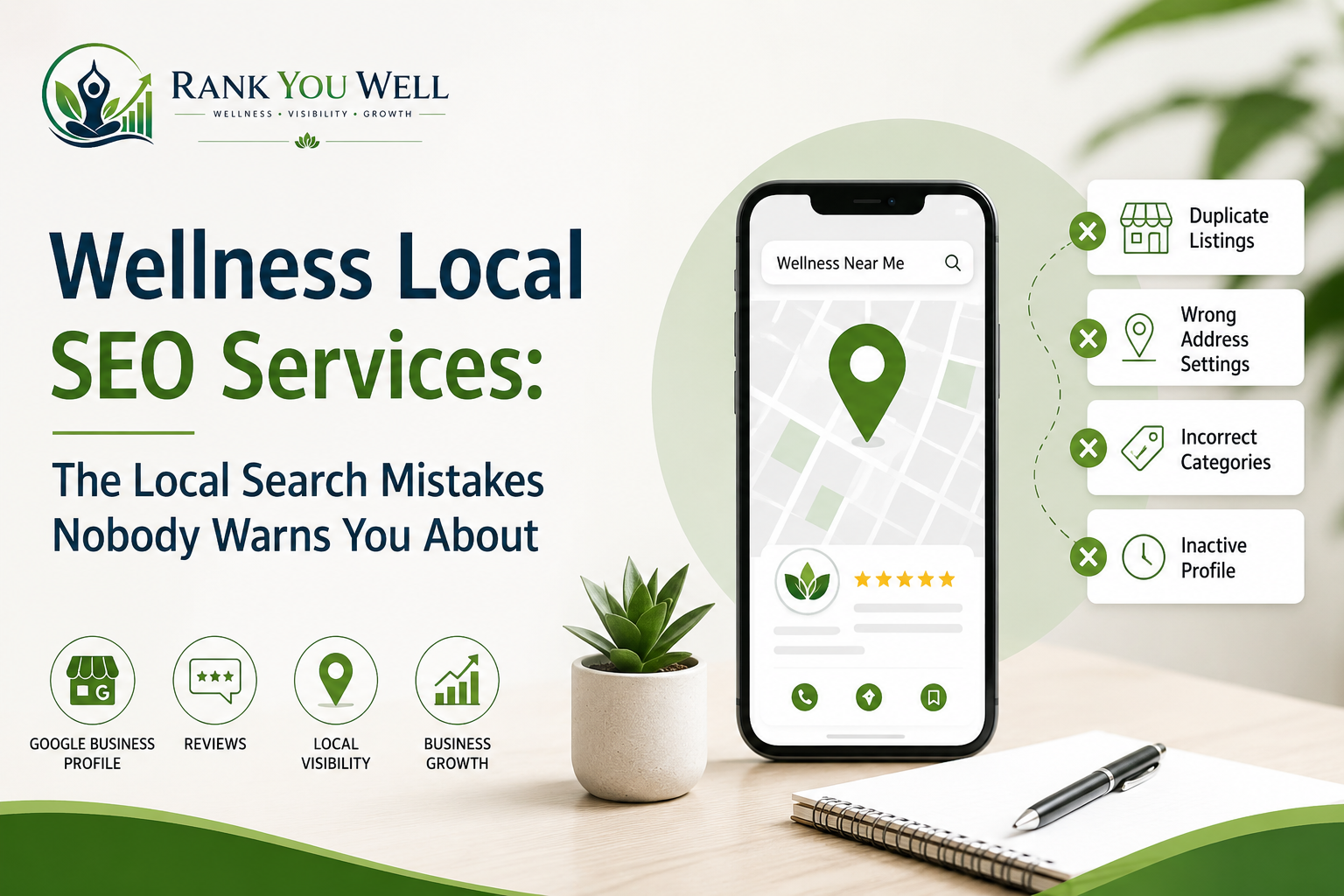
Wellness Local SEO Services: The Local Search Mistakes Nobody Warns You About

Most wellness local SEO advice covers the same ground — set up your Google Business Profile, collect reviews, build service pages. None of that's wrong. It's just incomplete.
What rarely gets mentioned is how wellness businesses quietly lose visibility they already have — not through bad SEO, but through small decisions that look harmless until Google flags them. A multi-practitioner clinic. A second location opened last year. A mobile massage therapist working from clients' homes. Each has its own local SEO trap that generic advice never covers.
This isn't a list of things to add. It's a list of things to check before they quietly cost you visibility.
The multi-practitioner trap
A clinic with several practitioners - a nutritionist, a physiotherapist, a massage therapist, all under one roof - often assumes each specialist needs their own Google listing to capture more searches. That instinct makes sense. It's also exactly what triggers Google's duplicate-listing detection.
Google generally expects one profile per location, not one per practitioner. Multiple listings at the same address, even for different specialties, regularly get flagged as duplicates — and the fix isn't fast. This is where Wellness Local SEO Services can help clinics manage listings correctly and avoid costly profile issues.
What actually works:
- One well-maintained profile for the clinic,
- With practitioner pages living on the website
- Separate Maps listings.
Google allows one page per practitioner and one for the clinic overall, not a separate listing per person.
The mobile and service-area problem
Not every wellness business has walk-in clients. Mobile massage therapists, in-home yoga instructors, and traveling wellness coaches don't work from a visible storefront, and treating their listing like one is a fast way to get suspended.
If clients aren't received at your address, that address should stay hidden, with the profile set to "service area business" instead. Listings that show a home address without accepting walk-ins get flagged often, because Google can't verify a location that isn't actually staffed and open.
What actually works:
-
Set the profile up as service-area,
-
Define the real areas served,
-
Keep the address private.
This isn't a workaround - it's what Google expects for this business model.
The "cast a wider net" category mistake
It's tempting to add extra categories hoping to show up for more searches - labeling a yoga studio as a "gym," or a spa as a "medical clinic." It feels like a smart move. Google reads it as manipulation.
Category mismatch is one of the more common, and most avoidable, suspension triggers - especially for small businesses trying to compete on more terms than their services justify.
What actually works:
pick the fewest categories that accurately describe the business, and let dedicated service pages on the site capture the more specific searches instead.
The multi-location duplicate confusion
Wellness brands opening a second or third location often hit a version of the same problem: Google sometimes flags a genuinely new location as a duplicate of the first, especially when the address, phone number, or website content overlap too closely.
What actually works:
-
Give each location its own phone number where possible.
-
Own dedicated page on the site.
-
Not one page listing every location together.
-
Distinct signage and photos per profile.
If a listing gets flagged, a direct explanation with documentation (business license, photos, a unique phone number) usually resolves it faster than waiting it out.
The quiet cost of an inactive profile
A business that hasn't touched its profile in a year or more - no new photos, no posts, no review responses - isn't just missing extra visibility. Prolonged inactivity is a signal Google weighs when deciding whether a listing represents a real, currently operating business.
What actually works:
-
Treat the profile as ongoing.
-
A one-time setup.
-
Occasional photo updates,
-
Review responses, and
-
Accurate hours matter more than most businesses assume.
Why this matters more than another blog post
None of this replaces the fundamentals - service pages, reviews, and local content still matter. But a business can do all of that right and still lose visibility overnight because of a duplicate listing it didn't know it created, or a category chosen years ago that no longer fits.
Local SEO isn't only about earning visibility. It's also about not accidentally losing what's already been earned.
Conclusion
Wellness businesses that struggle most with local search usually aren't missing a tactic - they're carrying a small, invisible risk: a duplicate listing, a mismatched category, an address that should have been hidden months ago.
The standard local SEO fundamentals matter, but perfectly optimized profiles can still face overlooked risks. That’s where Rank You Well audits for the issues that can lead to suspensions, because a profile that gets suspended next month isn't actually working for you. If local visibility has ever dipped without an obvious reason, this is usually where the answer is hiding.
FAQ
Can a clinic with multiple practitioners have multiple Google listings?
Generally no - one listing per location, with practitioner pages on the website instead.
Should a mobile wellness provider hide their address?
Yes, if clients aren't received there. Set the profile to service-area business instead.
Does adding extra categories help visibility?
No - mismatched categories are a common suspension trigger. Fewer, accurate categories work better.

 English
 Arabic
 French
 Spanish
 Portuguese
 Turkish
 Dutch
Dutch
 Italiano
 Russian
 Romaian
 Portuguese (Brazil)
 Greek
Greek