


Fenbendazole for Cats Dosage Chart by Weight: Complete Guide.
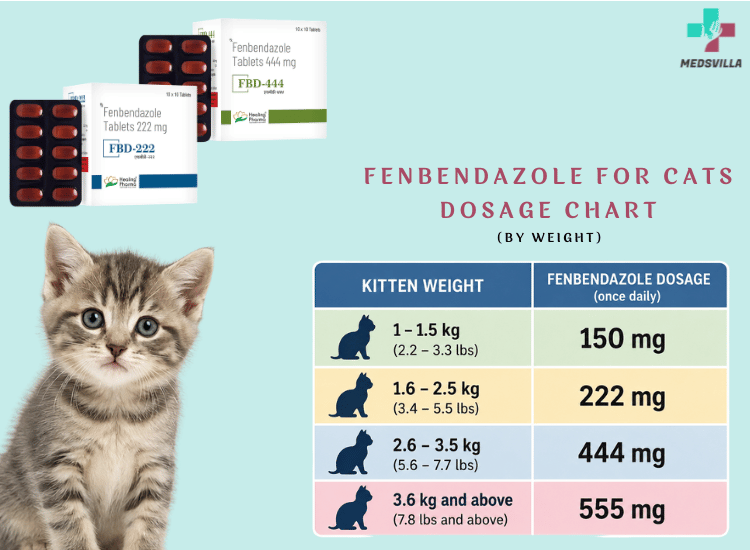
Fenbendazole is an antiparasitic medication commonly used in veterinary medicine to treat certain intestinal parasites in animals. It belongs to the benzimidazole class and works by interfering with structures that parasites need to survive. Because parasite infections can vary significantly between cats, knowing the appropriate fenbendazole dosage is important.
A fenbendazole for cats dosage chart by weight can help explain how veterinarians think about weight-based dosing, but it should not replace professional veterinary advice. The correct amount depends not only on a cat's weight but also on the parasite being treated, the product concentration, the formulation, and the treatment schedule recommended by a veterinarian.
What Is Fenbendazole?
Fenbendazole is a broad-spectrum antiparasitic medication used primarily in veterinary medicine. It is commonly associated with the treatment of certain gastrointestinal worms and other susceptible parasites.
It works by interfering with parasite microtubules and energy processes, ultimately preventing susceptible parasites from surviving normally.
Fenbendazole is available in different veterinary formulations, and concentrations can vary. Therefore, two products containing fenbendazole may not have the same amount of active ingredient per milliliter, gram, or tablet.
Why Does Cat Weight Matter?
Veterinary medications are often prescribed according to body weight because the amount of active ingredient needed can depend on the animal's size.
For cats, however, simply multiplying a generic dose by body weight is not enough to determine an appropriate treatment plan. The veterinarian also considers:
-
The cat's age
-
Body weight and overall condition
-
The suspected parasite
-
Severity of infection
-
Product formulation and concentration
-
Other medications being used
-
Pregnancy or nursing status
-
Liver or kidney concerns
-
Previous treatment history
For these reasons, owners should use a weight chart as an educational reference rather than as a substitute for an individualized veterinary prescription.
How Is Fenbendazole Given to Cats?
Fenbendazole may be available in different veterinary formulations. Depending on the product, it may be administered orally as directed by a veterinarian.
Always read the product label carefully. Concentrations can differ between products, so measuring a volume without checking the concentration can result in an incorrect amount of active ingredient.
If your veterinarian has prescribed fenbendazole, follow the exact instructions regarding the amount, frequency, and duration of treatment.
Do not increase the dose because you believe a larger amount will work faster. More medication does not necessarily provide better parasite control and can increase the risk of adverse effects.
How Long Is Fenbendazole Used?
Treatment duration depends on the parasite and the veterinarian's treatment plan. Different infections may require different schedules.
For this reason, owners should not assume that a schedule used for one parasite will work for another. A veterinarian may also recommend follow-up testing to determine whether treatment has successfully cleared the infection.
If symptoms continue after treatment, do not automatically repeat or extend the medication. Contact your veterinarian for further evaluation.
Possible Side Effects
Fenbendazole is generally used in veterinary medicine with a relatively established safety profile when administered appropriately, but side effects can occur.
Possible reactions may include:
-
Vomiting
-
Diarrhea
-
Reduced appetite
-
Drooling
-
Temporary gastrointestinal discomfort
If a cat develops severe vomiting, persistent diarrhea, weakness, difficulty breathing, facial swelling, or another concerning reaction, veterinary attention should be sought promptly.
Young kittens, elderly cats, pregnant cats, and cats with existing health problems may require additional consideration before treatment.
Fenbendazole and Other Antiparasitic Medications
Pet owners may encounter online searches for products described as fenbendazole ivermectin pills or fenbendazole ivermectin capsules. These terms should not be interpreted as evidence that combining the two medications is appropriate for cats.
Ivermectin and fenbendazole are different antiparasitic drugs with different properties and veterinary uses. Combining medications without professional guidance can increase the risk of inappropriate dosing or adverse effects.
A veterinarian should determine whether an additional antiparasitic medication is necessary based on the parasite involved and the individual animal.
What About Fenbendazole and Ivermectin Products for Humans?
Online searches may also include ivermectin and fenbendazole pills for humans. This is a separate issue from treating a cat.
Fenbendazole is primarily a veterinary medication and should not be assumed to be an approved human treatment. Ivermectin does have specific approved human uses, but that does not mean veterinary formulations or unapproved combinations should be used by people.
Likewise, searching for the fenbendazole and ivermectin tablets price should not be the basis for deciding whether a medication is suitable for a person or an animal. Approval status, formulation, quality, and appropriate dosing are more important considerations than price.
Can Cats Take Human Medications?
Pet owners should never assume that a medication intended for humans is automatically safe for cats. Cats process many substances differently from humans, and certain ingredients or doses that are acceptable for people can be dangerous to animals.
The same principle applies to veterinary products. A product intended for another animal species may not be appropriate for cats.
Before giving any antiparasitic medication, provide your veterinarian with information about all medications, supplements, and treatments your cat is currently receiving.
Final Thoughts
A fenbendazole for cats dosage chart by weight can provide useful background information, but weight alone does not determine the correct treatment. The appropriate dose depends on the parasite being treated, the cat's health, and the specific fenbendazole formulation. You can learn more about fenbendazole from Medsvilla.com and explore available product information.
Pet owners should use only products appropriate for cats and follow veterinary instructions carefully. Do not combine fenbendazole with ivermectin or another antiparasitic medication without professional guidance.
If your cat has symptoms such as diarrhea, vomiting, weight loss, poor appetite, or visible worms, a veterinarian can determine whether parasites are responsible and recommend the appropriate diagnostic testing and treatment.
Using the correct medication, formulation, and veterinary-directed schedule is the safest way to treat a suspected parasitic infection while minimizing unnecessary medication exposure.

 English
 Arabic
 French
 Portuguese
 Deutsch
 Turkish
 Dutch
Dutch
 Italiano
 Russian
 Romaian
 Portuguese (Brazil)
 Greek
Greek