


DOT 3 vs DOT 4 Brake Fluid: Technical Comparison for Manufacturers and Distributors
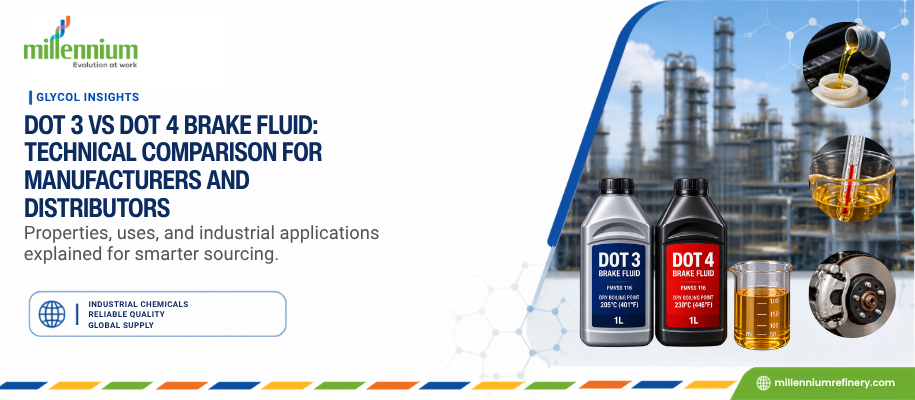
Brake fluid selection is an important consideration for automotive manufacturers, lubricant suppliers, and distributors serving the global aftermarket. While DOT 3 and DOT 4 fluids perform the same fundamental function of transmitting hydraulic force within a braking system, their physical properties and performance capabilities differ.
The choice between these two grades depends on factors such as operating temperature, vehicle design, braking intensity, and manufacturer specifications. Understanding these differences can help bulk buyers and distributors make informed sourcing decisions and maintain the right product portfolio for their customers.
DOT 3 Specifications
DOT 3 is a glycol-based hydraulic brake fluid designed for use in braking systems that require this specification. It has been widely used across conventional passenger vehicles and remains an important product in the automotive aftermarket.
One of the defining characteristics of DOT 3 fluid is its boiling-point requirement. Under standard specifications, DOT 3 must meet a minimum dry equilibrium reflux boiling point of 205°C and a minimum wet boiling point of 140°C. The dry boiling point refers to fresh fluid with minimal moisture contamination, while the wet boiling point represents performance after the fluid has absorbed moisture.
Like other glycol-based brake fluids, DOT 3 is hygroscopic. This means it naturally absorbs moisture over time. Moisture absorption can gradually reduce the boiling point, which is why proper storage, handling, and replacement intervals are important.
DOT 3 also needs to maintain suitable viscosity characteristics across different temperatures. This allows the fluid to flow efficiently through brake lines and hydraulic components. In addition, a quality DOT 3 formulation should provide corrosion protection for metallic components and compatibility with seals and other brake-system materials.
For manufacturers and distributors, DOT 3 remains a relevant option for replacement markets where vehicle specifications call for this grade.
DOT 4 Specifications
DOT 4 brake fluid is developed for braking systems that require improved resistance to high operating temperatures. The major advantage of dot 4 brake fluid is its higher minimum boiling-point performance compared with DOT 3.
A standard DOT 4 fluid must achieve a minimum dry boiling point of 230°C and a minimum wet boiling point of 155°C. These higher limits provide an additional performance margin in situations where braking systems generate significant heat.
During repeated or intensive braking, temperatures within the braking system can increase substantially. If brake fluid reaches its boiling point, vapor bubbles may form, potentially affecting hydraulic pressure transmission. The higher boiling-point characteristics of DOT 4 make it suitable for systems designed to operate under greater thermal stress.
DOT 4 formulations may contain borate ester components in addition to glycol ethers, helping achieve the required performance characteristics. However, product formulations can differ between manufacturers depending on performance targets and market requirements.
As with DOT 3, moisture management is important because DOT 4 is also hygroscopic. Properly sealed packaging and controlled storage conditions help preserve product quality before use.
Technical Comparison
Although DOT 3 and DOT 4 fluids share several characteristics, their performance specifications create important distinctions for automotive applications.
The most noticeable difference is thermal performance. DOT 4 offers higher minimum dry and wet boiling points, making it better suited to braking systems exposed to higher operating temperatures. DOT 3, meanwhile, provides reliable performance for systems designed around its specification.
Another consideration is moisture absorption. Both products absorb water from the environment over time, which can reduce their boiling points. Therefore, neither product should be treated as maintenance-free.
From a manufacturing perspective, consistency is essential. Raw material quality, blending accuracy, laboratory testing, filtration, and packaging all influence the final product. Brake-fluid producers must maintain strict quality-control procedures to ensure each batch meets the required specification.
| Feature | DOT 3 | DOT 4 |
|---|---|---|
| Fluid base | Glycol-based | Glycol-based with performance-enhancing components |
| Minimum dry boiling point | 205°C | 230°C |
| Minimum wet boiling point | 140°C | 155°C |
| Thermal performance | Standard | Higher |
| Moisture absorption | Hygroscopic | Hygroscopic |
| Typical market | Conventional applications | Higher-demand applications |
It is important to note that a higher specification does not automatically mean that one fluid should replace another in every braking system. Vehicle manufacturers specify brake-fluid grades based on complete system design and performance requirements.
Industrial Applications
DOT 3 and DOT 4 brake fluids serve a wide range of automotive supply-chain requirements. Their primary application is in hydraulic brake and clutch systems where the respective specification is recommended.
For distributors, DOT 3 is commonly relevant to replacement and maintenance markets involving vehicles designed for conventional brake-fluid specifications. Demand may come from automotive workshops, service centers, spare-parts distributors, and fleet maintenance operations.
DOT 4 products are widely supplied for modern vehicles requiring greater heat resistance. The dot 4 brake fluid market can include passenger vehicles, commercial automotive applications, and service networks that require products meeting specific technical standards.
Manufacturers supplying these fluids in bulk may offer multiple packaging options, including small bottles for retail distribution, larger containers for workshops, and industrial packaging for distributors. Packaging quality is particularly important because brake fluid should be protected from moisture contamination.
Technical documentation also plays a significant role in industrial supply. Buyers often require product specifications, safety documentation, certificates of analysis, and batch information before approving a supplier. Providing clear documentation improves confidence across the distribution chain.
For More information, industrial buyers should evaluate product specifications alongside packaging capabilities, quality-control procedures, and compliance requirements for their target markets. It is also useful to Read more about the technical properties of each brake-fluid grade before making procurement decisions.
The Bottom Line
DOT 3 and DOT 4 are both essential glycol-based brake-fluid grades, but they are designed to meet different performance requirements. DOT 3 offers dependable performance for compatible standard braking systems, while DOT 4 provides higher boiling-point capability for applications requiring greater thermal resistance.
For manufacturers and distributors, product selection should focus on specification compliance, consistent quality, proper packaging, and the requirements of the intended vehicle applications. Maintaining a reliable supply of both grades can also help distributors serve a broader range of automotive customers.
Ultimately, the correct brake fluid is not determined simply by choosing the highest-performing grade. It should always match the vehicle manufacturer's specified requirements to support safe and reliable braking-system operation.

 English
 French
 Spanish
 Portuguese
 Deutsch
 Turkish
 Dutch
Dutch
 Italiano
 Russian
 Romaian
 Portuguese (Brazil)
 Greek
Greek