


How Does a Modular IVF Lab Setup Company Help Laboratories Achieve Accreditation?
Introduction
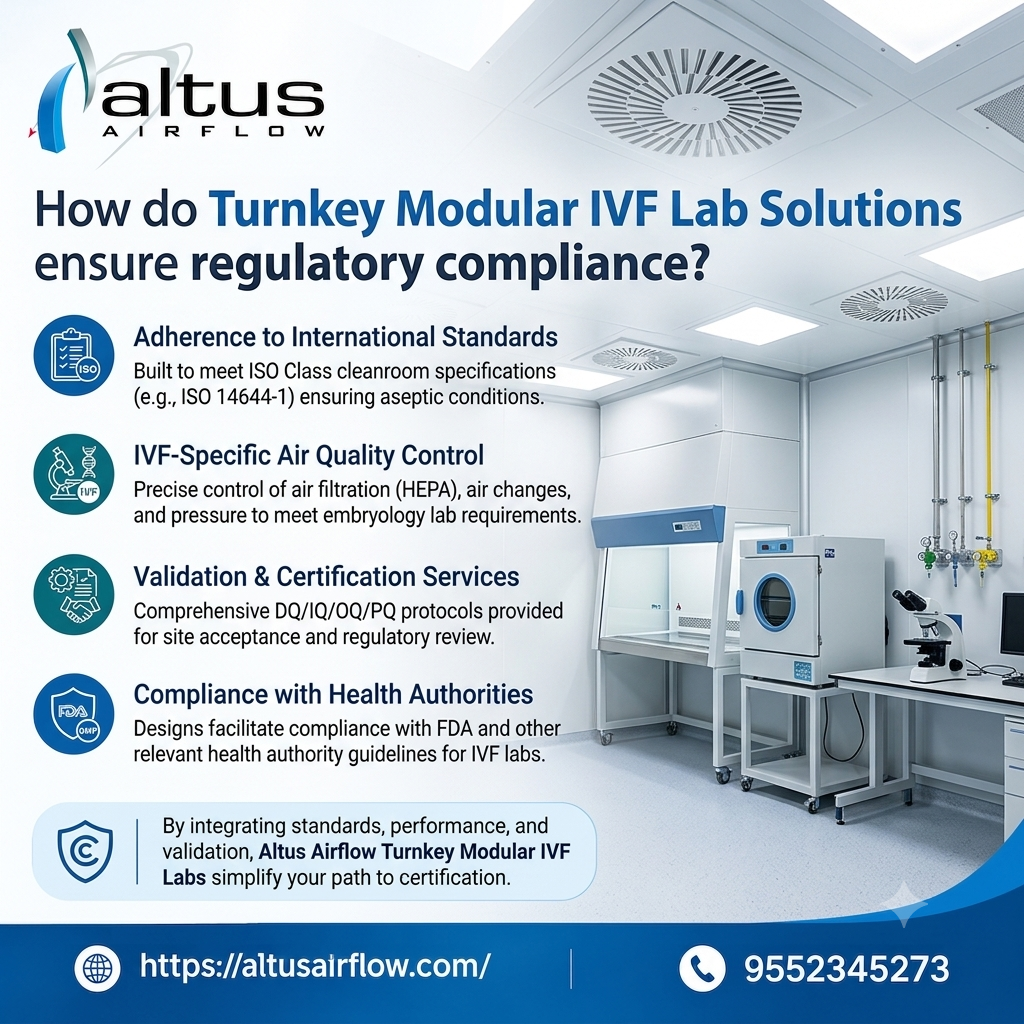
Altus Airflow specializes in developing controlled laboratory environments where infrastructure, environmental conditions, workflow, safety, and technical systems are carefully coordinated. Accreditation is an important objective for laboratories because it demonstrates that their facilities and processes are managed according to defined quality and technical requirements. A Modular IVF Lab Setup Company can support this objective by designing and installing laboratory infrastructure that is aligned with operational requirements. From room layout and HVAC systems to filtration, electrical infrastructure, monitoring, equipment integration, and documentation, each element can be planned to support a controlled and organized laboratory environment.
Achieving accreditation involves more than installing modern laboratory equipment. The facility must support documented procedures, environmental monitoring, equipment maintenance, quality control, safety, and consistent laboratory operations. A properly planned modular IVF laboratory can provide suitable spaces, cleanable finishes, controlled environmental conditions, organized utilities, and accessible maintenance systems. It can also support testing, commissioning, and documentation activities that may be required as part of the laboratory's quality-management process. By addressing these requirements during the design and setup stages, laboratories can establish a stronger physical foundation for accreditation preparation and ongoing compliance.
Understanding IVF Laboratory Accreditation
Accreditation provides formal recognition that a laboratory meets defined quality and technical requirements within its scope of operation. The exact requirements depend on the applicable accreditation framework, jurisdiction, laboratory activities, and services provided.
For an IVF laboratory, accreditation considerations may extend to personnel, procedures, equipment, environmental conditions, records, quality control, safety, sample handling, and facility management. The physical laboratory must therefore support the processes described in the laboratory's quality system.
Role of Facility Design in Accreditation
The laboratory environment can influence how consistently procedures are performed. An appropriately designed facility provides organized workspaces and supports logical movement of staff, materials, equipment, and samples.
A modular approach allows the laboratory environment to be planned around specific functional requirements. Room dimensions, wall systems, ceilings, doors, service points, HVAC provisions, electrical connections, and monitoring systems can be coordinated before installation.
Site Assessment and Requirement Analysis
A detailed site assessment is an important starting point. Existing hospitals or fertility centers may have limitations related to available space, structural conditions, ceiling height, electrical capacity, HVAC infrastructure, water supply, drainage, or access.
The design team can evaluate these factors before preparing the final laboratory plan. This helps ensure that the proposed facility can accommodate its technical requirements while working within the limitations of the existing building.
Laboratory Workflow and Zoning
IVF laboratories require carefully organized workflows. Activities involving sample handling, preparation, analysis, storage, equipment operation, cleaning, and waste management should be considered during space planning.
An Modular IVF Lab Setup Company can help organize the laboratory into functional zones based on the procedures being performed. Clear zoning can make workflows easier to manage and may help reduce unnecessary movement between different activities.
HVAC and Environmental Control
Environmental conditions are an important consideration for IVF laboratories. Temperature, humidity, ventilation, filtration, airflow distribution, and pressure relationships may need to be controlled according to laboratory requirements and applicable specifications.
The HVAC system should be designed around room dimensions, equipment heat loads, occupancy, and operational activities. Appropriate controls and monitoring systems can help laboratory personnel observe environmental conditions and respond to deviations.
Air Filtration
Air filtration should be considered as part of the overall environmental-control strategy. The required filtration level depends on the laboratory's processes, equipment, environmental objectives, and applicable requirements.
Where high-efficiency filtration is specified, the system should also provide suitable access for inspection and replacement. Performance testing can be conducted during commissioning to verify that the installed system operates according to its intended specifications.
Temperature and Humidity Monitoring
Consistent environmental monitoring can support laboratory quality-management practices. Temperature and humidity sensors can be positioned at suitable locations to provide meaningful measurements.
Digital monitoring systems may provide continuous data logging and alerts. If a parameter moves outside an established range, the system can notify designated personnel so that appropriate investigation and corrective action can be initiated according to laboratory procedures.
Electrical Infrastructure
IVF laboratories depend on reliable electrical power for incubators, microscopes, refrigerators, freezers, monitoring equipment, computers, lighting, HVAC controls, and other specialized systems.
Electrical planning should begin with an equipment load assessment. Appropriate outlets, dedicated circuits, grounding, electrical protection, and emergency power provisions can then be incorporated according to project requirements.
Backup Power for Critical Systems
Some laboratory equipment may be particularly sensitive to power interruptions. The laboratory should identify critical systems and determine appropriate continuity requirements.
Backup power solutions may include UPS systems, generators, emergency circuits, or other arrangements depending on the facility's electrical strategy. The modular laboratory design can be coordinated with the existing hospital power infrastructure.
Equipment Integration
Equipment placement should be considered before finalizing the room design. IVF equipment can have specific electrical, environmental, data, ventilation, and maintenance requirements.
Equipment schedules can be used to coordinate the location of workstations, incubators, microscopes, storage equipment, refrigerators, freezers, monitoring systems, and other devices. Adequate service clearance should also be maintained so that equipment can be inspected and maintained.
Cleanable Interior Surfaces
The selection of walls, ceilings, floors, doors, worktops, and other finishes should support routine cleaning and maintenance.
Smooth, sealed, and appropriately finished surfaces can make cleaning more practical. Joints, corners, service penetrations, and transitions should be carefully considered to minimize difficult-to-clean areas.
Utility Planning
An IVF laboratory may require multiple utilities, including electrical power, water, drainage, data connectivity, HVAC services, and other specialized connections.
These utilities should be coordinated with equipment locations and laboratory workflow. Organized service pathways can reduce unnecessary exposed cables and pipes while providing suitable access for future maintenance.
Medical and Specialized Gas Services
Where required by laboratory procedures or equipment, specialized gas services can be incorporated into the facility design.
The design should consider gas types, outlet locations, pipe routing, isolation arrangements, equipment connections, and maintenance access. Utility planning should be coordinated with electrical, HVAC, architectural, and modular wall systems.
Fire and Life Safety
Fire and life safety provisions should be incorporated into the laboratory design. Emergency exits, fire detection, emergency lighting, alarms, access routes, and other safety systems should be coordinated with the existing hospital infrastructure.
The laboratory layout should not obstruct emergency pathways or existing safety equipment. Any modifications to building systems should be reviewed with the appropriate engineering and safety teams.
Equipment Maintenance and Calibration
Accreditation preparation often involves demonstrating that laboratory equipment is properly maintained and fit for its intended purpose. Equipment may require defined maintenance schedules, calibration, identification, and service records.
The laboratory design should provide adequate clearance around equipment for inspection and servicing. Accessible placement can make preventive maintenance easier and reduce disruption to laboratory operations.
Environmental Monitoring Documentation
Monitoring systems are most useful when their information is documented and managed according to established procedures. Temperature, humidity, pressure, airflow, or other monitored parameters may require defined limits and response procedures.
A well-designed facility can provide suitable locations for sensors, displays, control panels, and communication systems. Data logging can also support the laboratory's record-keeping process where required.
Validation and Performance Testing
Facility systems may require testing or validation before the laboratory begins routine operations. The exact testing program depends on the laboratory's quality system, project specifications, equipment, and applicable requirements.
Testing may cover HVAC performance, temperature, humidity, airflow, filtration, pressure relationships, electrical systems, monitoring devices, and other facility components. Results can be documented as part of the commissioning and qualification records where applicable.
Documentation for Accreditation
Documentation is a major component of accreditation preparation. Laboratories may need to maintain facility drawings, equipment records, maintenance schedules, calibration certificates, environmental monitoring logs, cleaning records, test reports, and corrective-action documentation.
The setup process can support documentation by providing organized technical records and as-built drawings. These documents can help laboratory personnel and facility managers understand how the systems are installed and maintained.
Supporting Quality Management
A modular laboratory does not independently provide accreditation. Instead, the physical facility should support the laboratory's broader quality-management system.
The design can make it easier to implement procedures by providing appropriate work areas, environmental controls, equipment access, monitoring, utilities, storage, and safety provisions. This alignment between the physical environment and documented procedures can strengthen day-to-day operational consistency.
Risk Management
Risk assessment can identify potential problems associated with laboratory workflow, environmental conditions, equipment placement, utilities, maintenance, and safety.
Design-stage risk evaluation can help address physical risks before they become operational problems. Controls can then be incorporated into the room layout, equipment arrangement, HVAC system, monitoring strategy, and maintenance plan.
Testing, Commissioning, and Handover
After installation, the facility should undergo appropriate inspections and commissioning activities. HVAC, electrical systems, monitoring equipment, utilities, modular components, lighting, and other systems can be checked according to the approved project scope.
Handover documentation should include relevant drawings, manuals, test results, maintenance information, warranties, and system specifications. These records can be useful during facility operation and accreditation preparation.
Future Expansion
IVF laboratories may need additional equipment or modified workflows as services develop. A flexible laboratory design can make future changes easier.
Spare electrical capacity, accessible service routes, adaptable workspaces, and suitable utility provisions can support future upgrades. Considering expansion during the initial design can reduce the need for major structural changes later.
How Modular Setup Supports Accreditation Preparation
A coordinated modular approach can bring architectural, HVAC, electrical, utility, equipment, monitoring, and safety requirements together. This reduces the likelihood of different systems being designed independently.
Modular IVF Lab Setup Company services can therefore support accreditation preparation by creating infrastructure that complements the laboratory's quality system. The actual accreditation outcome still depends on the laboratory's complete compliance with applicable standards, procedures, personnel requirements, documentation, and operational practices.
Choosing a Suitable Setup Partner
Laboratories should assess a setup provider's experience with IVF environments, technical expertise, project coordination, HVAC capabilities, modular construction methods, documentation practices, testing support, and maintenance services.
It is beneficial to select a provider that understands the relationship between laboratory workflow and technical infrastructure. A coordinated approach can make the facility easier to operate, monitor, maintain, and prepare for assessment.
Conclusion
Accreditation preparation requires a combination of qualified personnel, documented procedures, suitable equipment, effective quality management, and an appropriate physical environment. Altus Airflow can support the facility-planning side by coordinating modular construction, HVAC, filtration, electrical infrastructure, utilities, equipment integration, environmental monitoring, safety, testing, and documentation.
For laboratories preparing for accreditation, working with an experienced Modular IVF Lab Setup Company can help establish infrastructure that supports controlled operations and documented quality processes. Altus Airflow focuses on creating coordinated laboratory environments that consider present operational needs as well as maintenance, testing, monitoring, and future expansion requirements.
Frequently Asked Questions
1. How does a Modular IVF Lab Setup Company help with accreditation?
A Modular IVF Lab Setup Company can support accreditation preparation by designing infrastructure for suitable workflow, environmental control, utilities, equipment integration, monitoring, safety, testing, and documentation.
2. Does a modular laboratory guarantee accreditation?
No. Accreditation also depends on personnel, procedures, equipment, quality management, documentation, and compliance with applicable requirements.
3. Why is HVAC important in an IVF laboratory?
HVAC helps manage environmental conditions such as temperature, humidity, ventilation, filtration, and airflow according to the laboratory's requirements.
4. Can environmental conditions be digitally monitored?
Yes. Temperature, humidity, pressure, airflow, and other selected parameters can be monitored using appropriate digital systems.
5. Is equipment maintenance considered during laboratory design?
Yes. Equipment clearance, service access, utility connections, and maintenance pathways can be incorporated during planning.
Read Our Previous Blog ---------------> How does a Modular IVF Lab Setup Company help laboratories achieve accreditation?

 English
 Arabic
 French
 Spanish
 Portuguese
 Deutsch
 Turkish
 Dutch
Dutch
 Italiano
 Romaian
 Portuguese (Brazil)
 Greek
Greek