


Understanding Different Animation Styles and Where to Use Them
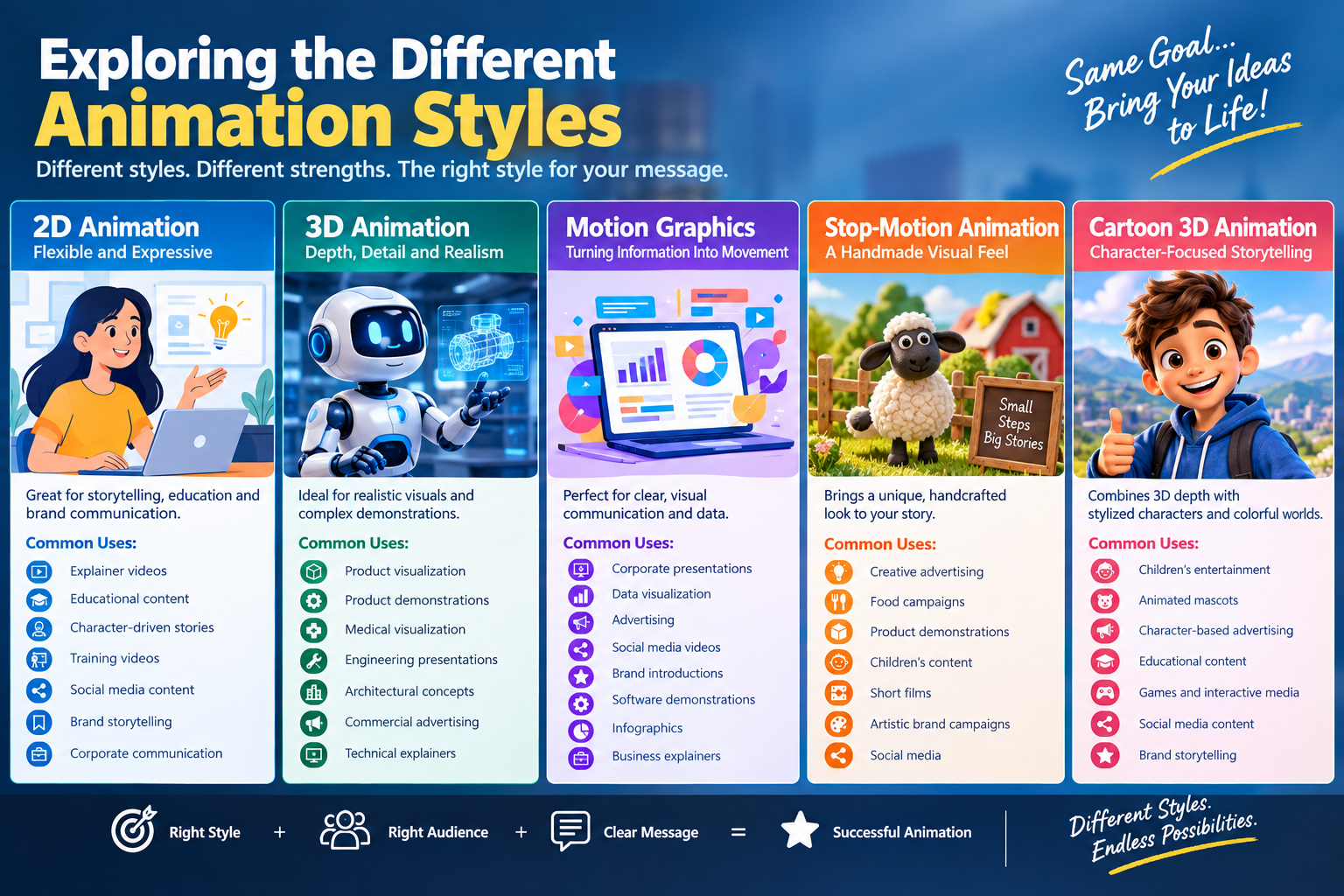
Animation is no longer limited to cartoons and entertainment. Businesses use animated visuals for product demonstrations, explainer videos, advertisements, training materials, educational content, social media campaigns, and brand storytelling.
However, choosing an animation style can be challenging because different techniques create very different visual experiences. A detailed 3D product animation may be ideal for demonstrating how a physical device works, while a simple 2D animation could be more effective for explaining a service or telling a character-driven story.
Understanding the major animation styles and their practical applications can make it easier to choose an approach that matches a project's message, audience, and goals.
2D Animation: Flexible and Expressive
2D animation uses two-dimensional artwork to create movement. It can range from traditional hand-drawn visuals to digitally illustrated characters, environments, and objects.
Because artists have considerable control over the visual style, 2D animation can feel playful, artistic, educational, or highly professional.
Common Uses
2D animation works particularly well for:
- Explainer videos
- Educational content
- Character-driven stories
- Training videos
- Social media content
- Brand storytelling
- Corporate communication
It can also be an effective choice when a project needs a warm, approachable visual style rather than photorealistic imagery.
For example, a software company explaining its platform might use illustrated characters and animated interfaces to walk viewers through a complicated process.
3D Animation: Depth, Detail, and Realism
3D animation creates characters, objects, and environments within a three-dimensional digital space. This allows artists to control cameras, lighting, materials, textures, and movement from multiple perspectives.
One of its biggest advantages is the ability to represent physical objects with considerable detail.
Common Uses
3D animation is often suitable for:
- Product visualization
- Product demonstrations
- Medical visualization
- Engineering presentations
- Architectural concepts
- Commercial advertising
- Technical explainers
- Cinematic storytelling
It can be particularly valuable when a company needs to show something that is difficult to film in real life.
For example, a manufacturer can use 3D animation to show the internal operation of a machine without physically cutting the machine open.
Hatch Studios describes 3D animation as particularly useful for showcasing physical objects because artists can accurately represent materials, lighting, and other visual details.
Motion Graphics: Turning Information Into Movement
Motion graphics focus primarily on graphic elements such as typography, icons, shapes, charts, illustrations, and diagrams.
Unlike character-driven animation, motion graphics often prioritize information and visual communication.
Common Uses
Motion graphics are frequently used for:
- Corporate presentations
- Data visualization
- Advertising
- Social media videos
- Brand introductions
- Software demonstrations
- Infographics
- Business explainers
For instance, a company presenting annual statistics could transform static numbers into animated charts and graphics. This can make information easier to follow while maintaining a professional visual style.
Motion graphics are also useful when a project needs to communicate information quickly without requiring complex character animation.
Stop-Motion Animation: A Handmade Visual Feel
Stop-motion is created by photographing physical objects or models one frame at a time and moving them slightly between photographs. When the frames are played sequentially, the objects appear to move.
The technique has a distinctive handcrafted quality that can make advertising and storytelling feel more personal.
Common Uses
Stop-motion can work well for:
- Creative advertising
- Food campaigns
- Product demonstrations
- Children's content
- Short films
- Artistic brand campaigns
- Social media
Clay animation, paper cutouts, miniature sets, and physical objects can all be incorporated into this style.
Modern digital production can also simulate the appearance of traditional stop-motion while providing greater control over the final result.
Cartoon 3D Animation: Character-Focused Storytelling
Cartoon 3D animation combines the dimensional advantages of 3D production with exaggerated, stylized character design.
Characters can have unusual proportions, expressive facial features, colorful environments, and highly imaginative appearances.
Common Uses
This approach is often suitable for:
- Children's entertainment
- Animated mascots
- Character-based advertising
- Educational videos
- Entertainment projects
- Brand storytelling
The style can also help brands create memorable characters that can be reused across multiple campaigns.
Although cartoon 3D can look simple from the audience's perspective, producing expressive characters requires substantial modeling, rigging, animation, lighting, and rendering work.
Stylized 3D Animation: Beyond Photorealism
3D does not have to look realistic.
Stylized 3D animation deliberately uses artistic choices to create a distinctive visual identity. Characters, environments, lighting, textures, and colors can all be exaggerated.
This gives creative teams more freedom to develop a recognizable look.
Common Uses
Stylized 3D can be effective for:
- Brand campaigns
- Commercials
- Product videos
- Entertainment
- Social media campaigns
- Character animation
- Creative storytelling
It is particularly useful when realism is not the primary objective and the project needs a unique visual personality.
Rotoscope Animation: Combining Live Action and Animation
Rotoscoping involves using live-action footage as a reference for creating animated movement. Artists can trace or recreate movement from recorded footage to produce a distinctive animated appearance.
The result can combine the realism of human movement with an artistic visual treatment.
Common Uses
Rotoscope animation can be used for:
- Music videos
- Experimental films
- Artistic advertising
- Stylized storytelling
- Live-action/animation hybrids
It is a useful option when a project needs movement that feels grounded in real-world performance but still has an illustrated or surreal appearance.
Whiteboard Animation: Explaining Ideas Step by Step
Whiteboard animation creates the appearance of illustrations being drawn progressively on a white background.
Its straightforward presentation makes it particularly useful for explaining processes and concepts.
Common Uses
Businesses and organizations can use whiteboard animation for:
- Educational content
- Training materials
- Process explanations
- Business presentations
- Instructional videos
- Simple explainers
Because visual information appears progressively, the style can naturally guide viewers through a sequence of ideas.
Mixed Media Animation: Combining Multiple Techniques
Some projects do not need to follow a single animation style.
Mixed media animation combines different visual techniques, such as 2D animation, 3D elements, photography, live-action footage, illustration, and motion graphics.
This approach can create a more distinctive visual experience.
For example, a marketing video might combine a real product demonstration with 3D product visualization and animated graphic overlays.
Mixed media is particularly useful when different parts of a message require different visual treatments. Hatch Studios identifies mixed media as a technique that can combine 2D, 3D, live-action footage, photography, and different art styles.
Combining 3D Animation and Motion Graphics
Another increasingly useful approach is combining 3D animation with motion graphics.
A video could use a detailed 3D product while animated typography, icons, diagrams, or interface elements explain its features.
This hybrid approach is useful because it combines the visual impact of 3D with the clarity of graphic communication.
For example, a technology company could show a 3D rendering of a device while animated labels identify its components and explain how they work.
Motion Capture: Realistic Human Movement
Motion capture records the movements of real performers and transfers that movement to digital characters.
It can produce highly realistic body movement and is particularly valuable when natural human performance is difficult to reproduce manually.
Common Uses
Motion capture is often associated with:
- Film production
- Video games
- Virtual characters
- Realistic 3D animation
- Digital performances
- Interactive experiences
The technique can reduce the difficulty of manually recreating complex human movement while preserving the performance of a real actor.
Abstract and Experimental Animation
Animation does not always need to represent recognizable people, products, or environments.
Abstract animation can use shapes, patterns, colors, particles, geometry, and procedural effects to create visual experiences that communicate mood or concepts rather than literal stories.
This can be useful for:
- Brand intros
- Artistic campaigns
- Music visuals
- Digital experiences
- Technology presentations
- Experimental advertising
Fractal animation is one example of an experimental 3D approach that can generate intricate visual patterns and effects.
How to Choose the Right Animation Style
The best animation style is not necessarily the most visually impressive one. It is the one that communicates the intended message most effectively.
Consider these factors before selecting a technique.
1. Define the Purpose
Ask what the animation needs to accomplish.
Is it supposed to explain a product, teach a concept, entertain an audience, demonstrate a process, or strengthen brand recognition?
The answer immediately narrows down the possibilities.
2. Consider Your Audience
A playful cartoon may work well for children or consumer brands, while a technical 3D visualization may be more appropriate for engineering or medical audiences.
The visual language should feel appropriate to the people watching.
3. Think About the Subject
Physical products often benefit from 3D visualization because materials, dimensions, and internal components can be shown from almost any angle.
Abstract concepts, meanwhile, may be easier to communicate through 2D illustration or motion graphics.
4. Consider Production Requirements
Different styles require different levels of production work.
A detailed 3D animation may involve modeling, texturing, rigging, lighting, rendering, and compositing. A motion graphics project may have a simpler production pipeline.
Budget and timeline should therefore be considered alongside creative goals.
5. Think About Brand Identity
The animation should feel like part of the brand.
Colors, typography, character design, pacing, and visual style can all contribute to brand recognition.
A consistent animation language can also make future videos easier to identify as part of the same campaign or organization.
Can Different Animation Styles Be Combined?
Absolutely.
Modern animation production does not require a project to stay within one technique. 2D, 3D, motion graphics, live action, photography, and other approaches can be combined to create a custom visual language.
Hatch Studios, for example, highlights combinations such as stylized 3D with motion graphics, 3D with 2D, and broader mixed-media approaches.
This flexibility can be especially useful when a project has multiple communication requirements.
Final Thoughts
There is no universal best animation style for every project.
2D animation can provide warmth and expressive storytelling. 3D can create depth and detailed product visualization. Motion graphics can simplify information, while stop-motion can add a handcrafted personality. Rotoscoping, whiteboard animation, mixed media, motion capture, and stylized 3D provide even more creative possibilities.
The right choice ultimately depends on the message, audience, subject, brand identity, production requirements, and desired emotional response.
By understanding what each animation technique does best, businesses can choose a visual approach that supports communication rather than simply adding movement to a video.

 English
 Arabic
 French
 Spanish
 Portuguese
 Deutsch
 Turkish
 Dutch
Dutch
 Italiano
 Russian
 Portuguese (Brazil)
 Greek
Greek