


What Is a Hydraulic Cylinder and How Does It Work?
A hydraulic cylinder is a powerful mechanical device used to convert hydraulic energy into linear motion and force. It plays a crucial role in various industries across the United States and Mexico, including construction, manufacturing, agriculture, and mining. Understanding how does a hydraulic cylinder work can help businesses improve efficiency, reduce downtime, and maintain equipment effectively.
What Is a Hydraulic Cylinder?
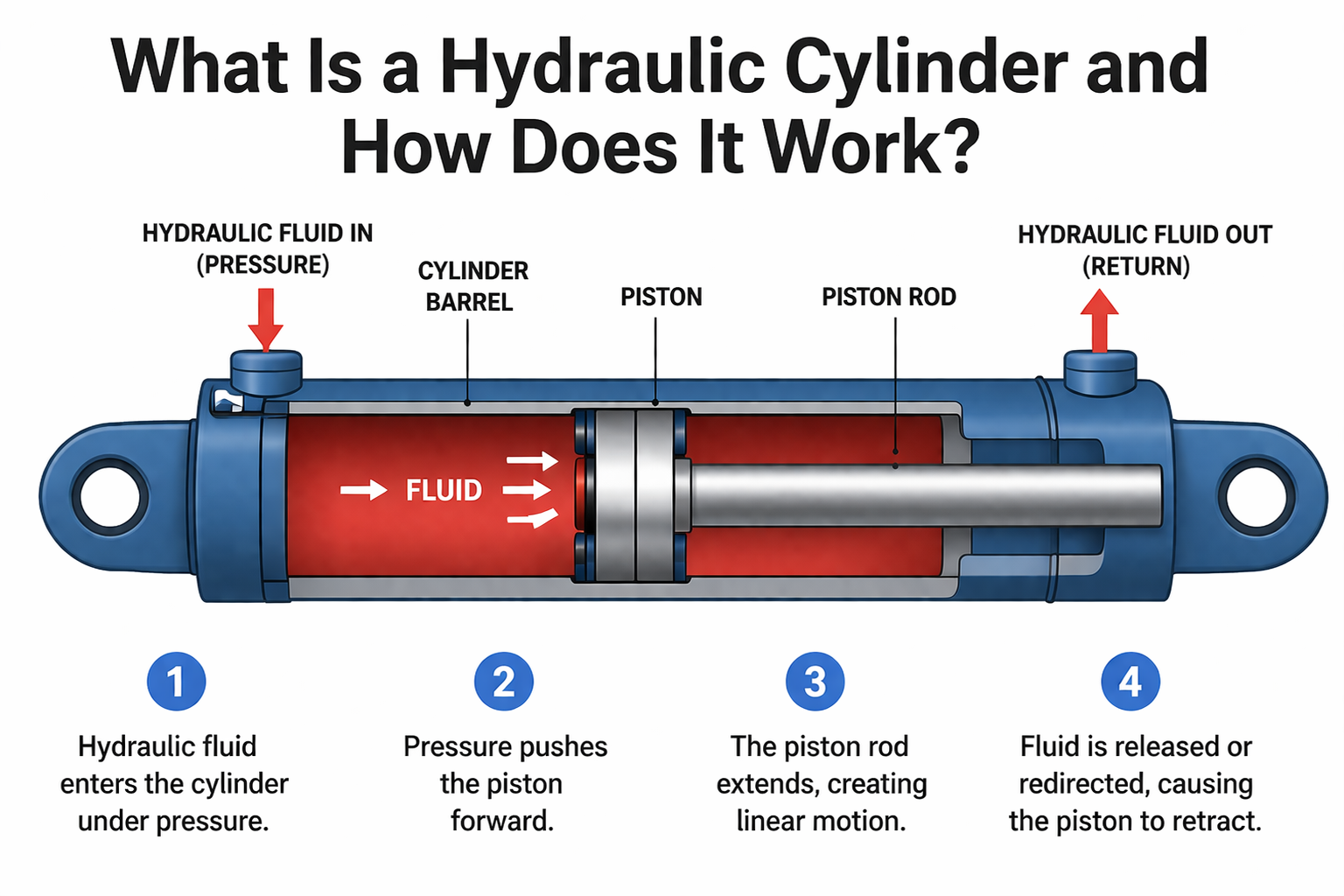
A hydraulic cylinder is a tube-like structure that contains fluid under pressure. It consists of key components such as the cylinder barrel, piston, piston rod, seals, and end caps. These components work together to create motion when hydraulic fluid is pumped into the cylinder.
Hydraulic cylinders are commonly found in heavy machinery such as excavators, loaders, cranes, and industrial presses. Their ability to generate high force with precision makes them essential in demanding applications.
How Does a Hydraulic Cylinder Work?
To understand how does a hydraulic cylinder work, it’s important to know the basic principle behind it—Pascal’s Law. This law states that pressure applied to a confined fluid is transmitted equally in all directions.
Here’s a simple step-by-step explanation:
- Hydraulic fluid (usually oil) is pumped into the cylinder through a port.
- The pressure builds up inside the cylinder barrel.
- This pressure pushes the piston forward.
- As the piston moves, it extends the piston rod outward.
- This linear motion is used to perform work, such as lifting or pushing heavy loads.
When the fluid is released or redirected, the piston retracts, completing the cycle. This process explains how does a hydraulic cylinder work in real-world applications.
Types of Hydraulic Cylinders
There are several types of hydraulic cylinders used in industries across Mexico and the United States:
- Single-acting cylinders: Use hydraulic pressure in one direction only.
- Double-acting cylinders: Use pressure for both extension and retraction.
- Telescopic cylinders: Provide extended reach with multiple stages.
- Tie-rod cylinders: Common in industrial applications due to easy maintenance.
Each type is designed for specific operational needs, depending on the required force and movement.
Applications in the United States and Mexico
Hydraulic cylinders are widely used in both regions due to rapid industrial growth. In the United States, they are essential in construction equipment, aerospace systems, and manufacturing plants. In Mexico, they play a major role in automotive production, agriculture, and mining operations.
Knowing how does a hydraulic cylinder work helps industries in these regions optimise machinery performance and ensure safety in operations.
Benefits of Hydraulic Cylinders
- High force generation
- Smooth and controlled motion
- Durable and reliable performance
- Low maintenance with proper care
These advantages make hydraulic cylinders a preferred choice for heavy-duty tasks.
Conclusion
A hydraulic cylinder is a vital component in modern machinery, offering efficient and powerful motion control. By understanding how does a hydraulic cylinder work, businesses in the United States and Mexico can make better decisions regarding equipment usage and maintenance. Whether in construction or manufacturing, hydraulic cylinders continue to drive productivity and innovation.

 English
 Arabic
 French
 Portuguese
 Deutsch
 Turkish
 Dutch
Dutch
 Italiano
 Russian
 Romaian
 Portuguese (Brazil)
 Greek
Greek