


Vietnam Exports Growth, Top Industries, and Trade Partners in 2025
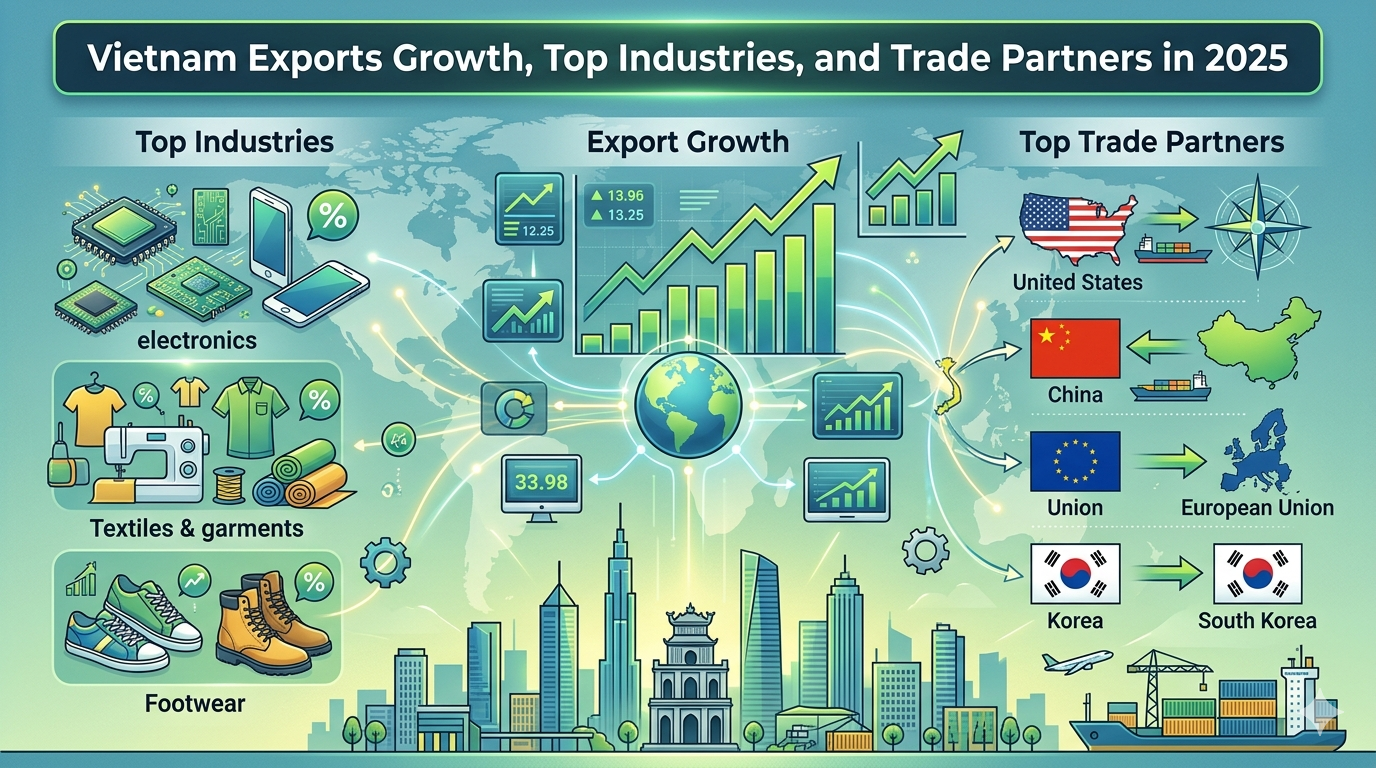
In recent years, Vietnam has rapidly transformed into one of Asia’s most dynamic export-driven economies. With its strategic geographic position, cost-effective labor force, and expanding industrial base, the country has secured a strong foothold in global trade. According to the latest vietnam customs data, Vietnam’s total export value reached approximately $403.2 billion in 2024, marking a steady growth of 6.4% compared to the previous year.
The consistent rise in vietnam exports highlights the country’s growing importance in international markets. In fact, Vietnam now ranks among the top global exporters, holding the 21st position worldwide. This remarkable progress reflects its successful integration into global supply chains and increasing competitiveness across multiple industries.
Vietnam Export Performance in 2025
The upward trajectory of vietnam exports has continued into 2025. In the first quarter alone, export turnover reached $102.8 billion, representing a 10.6% year-on-year increase. Overall trade turnover hit $202.5 billion during the same period, growing by 13.7%.
Additionally, Vietnam recorded a trade surplus of $4.67 billion in the first five months of 2025, demonstrating strong export resilience despite global uncertainties. These figures, derived from vietnam customs data, indicate a stable and expanding export economy.
Top Vietnam Exports by Industry
Vietnam’s export portfolio is highly diversified, with strong performance across manufacturing, agriculture, and technology sectors. The dominance of electronics and textiles has significantly shaped the structure of vietnam exports in recent years.
1. Electrical Machinery & Equipment (HS Code 85)
This sector leads all categories, generating $121.7 billion in exports and accounting for nearly 29.5% of total shipments. Electronics manufacturing remains the backbone of Vietnam’s export economy.
2. Footwear (HS Code 64)
Vietnam is a global leader in footwear exports, contributing $25.4 billion annually. The country’s competitive production costs make it a preferred sourcing destination.
3. Machinery & Mechanical Appliances (HS Code 84)
Exports in this category reached $23.5 billion, reflecting the country’s growing industrial capabilities.
4 & 5. Apparel (Knit & Non-Knit)
Combined, textile exports exceed $40 billion, reinforcing Vietnam’s position as a major garment exporter globally.
6. Furniture and Bedding (HS Code 94)
Vietnam has become a key supplier for global furniture brands, with exports totaling $14.2 billion.
7. Fish and Seafood (HS Code 03)
Seafood exports stand at $9.8 billion, driven by strong demand in global markets.
8–10. Wood, Coffee, and Rubber
Agricultural and raw material exports such as coffee, wood, and rubber continue to support the diversity of vietnam exports.
Vietnam Exports by Country
Understanding vietnam exports by country provides valuable insights into its global trade relationships. Vietnam’s export success is closely tied to its strong network of international partners.
United States
The U.S. is Vietnam’s largest export destination, accounting for $113.9 billion (27.5%). Electronics, textiles, and footwear dominate exports to this market.
China
China ranks second with $60.7 billion in imports from Vietnam. Agricultural goods and electronics are key export categories.
South Korea
South Korea imports $28.2 billion worth of Vietnamese goods, particularly electronics and machinery.
Japan
Exports to Japan total $26.8 billion, focusing on automotive parts, seafood, and technology products.
European Markets
Countries such as Germany, the Netherlands, and the United Kingdom play a crucial role in vietnam exports by country, importing machinery, textiles, and furniture.
Other significant markets include Hong Kong, Thailand, and India, all contributing to the expansion of Vietnam’s global trade network.
Vietnam Trade Partners and Global Influence
Vietnam’s rapid export growth is strongly supported by its strategic vietnam trade partners. These relationships enable the country to diversify markets and reduce dependency on any single region.
The United States and China remain dominant partners, while the European Union continues to gain importance due to trade agreements like EVFTA. Regional partnerships within ASEAN and Asia-Pacific also contribute to consistent export demand.
The strength of these vietnam trade partners ensures stability and opens new opportunities for exporters and investors alike.
Leading Exporters Driving Vietnam’s Growth
The success of vietnam exports is largely driven by multinational corporations and strong domestic companies.
- Samsung Group Vietnam leads with approximately $65 billion in exports, primarily electronics.
- Intel Products Vietnam contributes significantly with semiconductor exports.
- LG Group and Foxconn Vietnam strengthen the electronics supply chain.
- Domestic players like VINATEX and Vinamilk represent Vietnam’s capabilities in textiles and agriculture.
These companies play a vital role in boosting export volume and enhancing the country’s global competitiveness.
Historical Growth of Vietnam Exports
Vietnam’s export journey over the past decade highlights consistent and impressive growth:
- 2014: $150.21 billion
- 2018: $243.69 billion
- 2021: $335.79 billion
- 2024: $403.2 billion
This steady rise reflects the country’s successful economic reforms and global integration. The expansion of vietnam exports has been particularly strong in manufacturing and processing industries, which now account for nearly 88.7% of total exports.
Challenges and Tariff Impacts
Despite strong growth, Vietnam faces several challenges, particularly related to global trade policies. Tariffs on steel and aluminum, as well as potential new trade restrictions, could impact export performance.
Uncertainty in major markets like the United States may lead to fluctuations in demand. However, proactive measures such as trade diversification and compliance with international standards help mitigate risks.
Opportunities for Buyers and Exporters
For international buyers, Vietnam offers a reliable sourcing destination with competitive pricing and high-quality manufacturing. Leveraging vietnam customs data can help identify the best suppliers and optimize sourcing strategies.
Exporters, on the other hand, can benefit from expanding into emerging markets and strengthening supply chain resilience. Understanding vietnam exports by country enables businesses to target high-growth regions effectively.
Future Outlook for Vietnam Exports
The future of vietnam exports remains highly promising. Forecasts suggest export values could exceed $450 billion in 2025, driven by continued industrial growth and strong global demand.
Vietnam’s role in supply chain diversification, particularly as companies shift away from China, positions it as a key manufacturing hub in Southeast Asia. However, maintaining growth will require adapting to environmental regulations, trade policies, and technological advancements.
Conclusion
Vietnam has firmly established itself as a global export powerhouse, driven by strong industrial growth, strategic partnerships, and a diverse product portfolio. From electronics and textiles to agriculture and furniture, the country’s export sectors continue to expand and evolve.
The analysis of vietnam exports by country highlights the importance of global trade relationships, while insights from vietnam customs data provide valuable direction for businesses and investors.
As Vietnam strengthens its position in international markets, collaboration with key vietnam trade partners and continued innovation will be essential. With the right strategies in place, Vietnam is well on track to achieving sustained export growth and becoming an even more influential player in global trade.

 English
 Arabic
 French
 Spanish
 Portuguese
 Turkish
 Dutch
Dutch
 Italiano
 Russian
 Romaian
 Portuguese (Brazil)
 Greek
Greek