


Trade Credit Insurance Underwriting: Managing Buyer Risk in Global Trade
Role of Trade Credit Insurance in Global Commerce
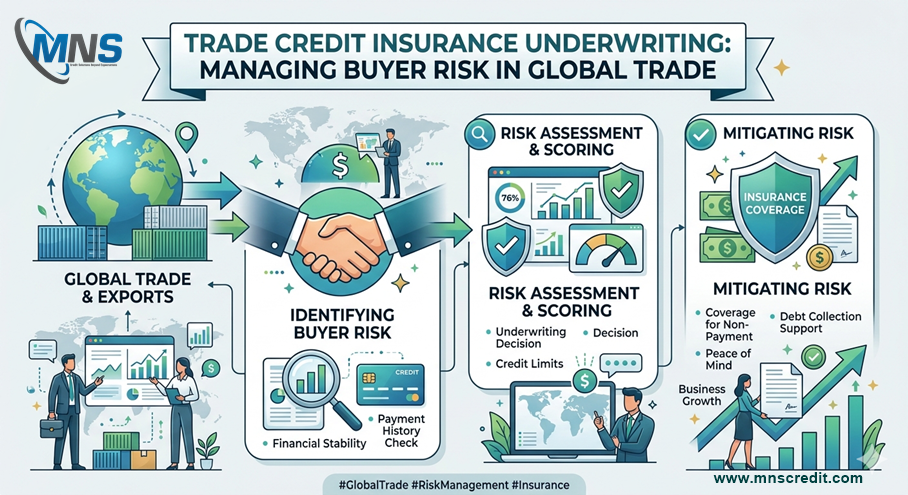
Trade credit insurance is one of the most commercially important and least widely understood financial products in the global economy. It protects sellers — whether exporters selling across borders or domestic suppliers extending trade credit — against the risk that their buyers will fail to pay for goods or services already delivered. By absorbing the credit risk inherent in trade, credit insurance enables sellers to extend more generous payment terms, enter new markets with confidence, and access trade finance on better terms — fuelling the commercial relationships that drive international and domestic trade.
At the heart of trade credit insurance is the underwriting function: the assessment of buyer credit risk, the setting of credit limits within which sellers can transact on a covered basis, and the ongoing management of exposure as buyer risk profiles evolve. Trade credit insurance underwriting is a specialised discipline that combines elements of commercial credit assessment, country risk analysis, and portfolio management into a framework that must operate at the scale required to cover the diverse buyer populations of large commercial sellers.
How Trade Credit Insurance Underwriting Works
Trade credit insurance policies are typically structured as whole-turnover policies that cover a seller's receivables from a defined population of buyers, subject to policy terms and individual buyer credit limits set by the insurer. The underwriting process involves two distinct levels of assessment: the policy-level assessment of the insured seller, and the buyer-level assessment of each buyer for whom a credit limit is requested.
Seller assessment evaluates the quality of the insured's credit management practices, the diversity and credit quality of their customer base, their claims history with the insurer, and the adequacy of the policy terms and premium to reflect the expected loss exposure across their buyer portfolio. An insured with concentrated exposure to a small number of high-risk buyers, a history of poor credit management, and a claims record that reflects inadequate internal risk controls represents a very different underwriting proposition from one with a diverse, well-managed buyer base and disciplined credit practices.
Buyer credit limit assessment is where the granular risk work of trade credit insurance underwriting takes place. For each buyer for whom the insured requests a credit limit, the insurer assesses the buyer's creditworthiness and sets a maximum covered exposure amount. This assessment draws on the same sources of risk intelligence used in commercial credit underwriting — financial statements and the Financial Ratios derived from them, credit bureau data, payment behaviour from trade creditor references, corporate registry information including director history and compliance records, and Business Information Reports that consolidate these sources into a structured risk profile.
Country Risk in Trade Credit Underwriting
For export credit insurance and international receivables coverage, country risk adds a dimension of underwriting complexity that domestic trade credit does not face. Even a financially strong buyer can fail to pay due to factors outside their control — government-imposed payment restrictions, currency inconvertibility, political instability, or the imposition of international sanctions. The underwriter must assess not just the creditworthiness of the individual buyer but the risk that their operating country will prevent or impair payment even from a willing payer.
Country risk assessment in trade credit underwriting draws on sovereign credit ratings, political risk indices, analysis of the country's foreign exchange reserves and balance of payments position, and assessment of the legal and regulatory environment for commercial dispute resolution and cross-border payment transfer. Higher-risk countries command higher premiums for cover, reduced credit limits for individual buyers, or in some cases exclusion from coverage entirely — reflecting the insurer's assessment that country-level risk makes the exposure unacceptable regardless of individual buyer quality.
Ongoing Portfolio Management and Limit Review
Trade credit insurance underwriting is not a one-time assessment — it is a continuous portfolio management discipline. Buyer credit limits must be reviewed and updated as buyer risk profiles evolve, economic conditions change, and new information emerges about individual buyers' financial health. Insurers monitor their buyer portfolios through automated screening against financial news and adverse media, periodic re-assessment of buyer financial data as new accounts are filed, and analysis of payment behaviour trends across the buyers in their portfolio.
When a buyer's risk profile deteriorates — whether through adverse financial data, payment difficulties signalled by trade references, adverse media coverage, or changes in their corporate structure visible in registry data — the insurer may reduce or withdraw the credit limit, effectively signalling to the insured that covered exposure on that buyer should be reduced. This ongoing limit management function is one of the most valuable services that trade credit insurers provide: real-time risk intelligence about the creditworthiness of the insured's customer base that most sellers could not generate independently.
Technology in Trade Credit Underwriting
The volume of buyer assessments required to support a large trade credit insurance portfolio — potentially thousands of individual buyer limit decisions annually — makes automation essential. Modern trade credit insurers use automated data feeds, algorithmic risk scoring, and machine learning models to process routine buyer limit decisions at scale, reserving manual underwriter attention for complex, high-value, or borderline assessments that require expert judgment.
Conclusion
Trade credit insurance underwriting is a specialised discipline that manages credit risk at the intersection of individual buyer assessment, portfolio management, and country risk analysis. Done well, it enables the extension of trade credit that drives commercial activity, provides sellers with the confidence to enter new markets, and delivers the claims-paying capacity that fulfils the product's fundamental promise. The quality of the underwriting — the accuracy of buyer risk assessment, the appropriateness of credit limits, and the rigour of ongoing portfolio monitoring — determines whether trade credit insurance delivers on that promise or becomes a source of unexpected losses for insurer and insured alike.
Role of Trade Credit Insurance in Global Commerce
Trade credit insurance is one of the most commercially important and least widely understood financial products in the global economy. It protects sellers — whether exporters selling across borders or domestic suppliers extending trade credit — against the risk that their buyers will fail to pay for goods or services already delivered. By absorbing the credit risk inherent in trade, credit insurance enables sellers to extend more generous payment terms, enter new markets with confidence, and access trade finance on better terms — fuelling the commercial relationships that drive international and domestic trade.
At the heart of trade credit insurance is the underwriting function: the assessment of buyer credit risk, the setting of credit limits within which sellers can transact on a covered basis, and the ongoing management of exposure as buyer risk profiles evolve. Trade credit insurance underwriting is a specialised discipline that combines elements of commercial credit assessment, country risk analysis, and portfolio management into a framework that must operate at the scale required to cover the diverse buyer populations of large commercial sellers.
How Trade Credit Insurance Underwriting Works
Trade credit insurance policies are typically structured as whole-turnover policies that cover a seller's receivables from a defined population of buyers, subject to policy terms and individual buyer credit limits set by the insurer. The underwriting process involves two distinct levels of assessment: the policy-level assessment of the insured seller, and the buyer-level assessment of each buyer for whom a credit limit is requested.
Seller assessment evaluates the quality of the insured's credit management practices, the diversity and credit quality of their customer base, their claims history with the insurer, and the adequacy of the policy terms and premium to reflect the expected loss exposure across their buyer portfolio. An insured with concentrated exposure to a small number of high-risk buyers, a history of poor credit management, and a claims record that reflects inadequate internal risk controls represents a very different underwriting proposition from one with a diverse, well-managed buyer base and disciplined credit practices.
Buyer credit limit assessment is where the granular risk work of trade credit insurance underwriting takes place. For each buyer for whom the insured requests a credit limit, the insurer assesses the buyer's creditworthiness and sets a maximum covered exposure amount. This assessment draws on the same sources of risk intelligence used in commercial credit underwriting — financial statements and the Financial Ratios derived from them, credit bureau data, payment behaviour from trade creditor references, corporate registry information including director history and compliance records, and Business Information Reports that consolidate these sources into a structured risk profile.
Country Risk in Trade Credit Underwriting
For export credit insurance and international receivables coverage, country risk adds a dimension of underwriting complexity that domestic trade credit does not face. Even a financially strong buyer can fail to pay due to factors outside their control — government-imposed payment restrictions, currency inconvertibility, political instability, or the imposition of international sanctions. The underwriter must assess not just the creditworthiness of the individual buyer but the risk that their operating country will prevent or impair payment even from a willing payer.
Country risk assessment in trade credit underwriting draws on sovereign credit ratings, political risk indices, analysis of the country's foreign exchange reserves and balance of payments position, and assessment of the legal and regulatory environment for commercial dispute resolution and cross-border payment transfer. Higher-risk countries command higher premiums for cover, reduced credit limits for individual buyers, or in some cases exclusion from coverage entirely — reflecting the insurer's assessment that country-level risk makes the exposure unacceptable regardless of individual buyer quality.
Ongoing Portfolio Management and Limit Review
Trade credit insurance underwriting is not a one-time assessment — it is a continuous portfolio management discipline. Buyer credit limits must be reviewed and updated as buyer risk profiles evolve, economic conditions change, and new information emerges about individual buyers' financial health. Insurers monitor their buyer portfolios through automated screening against financial news and adverse media, periodic re-assessment of buyer financial data as new accounts are filed, and analysis of payment behaviour trends across the buyers in their portfolio.
When a buyer's risk profile deteriorates — whether through adverse financial data, payment difficulties signalled by trade references, adverse media coverage, or changes in their corporate structure visible in registry data — the insurer may reduce or withdraw the credit limit, effectively signalling to the insured that covered exposure on that buyer should be reduced. This ongoing limit management function is one of the most valuable services that trade credit insurers provide: real-time risk intelligence about the creditworthiness of the insured's customer base that most sellers could not generate independently.
Technology in Trade Credit Underwriting
The volume of buyer assessments required to support a large trade credit insurance portfolio — potentially thousands of individual buyer limit decisions annually — makes automation essential. Modern trade credit insurers use automated data feeds, algorithmic risk scoring, and machine learning models to process routine buyer limit decisions at scale, reserving manual underwriter attention for complex, high-value, or borderline assessments that require expert judgment.
Conclusion
Trade credit insurance underwriting is a specialised discipline that manages credit risk at the intersection of individual buyer assessment, portfolio management, and country risk analysis. Done well, it enables the extension of trade credit that drives commercial activity, provides sellers with the confidence to enter new markets, and delivers the claims-paying capacity that fulfils the product's fundamental promise. The quality of the underwriting — the accuracy of buyer risk assessment, the appropriateness of credit limits, and the rigour of ongoing portfolio monitoring — determines whether trade credit insurance delivers on that promise or becomes a source of unexpected losses for insurer and insured alike.

 English
 Arabic
 Spanish
 Portuguese
 Deutsch
 Turkish
 Dutch
Dutch
 Italiano
 Russian
 Romaian
 Portuguese (Brazil)
 Greek
Greek