


Hydronic Balancing Valves Market Value Forecast 2031: Growth Trends, Industry Outlook, and Strategic Analysis
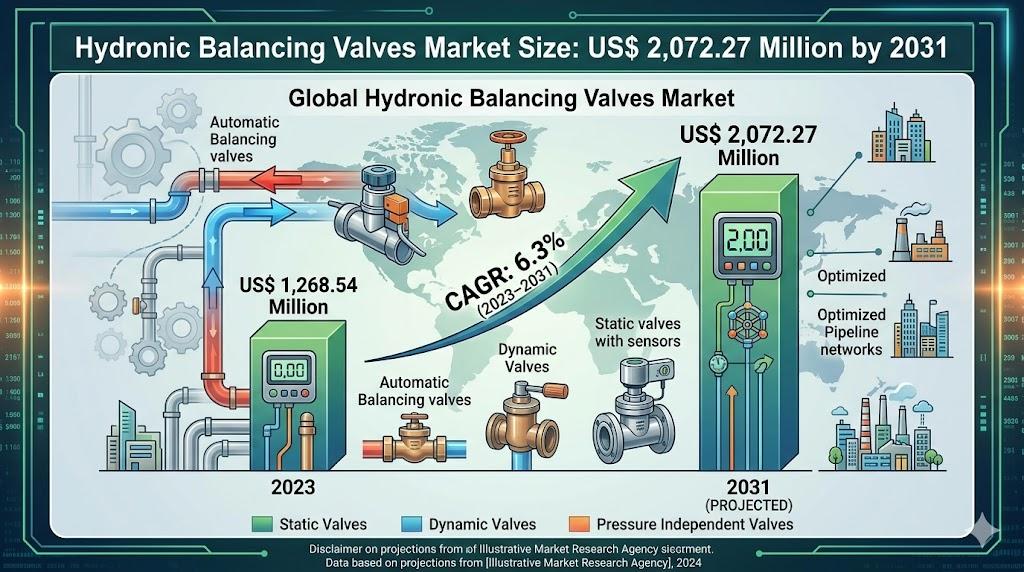
The global hydronic balancing valves market is experiencing a period of robust growth driven by the increasing demand for energy efficiency in heating, ventilation, and air conditioning (HVAC) systems. As urbanization continues to accelerate and the construction of high-rise commercial and residential buildings rises, the need for precise flow control and thermal comfort has become paramount. The hydronic balancing valves market size is projected to reach US$ 2,072.27 million by 2031 from US$ 1,268.54 million in 2023. The market is expected to register a CAGR of 6.3% during 2023–2031.
Market Dynamics and Growth Drivers
The primary driver for the hydronic balancing valves market is the global shift toward green building standards. Governments and regulatory bodies are implementing strict mandates to reduce carbon footprints and energy consumption in the building sector. Hydronic balancing valves play a critical role in this transition by ensuring that water is distributed evenly throughout a system, preventing overflows in some circuits and underflows in others. This optimization not only improves the efficiency of pumps and boilers but also significantly reduces operational costs for facility managers.
Furthermore, the integration of smart technologies into HVAC components is revolutionizing the industry. Modern balancing valves are increasingly being equipped with digital sensors and actuators that allow for real-time monitoring and remote adjustments. This shift from manual to automatic and electronic balancing valves is a key trend, particularly in large-scale commercial projects where manual balancing can be time-consuming and prone to human error.
Market Segmentation by Product and End User
The market is generally categorized into manual balancing valves and automatic balancing valves. While manual valves remain popular due to their cost-effectiveness in smaller systems, automatic balancing valves are seeing higher adoption rates in complex installations. Automatic valves, such as pressure independent control valves (PICVs), are capable of maintaining a constant flow despite pressure fluctuations, which is essential for maintaining consistent indoor temperatures.
In terms of end users, the commercial sector remains the largest consumer of hydronic balancing valves. This includes office buildings, hospitals, hotels, and educational institutions. The residential sector is also showing steady growth, fueled by the rising popularity of underfloor heating systems and centralized district heating networks in regions like Europe and North America.
Download Sample Report: https://www.theinsightpartners.com/sample/TIPRE00039111
Regional Market Analysis
Geographically, Europe holds a significant share of the hydronic balancing valves market. The region’s focus on energy-efficient renovations of old buildings and the widespread use of hydronic heating systems provide a stable foundation for market expansion. However, the Asia Pacific region is expected to witness the fastest growth rate during the forecast period. Rapid industrialization and the construction of new smart cities in China and India are creating a massive demand for advanced HVAC infrastructure.
Key Players in the Hydronic Balancing Valves Market
The market is characterized by the presence of several established players who are focusing on product innovation and strategic partnerships to maintain their market position. Key players include:
-
Danfoss AG
-
Hays Fluid Controls
-
Victaulic Company
-
Red-White Valve Corp.
-
Oventrop Corporation
-
Caleffi SpA
-
Siemens
-
Frese Group
-
Johnson Controls, Inc.
-
American Wheatly
-
Xylem
Future Outlook
The future of the hydronic balancing valves market looks promising as the industry moves toward more sustainable and intelligent building solutions. We can expect to see a higher level of integration between balancing valves and Building Management Systems (BMS), where Artificial Intelligence (AI) will be used to predict flow requirements and optimize system performance automatically. Additionally, the replacement of aging infrastructure in developed economies will continue to provide a steady stream of revenue for manufacturers. As the world prioritizes decarbonization, the role of hydronic balancing valves in creating high-performance, low-energy buildings will be more critical than ever.
Green Cement and Concrete Market
About Us
The Insight Partners is a leading global market research and consulting firm specializing in delivering actionable insights across various industries. Our research reports combine extensive primary and secondary research to provide accurate market intelligence, helping businesses make informed strategic decisions. The company provides detailed analysis on emerging technologies, market trends, competitive landscapes, and growth opportunities across sectors including technology, healthcare, manufacturing, and energy.
Contact Us:
Contact Person: Ankit Mathur
E-mail: ankit.mathur@theinsightpartners.com
Phone: +1-646-491-9876

 English
 Arabic
 French
 Spanish
 Portuguese
 Deutsch
 Turkish
 Italiano
 Russian
 Romaian
 Portuguese (Brazil)
 Greek
Greek