


Company Incorporation in India | UK Business Expansion Guide
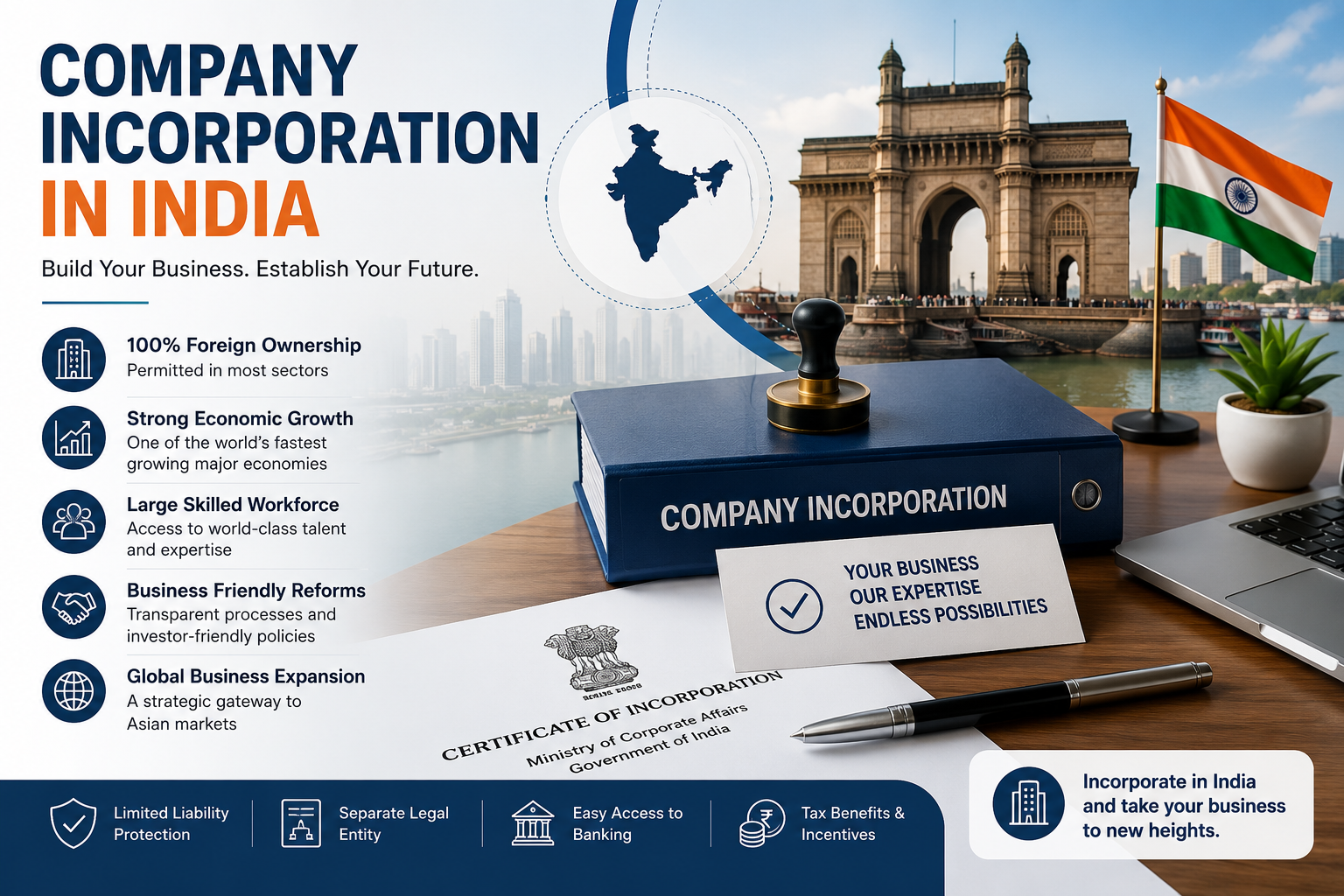
Company Incorporation in India: A Strategic Guide for UK and European Businesses
Expanding into one of the world's fastest-growing economies has become a priority for many international businesses. Company incorporation in India offers UK and European companies direct access to a market of over 1.4 billion consumers, a skilled workforce, competitive operating costs, and an increasingly business-friendly regulatory environment.
However, incorporating a company in a foreign country involves more than simply filing paperwork. Businesses must understand the legal structure, compliance obligations, taxation, and sector-specific regulations before entering the Indian market.
This guide explains everything overseas investors need to know about company incorporation in India, helping decision-makers plan a smooth and compliant market entry.
Why Company Incorporation in India Is Becoming a Global Business Priority
India has transformed into a preferred destination for global investment. Government initiatives such as Digital India, Make in India, simplified corporate procedures, and improved ease of doing business have made foreign investment more attractive.
According to the Department for Promotion of Industry and Internal Trade (DPIIT), India has attracted hundreds of billions of dollars in Foreign Direct Investment over the past decade, demonstrating strong international confidence in the country's long-term economic growth.
For UK and European businesses, incorporating an Indian company provides several advantages:
-
Direct access to India's expanding consumer market
-
Greater credibility with local customers and suppliers
-
Ability to hire employees directly
-
Eligibility for government incentives in selected industries
-
Easier participation in public and private contracts
-
Improved operational control compared to representative offices
Rather than operating through distributors alone, many companies now establish a legal entity to build long-term business operations.
Understanding Company Incorporation in India
Company incorporation in India refers to the legal process of registering a business under the Companies Act, allowing it to operate as an independent corporate entity.
Foreign investors typically choose one of the following structures.
| Business Structure | Suitable For | Foreign Ownership |
|---|---|---|
| Private Limited Company | Long-term commercial operations | Up to 100% in many sectors under FDI rules |
| Wholly Owned Subsidiary | Complete foreign ownership | Common choice for overseas companies |
| Joint Venture Company | Partnering with Indian businesses | Shared ownership |
| Limited Liability Partnership (LLP) | Professional or service businesses | Allowed in selected sectors |
For most UK and European investors, a Private Limited Company or Wholly Owned Subsidiary provides the highest level of flexibility and legal protection.
Step-by-Step Company Incorporation in India
A structured incorporation process helps avoid regulatory delays and compliance issues.
1. Choose the Appropriate Business Structure
Selecting the right legal entity depends on ownership preferences, taxation, investment goals, and future expansion plans.
2. Reserve the Company Name
The proposed company name must comply with Indian corporate naming regulations and be approved before incorporation.
3. Obtain Digital Signatures and Director Identification
Directors are required to obtain Digital Signature Certificates (DSC) and Director Identification Numbers (DIN) before filing incorporation documents.
4. Prepare Incorporation Documents
Typical documentation includes:
-
Identity proof of directors
-
Address proof
-
Registered office details
-
Memorandum of Association (MOA)
-
Articles of Association (AOA)
Foreign shareholders may also require notarised and apostilled documents depending on their jurisdiction.
5. Register with Authorities
Applications are submitted electronically through the Ministry of Corporate Affairs (MCA), followed by registration for tax, banking, and statutory compliance where applicable.
Once approved, the company receives its Certificate of Incorporation and Corporate Identification Number (CIN).
Compliance After Company Incorporation in India
Many foreign businesses focus only on registration and underestimate ongoing compliance responsibilities.
After incorporation, companies generally need to maintain:
-
Annual financial statements
-
Board meetings
-
Statutory registers
-
Income tax filings
-
Goods and Services Tax (GST) compliance where applicable
-
Regulatory filings with the Ministry of Corporate Affairs
Maintaining proper compliance protects the company's legal standing and reduces the risk of penalties.
Real-Life Case Study
A UK-based engineering solutions company wanted to expand its operations into India to support manufacturing clients across South Asia.
Initially, the company considered appointing distributors. After evaluating long-term growth potential, it proceeded with company incorporation in India through a wholly owned subsidiary.
Within two years, the business established a local technical support team, reduced project delivery times, improved customer confidence, and secured contracts that required a registered Indian entity. Local incorporation also simplified vendor management and recruitment.
This demonstrates how incorporation can become a strategic investment rather than simply a legal requirement.
Practical Example
Imagine a German software company selling enterprise solutions to Indian manufacturers.
Without an incorporated entity, billing, hiring employees, opening local bank accounts, and signing long-term contracts become more complex.
By completing company incorporation in India, the company gains the ability to invoice customers locally, recruit technical teams, comply with tax regulations, and build stronger relationships with enterprise clients.
For businesses planning sustainable growth, local incorporation creates operational efficiency.
Common Challenges During Company Incorporation in India
International businesses may encounter several challenges during the incorporation process.
These include:
-
Understanding Foreign Direct Investment regulations
-
Selecting the appropriate business structure
-
Preparing internationally authenticated documents
-
Managing tax registrations
-
Meeting ongoing compliance deadlines
-
Navigating sector-specific regulatory approvals
Working with experienced consultants significantly reduces these risks while ensuring compliance from day one.
Why Professional Guidance Matters
Every business expansion strategy is different. A technology startup entering India has different regulatory requirements than a manufacturing company or consulting firm.
Professional advisors assist with:
-
Business structure selection
-
Regulatory documentation
-
Government registrations
-
Compliance planning
-
Tax coordination
-
Corporate secretarial services
By partnering with specialists, overseas investors can focus on commercial growth while administrative processes are managed efficiently.
At Stratrich Consulting, businesses receive end-to-end support throughout the company incorporation in India process, from planning and documentation to post-incorporation compliance, helping international companies establish a strong and legally compliant presence in the Indian market.
Conclusion
For UK and European businesses seeking long-term growth, company incorporation in India is more than a legal formality—it is the foundation for building a sustainable presence in one of the world's most dynamic economies.
Success depends on choosing the right business structure, understanding regulatory obligations, and maintaining ongoing compliance after registration. Companies that invest time in proper planning often experience smoother expansion, stronger customer trust, and greater operational flexibility.
Whether you are entering India for manufacturing, technology, consulting, or professional services, working with experienced advisors can simplify the entire journey. Stratrich Consulting supports international businesses through every stage of company incorporation in India, enabling organisations to expand confidently while remaining fully compliant with Indian corporate regulations. You can discover more articles, guides, and professional resources by visiting our website Bolworld.

 English
 Arabic
 French
 Spanish
 Portuguese
 Deutsch
 Turkish
 Dutch
Dutch
 Italiano
 Romaian
 Portuguese (Brazil)
 Greek
Greek