


How Manufacturing Companies Use SAP to Track Resource Efficiency
In today's competitive manufacturing landscape, improving resource efficiency has become a key priority for businesses looking to reduce costs, improve productivity, and meet sustainability goals. Manufacturers must monitor raw materials, energy consumption, machine utilization, labor productivity, and inventory in real time to stay ahead of market demands. This is where SAP solutions play a significant role.
By integrating production, inventory, procurement, and analytics into a single platform, SAP enables manufacturers to make informed decisions based on accurate, real-time data. Instead of relying on manual reports or disconnected systems, businesses can identify inefficiencies quickly, optimize production schedules, and minimize waste. Modern solutions like SAP S/4HANA, SAP Business Technology Platform (SAP BTP), and SAP Analytics Cloud further enhance visibility across manufacturing operations, helping organizations improve operational performance while supporting long-term business growth.
Why Resource Efficiency Matters in Modern Manufacturing
Manufacturing companies operate in an environment where even small inefficiencies can significantly impact profitability. Excess inventory, machine downtime, material waste, and high energy consumption all contribute to increased operational costs. Tracking these resources accurately allows businesses to optimize production while maintaining product quality.
Resource efficiency also supports sustainability initiatives. Many manufacturers are under increasing pressure to reduce carbon emissions, minimize waste, and comply with environmental regulations. Having complete visibility into resource usage enables organizations to make smarter decisions that benefit both the business and the environment.
What Is SAP Resource Efficiency Management?
SAP provides an integrated digital platform that helps manufacturers monitor every stage of the production process. From procurement and inventory management to production planning and quality control, SAP connects business functions into a unified system.
With real-time reporting, manufacturers can:
- Monitor raw material consumption.
- Track machine utilization.
- Analyze production performance.
- Reduce manufacturing waste.
- Improve inventory accuracy.
- Identify operational bottlenecks faster.
Having access to accurate operational data allows management teams to respond proactively instead of reacting after problems occur.
How SAP S/4HANA Improves Manufacturing Operations
SAP S/4HANA serves as the digital core for modern manufacturing organizations. It provides real-time access to operational data, enabling faster and more informed decision-making across production facilities.
Production managers can monitor inventory levels, equipment availability, production orders, and supply chain activities from a single platform. This improves planning accuracy while reducing delays caused by material shortages or scheduling conflicts.
The platform also helps organizations automate routine manufacturing processes, improve quality management, and increase overall production efficiency without adding unnecessary operational complexity.
The Role of SAP Business Technology Platform
SAP Business Technology Platform (SAP BTP) extends manufacturing capabilities by connecting SAP systems with third-party applications, industrial equipment, and IoT devices.
Manufacturers can collect production data directly from machines and sensors, enabling real-time monitoring of equipment performance. This connectivity helps identify maintenance needs before equipment failures occur, reducing downtime and improving asset utilization.
SAP BTP also supports workflow automation and application development, allowing businesses to build customized manufacturing solutions that align with their operational requirements.
Using SAP Analytics Cloud for Smarter Decisions
Data becomes valuable only when it leads to better decisions. SAP Analytics Cloud transforms manufacturing data into interactive dashboards, reports, and predictive insights that help organizations understand operational performance.
Manufacturers can analyze production efficiency, monitor KPIs, forecast demand, and identify trends affecting productivity. Visual reports make it easier for managers to evaluate performance across multiple production lines and facilities.
Predictive analytics also supports proactive planning by identifying potential issues before they impact production, helping businesses improve efficiency while reducing unnecessary costs.
Benefits of SAP Implementation for Manufacturers
A successful SAP implementation delivers measurable improvements across manufacturing operations. By integrating business processes into a centralized platform, organizations gain greater visibility and operational control.
Some key benefits include:
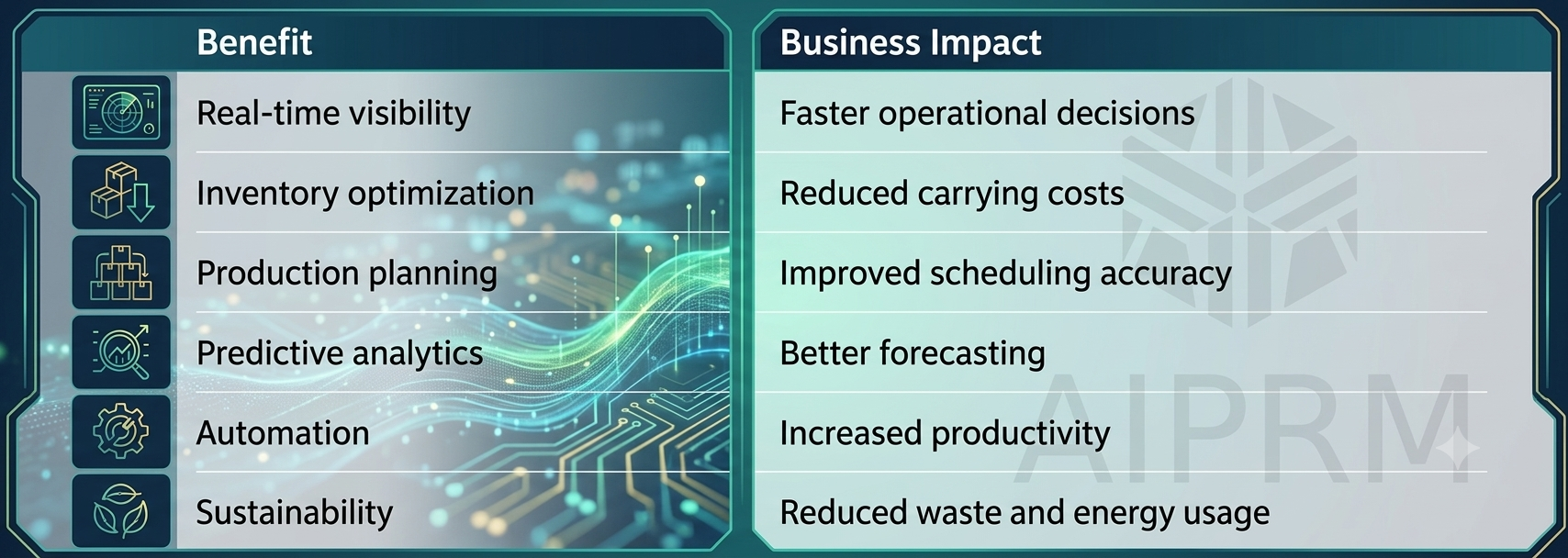
These improvements help manufacturers remain competitive while adapting to changing customer demands and market conditions.
Best Practices for Maximizing Resource Efficiency
Manufacturers can maximize the value of SAP by following several best practices:
- Integrate production, procurement, and inventory processes into one system.
- Monitor key performance indicators using real-time dashboards.
- Use predictive analytics to forecast demand and production capacity.
- Automate repetitive workflows wherever possible.
- Continuously review resource utilization to identify improvement opportunities.
When supported by accurate data and continuous process optimization, these practices contribute to long-term operational excellence.
Conclusion
Resource efficiency is no longer just a cost-saving initiative—it is a strategic advantage for modern manufacturers. SAP solutions provide the visibility, automation, and analytical capabilities needed to optimize materials, labor, equipment, and energy usage across the entire production process.
With technologies such as SAP S/4HANA, SAP Business Technology Platform, and SAP Analytics Cloud, manufacturers can make data-driven decisions, improve operational efficiency, reduce waste, and strengthen long-term business performance. As manufacturing continues to embrace digital transformation, organizations that leverage SAP effectively will be better positioned to achieve higher productivity, greater sustainability, and improved competitiveness.

 English
 Arabic
 French
 Portuguese
 Deutsch
 Turkish
 Dutch
Dutch
 Italiano
 Russian
 Romaian
 Portuguese (Brazil)
 Greek
Greek