


Breaking the Cycle of Poverty Through Free Education Programs
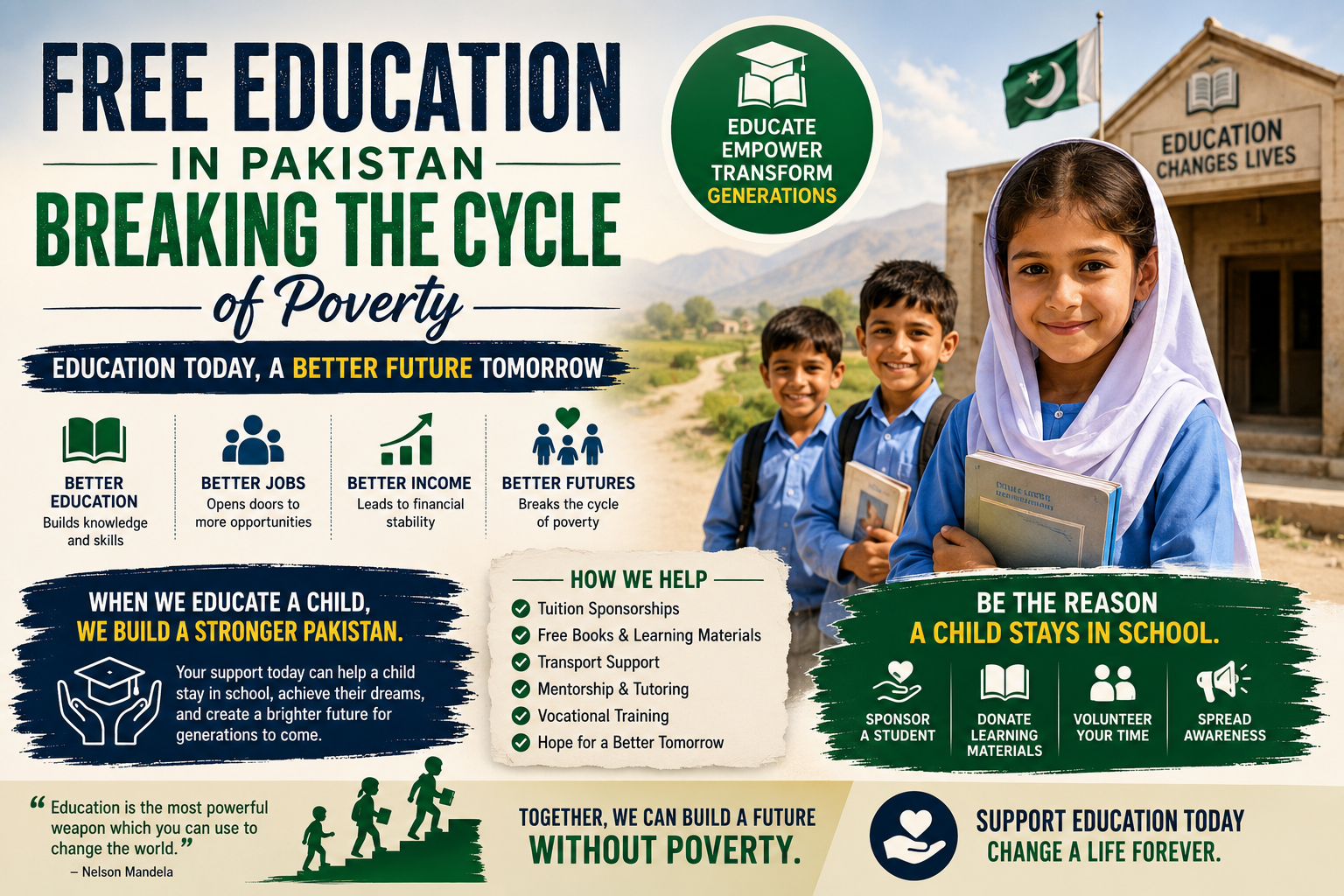
Poverty rarely stays inside one generation. When a family struggles with money, the effects carry forward. Children miss school. They grow up with fewer skills and fewer chances. Later, they raise their own families under the same financial pressure. People call this the cycle of poverty. Free education in Pakistan is one of the best tools to break this cycle.
Why Education Is the Turning Point
Education does more than teach children to read and write. It opens doors to better jobs. It helps people make smarter choices about health and money. It builds the confidence a person needs to chase a different future than the one they were born into.
People with even basic schooling tend to earn more over their lives. They are also less likely to stay stuck in extreme poverty. When this happens across a whole community, it changes that community's future. Quality education access does not just help one child. It helps entire neighborhoods over time.
This effect grows stronger with each generation that stays in school. A parent who finished even primary school is more likely to push their own children to finish school too. Over two or three generations, this shift can move a family from struggling to survive toward real, lasting stability.
Why So Many Children Still Miss Out:
Despite these clear benefits, millions of children in Pakistan still miss school. This is rarely about a lack of desire to learn. It almost always comes down to circumstance.
Even where tuition is free, other costs add up fast. Books, uniforms, and transport all cost money that many families do not have. Some children go to work instead of school because their income, even if small, helps the family survive. In rural areas, the nearest school may be too far away, or the road to reach it may not feel safe.
Girls face this problem even more than boys. Many families pull girls out of school earlier due to safety worries or old traditions. Some families also worry about the cost of school even when tuition itself is free, since exam fees, extra tutoring, and uniform replacements add up as children move to higher grades.
How Free Education Programs Interrupt the Cycle:
Structured education programs solve these problems directly. They do not just tell families that school matters. They remove the actual barriers standing in the way.
Most programs offer tuition sponsorships so families do not pay school fees. They provide free books and learning materials. Some cover transport costs so children can safely reach school. Many also offer mentorship and tutoring for students who fall behind. Older students often get vocational training, which gives them job-ready skills faster.
You can see how this works in practice through free education support programs. These programs remove the exact obstacles that push children out of school in the first place.
The Wider Ripple Effect:
The benefits of these programs rarely stop with one child. When one family member gets an education and finds better work, the whole family often becomes more stable financially. Younger siblings become more likely to stay in school too, since the family no longer needs their income to survive.
This is why groups working across many areas, like healthcare, education, and basic needs, tend to have a bigger impact overall. A family dealing with a medical crisis often cannot focus on school fees until their more urgent needs are met first. Solving these problems together creates lasting change instead of a short-term fix.
Common Barriers That Still Need Work:
Even with strong education programs, some barriers remain hard to solve. Distance is still a major issue in many rural areas. Building new schools closer to remote villages takes time and funding. Cultural attitudes toward girls' education also take years to shift, even with strong outreach efforts.
Teacher shortages add another layer of difficulty. Many trained teachers prefer working in cities, leaving rural schools short-staffed or relying on undertrained staff. Programs that offer teacher training alongside student support tend to see stronger, longer-lasting results.
Despite these challenges, steady progress continues. Every additional child who stays in school represents real, measurable change, even if the overall problem takes years to fully solve. Programs that track student attendance and outcomes over time help identify exactly where support is still needed most.
How Communities Change Over Time:
When education programs run for several years, entire communities begin to shift. Parents who once pulled children out of school start to see other families benefit from staying enrolled. This shift in mindset spreads slowly, but it spreads.
Local economies also feel the impact. Young people with skills training or basic education find jobs that pay better than manual labor alone. Some start small businesses of their own. Others move into roles that require reading, writing, and basic math, jobs that would have been out of reach without schooling.
Health outcomes improve too. Parents with even a few years of schooling tend to understand basic hygiene and nutrition better. They are more likely to bring sick children to a doctor early instead of waiting until an illness becomes severe. This connects education directly to better health across a whole family, not just better job prospects for one person.
None of this happens overnight. It takes years of consistent support, funding, and community trust. But the data across many countries, including Pakistan, shows the same pattern again and again: communities with stronger access to education see steady, measurable improvement in income, health, and stability over time.
What Individuals Can Do:
Supporting education does not require large amounts of money. You can sponsor a student's tuition or school supplies. You can volunteer as a tutor or mentor. You can donate learning materials your own children no longer use. You can also speak up in your own community about the importance of keeping girls in school.
If you want to get involved directly, you can explore volunteer opportunities to support students in a hands-on way.
Final Thoughts
Breaking the cycle of poverty rarely happens through one single action. But education comes closer than almost anything else to being that turning point. Free education in Pakistan gives children the chance to build a different future than the one their circumstances handed them.
Every sponsored student, every donated book, and every hour spent tutoring adds up over time. These small actions, repeated across thousands of families, are what actually shift a community's long-term future. If you would like to help a deserving student stay in school, you can contribute toward education programs that give children a real, lasting chance at a better life.

 Arabic
 French
 Spanish
 Portuguese
 Deutsch
 Turkish
 Dutch
Dutch
 Italiano
 Russian
 Romaian
 Portuguese (Brazil)
 Greek
Greek