


Trace’s $3M Bet on Context Engineering and the Future of Enterprise AI
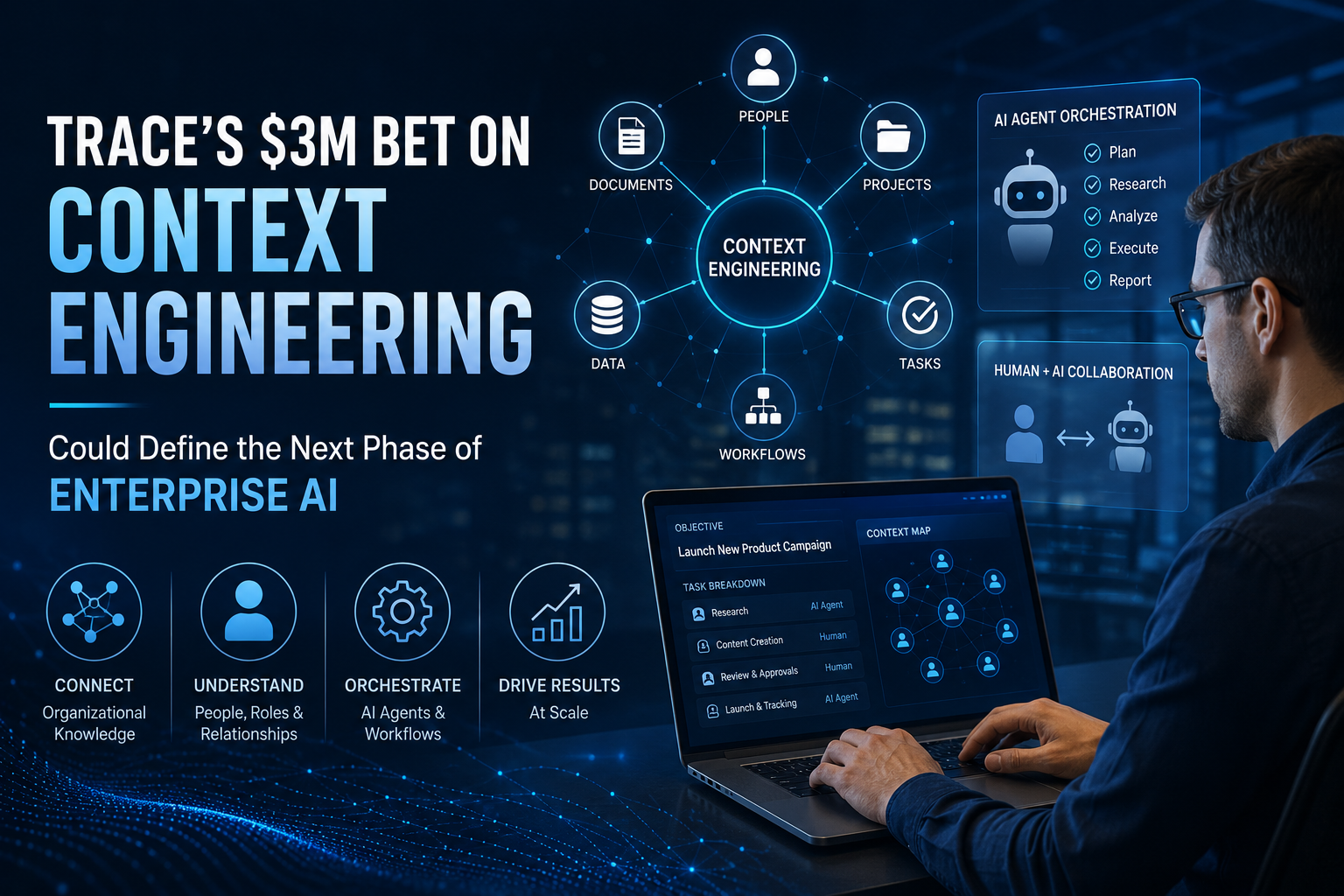
Trace’s $3 million seed funding signals a growing belief that context engineering could become the missing infrastructure layer for AI agents. The startup addresses a practical problem: AI agents struggle inside complex businesses because they lack organizational knowledge. Trace aims to solve that gap by mapping company systems, relationships, workflows, and responsibilities into a knowledge graph, then using that context to coordinate AI agents and human employees. The result could be a more reliable path from AI experiments to scalable enterprise automation.
What Is Context Engineering?
Context engineering means giving an AI system the right information, relationships, permissions, at the right moment. Trace connects information from tools such as Slack, email, Airtable. It builds a knowledge graph of people, projects, documents, and dependencies.
This matters because enterprise AI adoption is rarely limited by model intelligence. Agents can perform tasks yet fail without ownership, current documents, approvals, or authoritative data.
From Prompt Engineering to Context Engineering
Prompt engineering focuses on improving instructions given to a model; context engineering goes further.
A prompt might tell an agent to “create a product launch plan.” Context engineering can identify the owner, brand guidelines, approvals, and current performance data.
Companies can build reusable context.
Trace CTO Artur Romanov describes this shift as a move from prompt engineering toward context engineering, arguing that whoever supplies the best context could become foundational AI infrastructure.
How Trace’s AI Orchestration Model Works
Trace is an orchestration layer.
The workflow can involve three stages:
-
Map the organization through connected systems and relationships.
-
Break objectives into actionable tasks.
-
Route tasks to an AI agent or human with required context.
For example, a company could ask Trace to develop a new microsite. It could identify teams, documents, assets, dependencies, and approvals before assigning tasks.
This reflects a growing model of human-agent collaboration.
Why Knowledge Graphs Matter
Knowledge graphs matter because business information is relational. A document’s value depends on ownership, projects, timing, and dependencies.
Semantic retrieval helps AI systems discover relevant information while preserving structure.
Poor synchronization, duplicate records, incorrect permissions, or outdated relationships can create misleading context. Governance and access controls will be critical.
Trace vs Traditional AI Agent Deployment
Traditional deployment requires teams to configure agents, connect tools, define permissions, and maintain workflows. Trace is attempting to centralize that complexity.
| Traditional Approach | Trace’s Context-First Approach |
|---|---|
| Agent-specific setup | Shared organizational context |
| Prompt-focused | Context-focused |
| Manual coordination | Automated orchestration |
| Information across silos | Connected knowledge graph |
| Independent agents | Human-agent collaboration |
Competitive Enterprise AI Landscape
Trace is entering a crowded market. AI companies are developing enterprise agents, while workplace platforms embed AI. Anthropic has introduced enterprise-focused agent integrations, while platforms such as Atlassian are expanding AI features across workplace workflows.
Trace differentiates through context-first orchestration. Rather than competing solely on model capability, it is betting that a company-wide coordination layer can become equally valuable.
Why Trace’s $3M Funding Matters
The $3 million seed round, backed by Y Combinator, Zeno Ventures, Goodwater Capital, and others, gives Trace resources to develop infrastructure and pursue enterprise adoption.
The funding signals interest in AI-agent infrastructure. As enterprises move toward production, orchestration, governance, retrieval, and contextual intelligence could become major technology categories.
Frequently Asked Questions
What is Trace?
Trace is a London-based enterprise AI workflow orchestration startup helping agents operate within complex organizations.
What is context engineering?
Context engineering means structuring and delivering relevant organizational information, relationships, and operational data to AI systems when they need it.
Why did Trace raise $3 million?
Trace raised $3 million in seed funding to develop context-driven orchestration infrastructure and address slow enterprise AI agent adoption.
How is Trace different from AI agents?
Trace focuses on coordinating agents, workflows, humans, and organizational context rather than providing another standalone AI worker.
Conclusion
Trace’s $3 million bet highlights a significant shift in enterprise AI: smarter models are only part of the solution. The next advantage may come from delivering the right context, permissions, relationships, and workflows at the right moment.
If Trace can turn that vision into reliable enterprise infrastructure, context engineering could become an important foundation for AI-native businesses. For organizations evaluating agentic AI, understanding this emerging layer may be the next step toward moving beyond impressive demos and building automation that works in the real world.

 English
 Arabic
 French
 Spanish
 Portuguese
 Deutsch
 Turkish
 Dutch
Dutch
 Italiano
 Russian
 Portuguese (Brazil)
 Greek
Greek