


Which Real-World Assets Are Most Suitable for Tokenization?
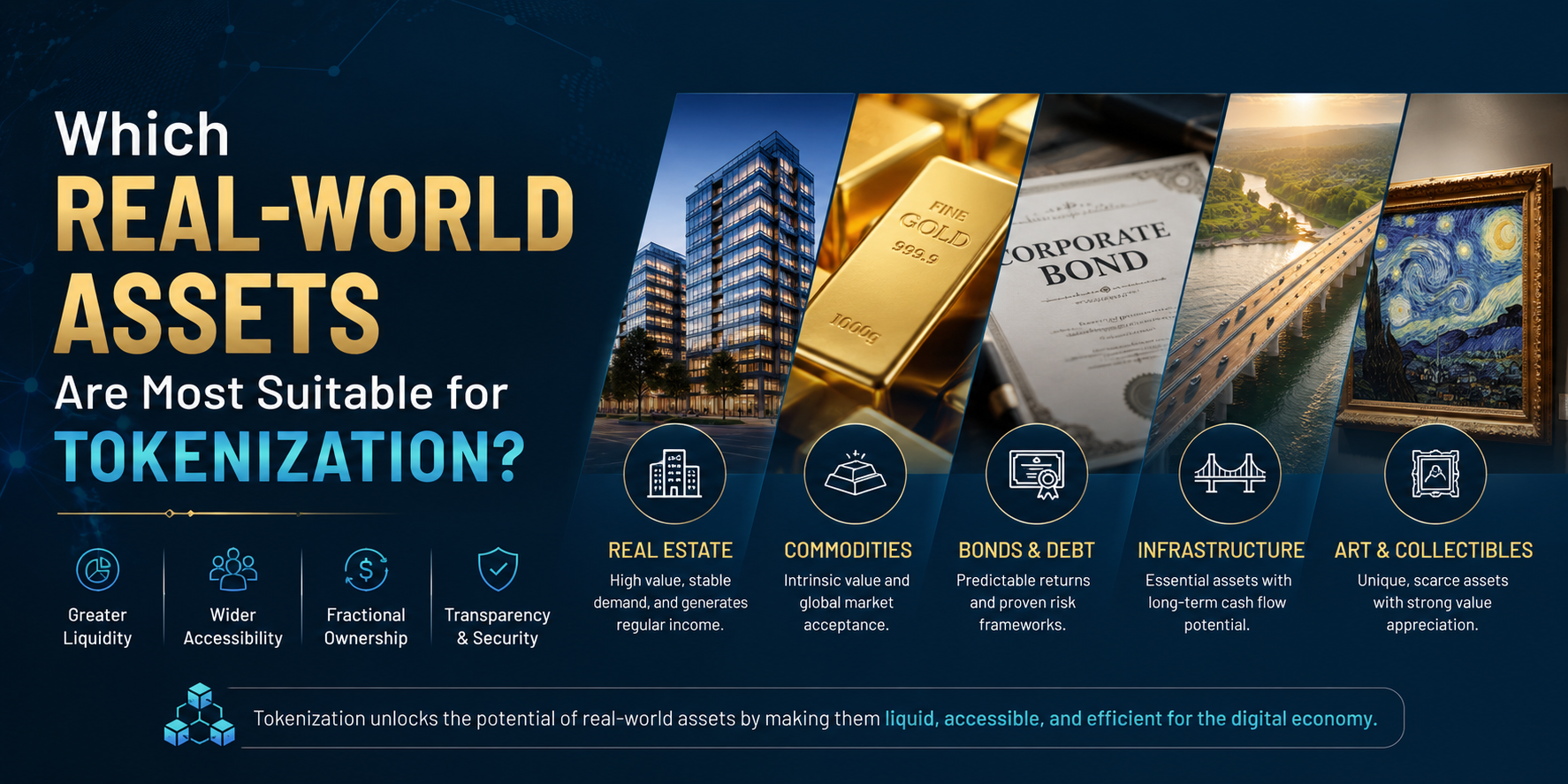
Real-world asset tokenization is moving beyond the experimental stage of blockchain adoption. Financial institutions, asset managers, property businesses, and technology companies are increasingly exploring how blockchain can represent ownership or economic rights to assets through digital tokens. The attraction is not simply that an asset can be placed “on-chain.” The more important question is whether tokenization can solve a genuine problem in the asset’s existing market, such as limited liquidity, high transaction costs, restricted investor access, fragmented records, or slow settlement.
The Bank for International Settlements (BIS) describes tokenization as the creation and recording of digital representations of assets on a programmable platform. Unlike a conventional database entry, a token can combine asset information with rules governing how it can be transferred, enabling automated transactions through smart contracts.
This distinction explains why some assets are considerably better candidates for tokenization than others. An asset with clear ownership, reliable valuation, predictable cash flows, strong documentation, and an established legal framework can generally be tokenized more effectively than an asset whose ownership or value is difficult to verify.
McKinsey estimates that tokenized financial assets could reach approximately $2 trillion in market capitalization by 2030, excluding cryptocurrencies and stablecoins, with a bullish scenario reaching about $4 trillion. Its analysis identifies cash and deposits, bonds, funds, loans, and securitization among the asset classes likely to lead adoption.
What Makes an Asset Suitable for Tokenization?
Not every physical or financial asset automatically benefits from becoming a blockchain token. The strongest candidates typically possess several characteristics.
First, the underlying asset should have clearly defined ownership rights. Investors need to understand exactly what a token represents. It might represent direct ownership, a share in a legal entity holding the asset, a claim on future cash flows, or another contractual right.
Second, tokenization becomes more attractive when an asset is illiquid or difficult to divide. Real estate is a classic example. Purchasing an entire commercial property may require substantial capital, whereas tokenization can potentially divide the economic interest into smaller units.
Third, there should be measurable economic benefits. If blockchain does not improve settlement, transparency, distribution, compliance, financing, or investor access, tokenization may simply add another technical layer to an already functional system.
Finally, the asset needs an appropriate legal and governance structure. BIS emphasizes that tokenization exists on a continuum: some assets are relatively straightforward to tokenize, while others involve substantially more complicated legal, technical, and governance challenges.
1. Real Estate
Real estate remains one of the most compelling candidates for tokenization because it combines high asset values, fragmented ownership structures, limited liquidity, and significant transaction friction.
A commercial building worth $20 million, for example, does not need to be purchased by a single investor if its economic ownership can legally be divided into smaller interests. A properly structured tokenization model could represent those interests digitally, allowing eligible investors to acquire smaller portions of the investment.
The benefits extend beyond fractional ownership. Smart contracts can potentially automate rental-income distributions, investor records, transfer restrictions, and reporting. A tokenized real estate platform can also create a standardized digital record of ownership and transaction history.
Recent BIS research provides particularly interesting evidence. A 2025 working paper, revised in June 2026, examined U.S. tokenized real estate platforms using data from 2019–25. It found that tokenized properties tended to emerge in areas with lower property prices, weaker demand, and less liquidity. The research also found that trading in tokenized properties increased by 35% cumulatively over the two days following a natural-disaster declaration, although this liquidity benefit depended on platform buyback mechanisms that can introduce additional solvency risk.
This illustrates an important point: tokenization can improve market access and liquidity, but it does not magically make an illiquid asset liquid. A functioning marketplace, appropriate investor protections, legal enforceability, and sufficient buyers and sellers remain essential.
2. Government Bonds and Treasury Securities
Government bonds are another highly suitable asset class, particularly because they already have standardized documentation, established valuation mechanisms, predictable cash flows, and deep financial markets.
Tokenized government securities can potentially simplify issuance, settlement, ownership tracking, and collateral management. Because bond payments follow defined schedules, smart contracts can potentially automate coupon payments and other lifecycle events.
BIS has specifically described government bonds as a natural starting point for tokenization because they are fundamental financial assets used to price other assets. Tokenized money and tokenized government bonds operating within compatible infrastructure could also create a foundation for broader tokenized financial markets.
The market is already showing meaningful activity. Dune's RWA data reports $16.5 billion in tokenized fixed-income assets, with approximately 88% represented by U.S. Treasuries.
This is significant because it demonstrates that tokenization is not limited to speculative blockchain projects. Institutional investors are exploring blockchain-based representations of conventional financial instruments where settlement efficiency, transparency, and programmability can provide practical benefits.
3. Private Credit and Loans
Private credit is another promising category because loan agreements contain structured information that can be translated into programmable financial logic.
A tokenized private-credit instrument could encode details such as principal, interest rates, repayment dates, eligibility requirements, and distribution rules. Smart contracts could then automate certain aspects of interest payments, reporting, and transfers.
The opportunity is particularly notable because private credit is already a large global market. S&P Global reported that the private-credit market was approaching $1.7 trillion globally, while tokenized private credit was still only around $500 million based on its estimates, indicating substantial room for expansion.
Tokenization could also help address one of private credit's traditional weaknesses: limited accessibility. Rather than requiring every investor to negotiate complex private-market documentation manually, a compliant tokenized structure can potentially standardize investor onboarding and ownership records.
However, private credit also illustrates why tokenization requires more than smart contracts. Credit underwriting, borrower risk, legal enforceability, servicing, collateral management, and regulatory compliance remain critical.
4. Investment Funds and Funds-Based Assets
Mutual funds, money-market funds, exchange-traded funds, and other pooled investment vehicles are particularly interesting because their structures already rely heavily on standardized ownership records and recurring calculations.
Tokenization can potentially bring subscriptions, redemptions, ownership records, distributions, and settlement into a more integrated digital environment. Investors could interact with a tokenized fund through blockchain infrastructure while the underlying fund continues to follow conventional investment and regulatory requirements.
McKinsey identifies mutual funds and ETFs as among the asset classes likely to see relatively early adoption. Its 2030 analysis estimated roughly $400 billion in potential tokenized market capitalization for mutual funds and ETFs, alongside approximately $300 billion each for loans/securitization and bonds/ETNs.
The appeal is therefore less about turning investments into cryptocurrencies and more about modernizing the infrastructure surrounding traditional financial products.
5. Gold and Other Precious Metals
Precious metals such as gold are also suitable for tokenization when the connection between digital tokens and physical inventory can be independently verified.
A token could represent ownership of a specified quantity of gold held by a custodian. The crucial requirement is reliable proof that the physical metal actually exists and that the token holder has an enforceable claim to it.
This makes proof of reserves, custody, auditing, redemption mechanisms, and independent verification fundamental components of gold tokenization.
The model can potentially reduce friction associated with transporting, storing, and transferring physical metals. Instead of physically moving bullion whenever ownership changes, the economic interest can potentially be transferred digitally while the underlying asset remains in secure custody.
However, the blockchain itself cannot prove that a physical gold bar exists. That requires trusted custodians, auditors, legal agreements, and reliable verification systems. This is a broader lesson for all physical RWAs: blockchain can make records transparent, but the connection between the digital record and physical reality still requires trusted infrastructure.
6. Commodities
Other commodities, including energy products, agricultural commodities, and industrial metals, can also be candidates for tokenization.
The strongest use cases are generally those where inventories can be measured and independently verified. Tokenization could connect digital ownership records with warehouses, supply chains, commodity exchanges, or physical delivery systems.
For example, a token representing a specific quantity of warehouse-held metal could potentially include information about its quantity, location, quality, and ownership status. Smart contracts could automate transfers when predetermined conditions are met.
Dune's RWA data currently reports approximately $5.5 billion in tokenized commodities, demonstrating that commodity tokenization is already a meaningful segment of the broader market.
The biggest challenge is the physical-digital connection. Without trustworthy inventory verification, a token can become a digital claim without reliable evidence that the underlying commodity exists.
7. Corporate Equity and Private Company Shares
Shares in private companies can also potentially benefit from tokenization, particularly where conventional cap-table management is cumbersome.
A compliant tokenized equity structure can represent shareholder rights while maintaining restrictions on who can acquire or transfer the tokens. Smart contracts can potentially automate dividend distributions, voting mechanisms, and ownership updates.
The challenge is regulatory rather than purely technical. Equity tokens can constitute securities, meaning issuers must consider securities laws, investor eligibility, transfer restrictions, disclosure requirements, and jurisdiction-specific rules.
For this reason, corporate equity is most appropriate for tokenization when the issuer has a clearly defined legal structure and the token platform has compliance controls built into its architecture.
8. Art and Collectibles
Art, collectibles, luxury goods, and other unique assets can also be tokenized, especially when provenance and ownership history are important.
Tokenization can create a digital record connected to an individual artwork or collectible. It can also potentially enable fractional economic ownership, although fractional ownership introduces additional legal and regulatory considerations.
The major advantage is provenance. A blockchain record can provide a persistent history of token transfers, provided that the original physical asset and its identity have been correctly authenticated.
The main challenge is valuation. Unlike government bonds or standardized commodities, an individual artwork may have subjective and rapidly changing market value. Consequently, tokenization does not eliminate the need for professional appraisal and authentication.
9. Intellectual Property and Royalty Streams
Intellectual property represents a different kind of RWA opportunity because the underlying asset is not necessarily physical.
Music royalties, licensing income, patents, trademarks, and other revenue-generating rights can potentially be represented through tokens that provide contractual claims to future income.
For example, a music-rights owner could establish a legal structure through which investors receive a defined portion of future royalty revenue. Smart contracts could then distribute proceeds according to predefined rules.
This use case is attractive because tokenization can transform an otherwise difficult-to-trade future cash flow into a more standardized digital investment instrument.
Nevertheless, revenue verification is critical. The blockchain cannot independently know how much royalty income a song or patent generated. External reporting systems and trusted data sources are therefore required.
10. Carbon Credits and Energy Assets
Carbon credits and renewable-energy assets are increasingly being explored for blockchain-based representation.
Tokenization can provide a transparent record of issuance, ownership, transfer, and retirement. For carbon markets in particular, this could help reduce problems associated with fragmented records and double counting, provided the token remains properly linked to an authoritative registry.
Energy assets can also benefit from programmable settlement. Renewable-energy production, power-generation rights, or other energy-related claims may eventually be connected to tokenized financial structures.
Yet these assets require careful verification. A token representing a carbon credit is only meaningful if the underlying credit is legitimate, unique, and properly retired when used.
Why Some Assets Are Better Than Others
The most suitable assets generally share five characteristics:
- Clear legal ownership or contractual rights
- Reliable valuation and pricing mechanisms
- Verifiable underlying assets or cash flows
- Existing market demand and potential liquidity
- A regulatory framework capable of supporting digital ownership
This is why government bonds, funds, private credit, and real estate are often more compelling than highly subjective or difficult-to-verify assets.
The BIS notes that tokenization can potentially reduce transaction costs and support faster, more convenient transactions, but its benefits depend on appropriate governance and risk management.
In other words, the best RWA to tokenize is not necessarily the most valuable asset. It is the asset where blockchain solves a meaningful economic problem.
What Businesses Should Evaluate Before Tokenizing an Asset
Before launching a tokenization project, asset owners should evaluate the entire ecosystem rather than focusing only on token creation.
They should first establish what the token legally represents. Is it ownership, debt, a revenue claim, a fund interest, or another contractual right? Next, they need to determine how the underlying asset will be valued, custodied, audited, and connected to the blockchain.
Investor onboarding is equally important. Depending on the asset and jurisdiction, KYC, AML screening, investor accreditation, transfer restrictions, and reporting may need to be integrated into the platform.
Technology also matters. The token contract must support the required compliance rules, while the broader platform may need custody integrations, identity systems, payment infrastructure, oracles, dashboards, secondary-market functionality, and automated distributions.
The BIS has emphasized that tokenization can enable atomic settlement and programmable transactions, but it also creates operational, legal, governance, custody, and financial-stability considerations that need to be addressed.
The Future of Real-World Asset Tokenization
The future of tokenization is unlikely to involve every physical asset suddenly becoming a blockchain token. Instead, adoption will likely occur where blockchain provides measurable improvements over existing infrastructure.
Financial assets with standardized structures are likely to continue leading adoption, followed by selected real estate, commodities, private credit, funds, and alternative assets. McKinsey's analysis similarly suggests that tokenization will develop in waves, with technically and regulatorily feasible asset classes advancing before more complex categories.
The long-term opportunity is therefore broader than fractional ownership. Tokenization could combine ownership records, compliance, settlement, payments, reporting, and asset servicing within programmable digital infrastructure. BIS describes this as a potentially significant transformation because the entire lifecycle of a transaction can increasingly be handled within integrated digital environments.
Conclusion
Real estate, government bonds, private credit, investment funds, precious metals, commodities, corporate equity, art, royalties, carbon credits, and selected energy assets all offer potential opportunities for tokenization, but their suitability depends on legal clarity, asset verification, liquidity needs, market demand, and regulatory requirements. The strongest projects will not tokenize assets simply because blockchain technology makes it possible; they will use blockchain to solve specific problems involving ownership, settlement, accessibility, transparency, or automation. Businesses planning to enter this market should therefore combine legal structuring, asset due diligence, compliance architecture, smart-contract security, and platform development. Blockchain App Factory provides best RWA tokenization services and a comprehensive RWA tokenization solution, helping businesses build tokenized asset platforms with components such as asset-backed token architecture, KYC/AML integration, investor onboarding, smart contracts, and secondary-market infrastructure.

 English
 Arabic
 French
 Spanish
 Portuguese
 Deutsch
 Turkish
 Dutch
Dutch
 Italiano
 Russian
 Romaian
 Portuguese (Brazil)