


What Should Hospitals Look for in NICU Manufacturers?
INTRODUCTION
A neonatal intensive care unit requires carefully coordinated infrastructure because premature, low-birth-weight, and critically ill newborns may need continuous monitoring, respiratory support, specialized equipment, and close clinical supervision. NICU Manufacturers should therefore be evaluated on their ability to develop an environment that supports neonatal care, equipment integration, infection prevention, environmental control, staff workflow, and emergency response. The Government of India's Facility Based Newborn Care Operational Guidelines 2025 specifically recognize NICUs as facilities for medically unstable or critically ill newborns requiring intensive monitoring, respiratory support, complex procedures, and continuous specialized personnel and equipment.
Understand the Hospital's Neonatal Care Requirements
The first step is to understand the type and scale of neonatal services the hospital intends to provide. Bed capacity, expected patient volume, clinical specialties, level of neonatal care, respiratory-support requirements, staffing, and links with maternity and surgical services should influence the infrastructure.
The current National Health Mission framework distinguishes different levels of facility-based newborn care, including newborn care corners, stabilization units, and Special Newborn Care Units. Hospitals should therefore ensure that the planned environment corresponds to the services they intend to deliver.
Evaluate the NICU Layout
The layout should provide adequate working space around each neonatal care position while allowing staff to observe patients, operate equipment, and respond to emergencies.
Location is also important. Indian guidance recommends that neonatal units have suitable linkages with maternity services and other relevant hospital departments. The 2022 IPHS guidance describes neonatal units as requiring a quiet environment with protection from unnecessary disturbance, contamination, and possible cross-infection.
Check Neonatal Equipment Integration
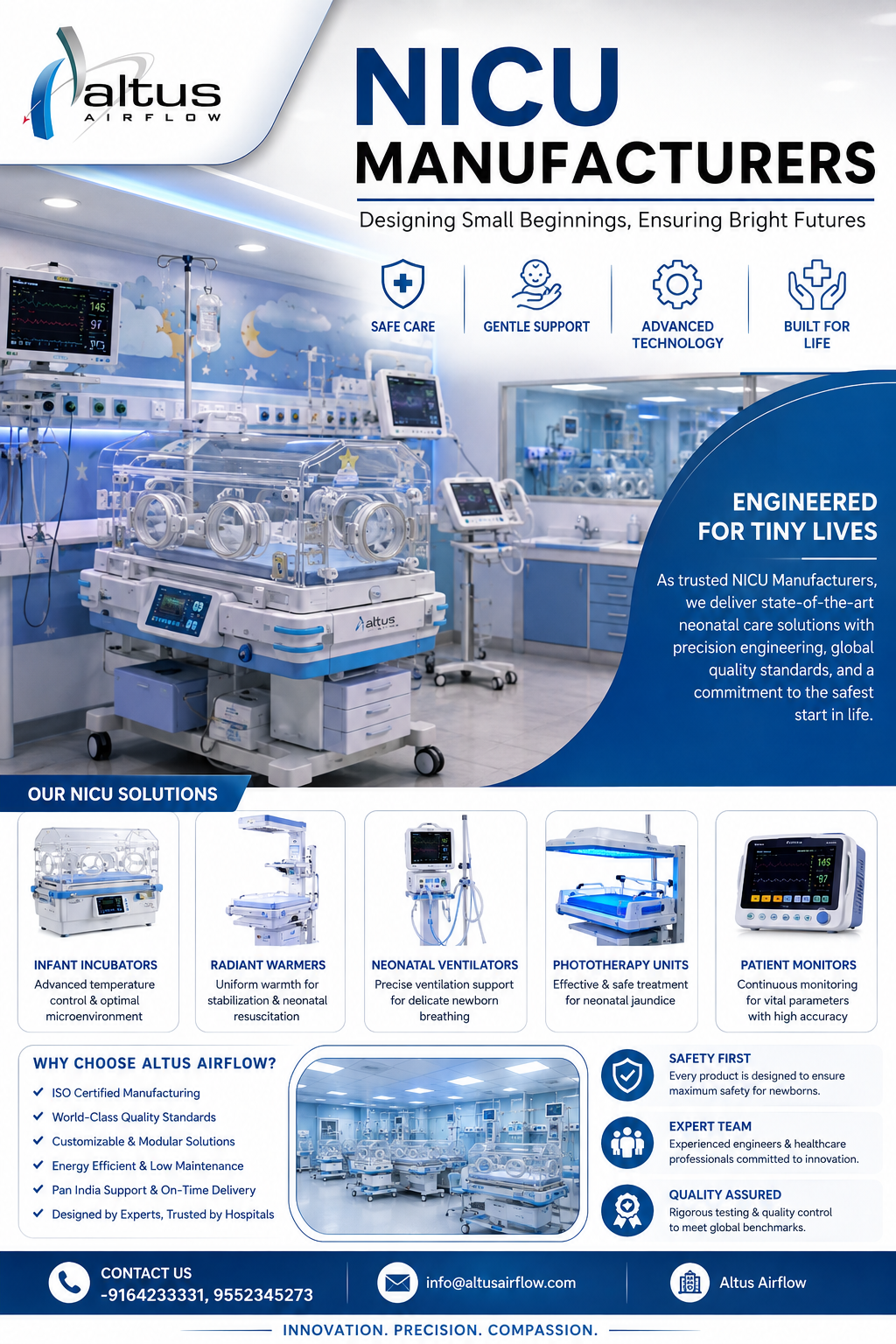
A NICU may require incubators, radiant warmers, ventilators, monitors, infusion pumps, phototherapy equipment, resuscitation equipment, and other specialized devices. The infrastructure should be planned around these requirements.
Hospitals should assess equipment positioning, electrical connections, medical gases, monitoring points, cable management, accessibility, cleaning requirements, and future equipment upgrades. The Government of India's FBNC resource page also provides technical specifications for medical devices used in Special Newborn Care Units and neonatal pediatric care ICUs.
Assess Temperature and Environmental Control
Newborns, particularly premature infants, require carefully controlled environmental conditions. NICU planning should therefore consider temperature, humidity, ventilation, air movement, lighting, and noise.
Environmental systems should be coordinated with the clinical requirements of the unit and designed so that maintenance can be performed without unnecessarily disrupting patient care. The 2025 FBNC guidelines provide updated infrastructure guidance for facility-based newborn-care services.
Review HVAC and Ventilation
Ventilation is an important component of neonatal-unit infrastructure. Hospitals should evaluate air-handling arrangements, filtration, airflow, pressure relationships where applicable, and the ability to monitor and maintain the system.
The physical structure and design of a NICU can influence infection risk. Research on NICU infection prevention identifies factors such as patient-room configuration, shared equipment, physical barriers, water systems, and air as relevant considerations.
Prioritize Infection Prevention
Infection prevention should be incorporated into the physical design rather than treated as a final-stage consideration. Hospitals should assess cleanable surfaces, hand-hygiene facilities, equipment accessibility, patient separation, waste movement, and storage arrangements.
Research involving NICUs in Pune found that structured interventions focused on hand hygiene, aseptic technique, medication preparation, and multidisciplinary teamwork can strengthen infection-prevention practices.
The design should therefore support the hospital's established infection-prevention protocols.
Consider Patient Separation
Depending on clinical requirements, the NICU may need suitable arrangements for separating patients or managing infection risks. Hospitals should consider whether the planned configuration can accommodate physical barriers, cohorting, isolation arrangements, and appropriate movement of staff and equipment.
NICU infection-prevention literature notes that multi-bed configurations can present additional transmission considerations and identifies screening, cohorting, limiting shared equipment, and physical barriers as possible risk-management measures.
Examine Medical Gas Infrastructure
Respiratory support is an important component of intensive neonatal care. Medical-gas and suction infrastructure should therefore be planned around the equipment and patient-care positions.
Hospitals should assess outlet placement, pipeline routing, accessibility, safety, capacity, and future requirements. These services should be coordinated with incubators, warmers, ventilators, monitors, and other equipment during the design stage.
Review Electrical and Backup Systems
A NICU may have multiple critical devices operating simultaneously. Electrical infrastructure should therefore provide sufficient capacity, organized connections, appropriate cable management, and suitable backup arrangements.
Hospitals should also consider how emergency power systems will support essential neonatal equipment and environmental services during power interruptions.
Support Staff Workflow
NICU healthcare teams need rapid access to patients, monitoring systems, medications, emergency equipment, supplies, and workstations. The layout should make these activities efficient while preserving clear access around each neonatal care position.
Nursing stations, storage areas, utility rooms, preparation spaces, staff facilities, and communication systems should be considered alongside the patient-care area.
Include Family-Centred Facilities
Modern newborn-care planning increasingly considers the role of parents in care. The National Health Mission promotes Mother Newborn Care Units with a goal of avoiding unnecessary separation between mothers and newborns and supporting family participation.
Hospitals should therefore consider appropriate counselling, parent access, privacy, hand hygiene, and spaces for family participation according to their clinical model.
Plan Emergency Accessibility
Emergency procedures require rapid access to newborns and essential equipment. Patient positions should be arranged so that clinicians can reach the baby without unnecessary obstruction.
Hospitals should also review transfer routes between the NICU, delivery areas, operating theatres, imaging departments, laboratories, and other services that may be required during critical situations.
Evaluate Safety Provisions
Safety should be incorporated throughout the infrastructure. Hospitals should review fire protection, emergency exits, electrical safety, equipment positioning, access routes, and emergency procedures.
The physical environment should also support safe movement of neonatal equipment and patient-care teams without creating avoidable obstacles.
Review Installation and Commissioning
NICU infrastructure involves coordination between clinical and technical teams. Architects, neonatologists, nurses, biomedical engineers, HVAC specialists, electrical teams, infection-control professionals, and hospital administrators may all contribute to the project.
Before commissioning, hospitals should verify medical gases, electrical systems, HVAC, equipment interfaces, safety provisions, and documentation. Proper commissioning can help identify infrastructure issues before clinical operations begin.
Assess Maintenance and Technical Support
Long-term reliability is an important selection criterion. Hospitals should understand preventive maintenance requirements, servicing procedures, calibration, troubleshooting, filter replacement, equipment support, and technical response arrangements.
Maintenance access should also be incorporated into the design so that essential systems can be inspected or serviced without unnecessarily affecting neonatal care.
Consider Future Adaptability
Neonatal technology and hospital requirements can evolve. New monitoring systems, respiratory-support equipment, additional beds, or revised clinical workflows may be required in the future.
Hospitals should therefore assess whether the infrastructure can accommodate reasonable modifications, additional utility requirements, and equipment upgrades without requiring extensive reconstruction.
Review Documentation and Handover
A complete project should include appropriate technical documentation. Hospitals should review drawings, utility layouts, equipment specifications, HVAC information, commissioning records, maintenance requirements, and operating instructions.
Clear documentation can help biomedical and engineering teams maintain the infrastructure and understand how different systems are integrated.
Compare the Complete Solution
Hospitals should avoid selecting a NICU solution based on one feature alone. Layout, equipment integration, environmental control, HVAC, infection prevention, medical gases, electrical systems, family facilities, safety, commissioning, maintenance, and future adaptability should be assessed together.
This approach provides a more practical basis for comparing proposed solutions against the hospital's clinical and technical requirements.
Conclusion
Hospitals selecting neonatal infrastructure should look for solutions that combine clinical functionality with carefully coordinated building services. NICU Manufacturers should be evaluated on their ability to address layout, neonatal equipment integration, environmental control, ventilation, infection prevention, medical gases, electrical systems, emergency access, family participation, maintenance, and future adaptability. The Government of India's 2025 Facility Based Newborn Care Operational Guidelines provide an important current reference for planning newborn-care services and infrastructure. A systematic evaluation can help hospitals develop a safer, functional, and adaptable environment for specialized neonatal care.
FAQs
1. What should hospitals look for when selecting NICU infrastructure?
Hospitals should evaluate layout, neonatal equipment integration, ventilation, environmental control, infection prevention, medical gases, electrical systems, emergency access, maintenance, and future adaptability.
2. Why is NICU layout important?
A suitable layout provides adequate space around neonatal care positions, supports staff movement, facilitates equipment access, and helps clinicians respond efficiently to patient needs.
3. How does infection prevention influence NICU design?
NICU design can influence cleaning, hand hygiene, patient separation, equipment sharing, air movement, and workflow. These factors should be incorporated into infrastructure planning.
4. Why should hospitals consider family facilities?
Family participation can be an important part of newborn care. The National Health Mission promotes Mother Newborn Care Units and family participation approaches designed to reduce unnecessary separation of mothers and newborns.
5. Why is future adaptability important for a NICU?
Neonatal equipment and clinical requirements can change. Flexible infrastructure can make it easier to accommodate new equipment, additional utility requirements, and changes in patient-care workflows.
Read Our Previous Blog-----------> Why Choose Trusted Modular OT Manufacturers for Hospitals?

 English
 Arabic
 French
 Spanish
 Portuguese
 Deutsch
 Turkish
 Italiano
 Russian
 Romaian
 Portuguese (Brazil)
 Greek
Greek