


How Does Toolholder Length Affect CNC Machining Performance and Stability?
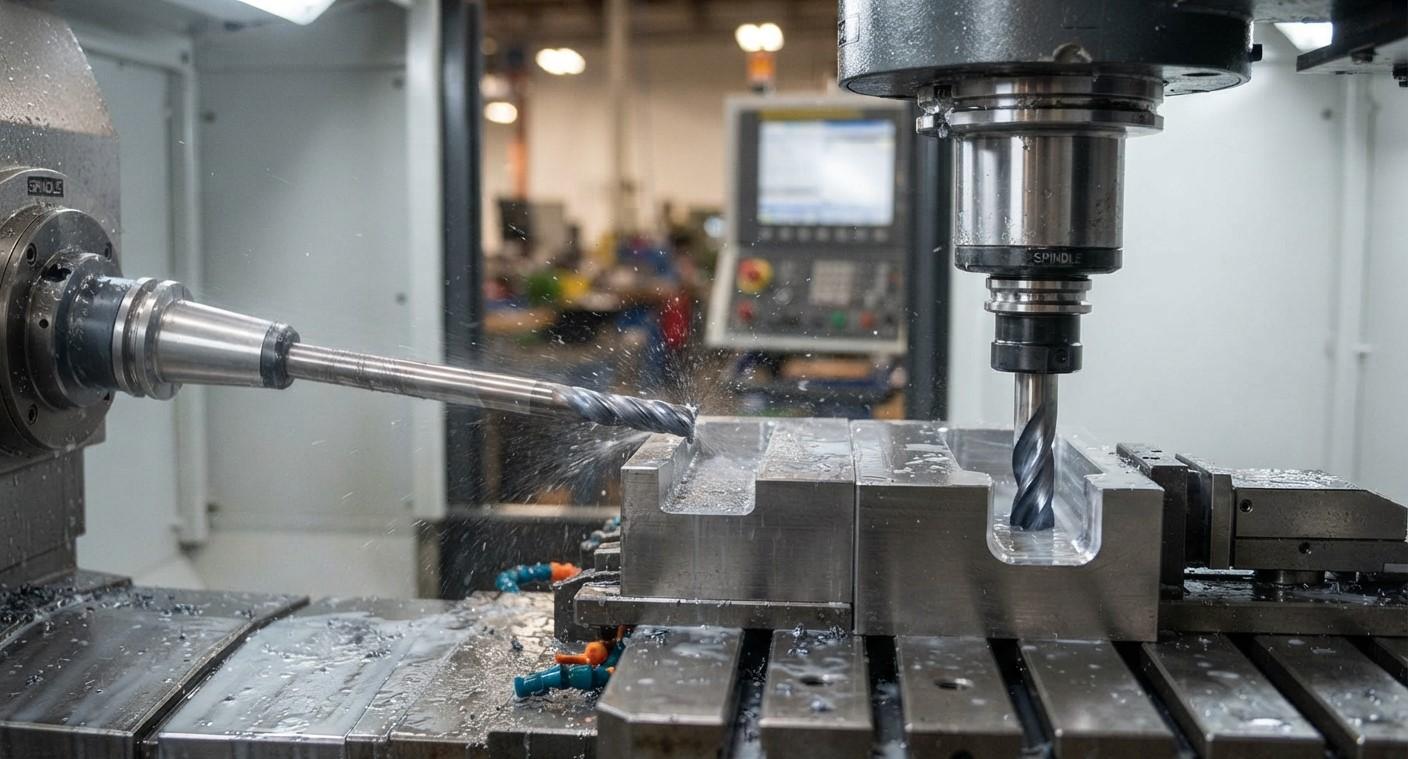
Toolholder length plays an important role in CNC machining performance, accuracy, and stability. While a longer toolholder or tool assembly may sometimes be necessary to reach deep pockets, cavities, and difficult-to-access features, excessive length can reduce rigidity and increase the risk of vibration and tool deflection.
The relationship between toolholder length and machining stability is especially important when performing precision milling, deep-pocket machining, high-speed machining, and operations involving small-diameter cutting tools.
A properly selected toolholder should provide enough reach for the machining application while keeping unnecessary projection to a minimum. As an experienced Industrial Tools Supplier in Dubai, Khokhawala Trading LLC understands the importance of selecting suitable tooling for different CNC machining requirements.
This article explains how toolholder length affects CNC machining and how workshops can select the right length for better stability, accuracy, and productivity.
Table of Contents
-
What Is Toolholder Length?
-
Why Does Toolholder Length Matter?
-
How Toolholder Length Affects Rigidity
-
Toolholder Length and Tool Deflection
-
How Long Toolholders Cause Vibration and Chatter
-
Effect on CNC Machining Accuracy
-
Effect on Surface Finish and Tool Life
-
How to Choose the Right Toolholder Length
-
Tips for Improving Stability With Long Toolholders
-
Common Mistakes to Avoid
-
Frequently Asked Questions
-
Conclusion and CTA
What Is Toolholder Length?
Toolholder length refers to the length of the toolholding assembly extending from the machine spindle toward the cutting tool.
Depending on the tooling system, this can include the holder body, collet or clamping mechanism, and the cutting tool itself.
It is important to distinguish between overall tool length and unsupported tool projection. For machining stability, the unsupported portion between the effective clamping point and the cutting area is particularly important.
A longer unsupported section behaves more flexibly under cutting forces. This is why reducing unnecessary tool projection is one of the simplest ways to improve machining stability.
Why Does Toolholder Length Matter?
CNC machining generates cutting forces whenever the tool engages with the workpiece. These forces can cause the tool assembly to bend or vibrate.
A shorter and more rigid assembly generally resists these forces better.
A long toolholder assembly can result in:
-
Increased tool deflection
-
Reduced rigidity
-
Greater vibration
-
Chatter
-
Poor surface finish
-
Dimensional inaccuracies
-
Uneven tool wear
-
Reduced tool life
-
Lower allowable cutting parameters
Research and machining guidance commonly model the cutting tool as a cantilever-like structure, where increasing unsupported length has a strong effect on deflection. In simplified beam models, deflection increases approximately with the cube of unsupported length, making unnecessary length particularly costly in terms of rigidity.
How Toolholder Length Affects Rigidity
Rigidity is the ability of the machining system to resist deformation when cutting forces are applied.
When the toolholder and cutting tool are short and well supported, cutting forces have less leverage to bend the assembly.
When the assembly becomes longer, the same cutting force can produce significantly more deflection.
For example, imagine holding a ruler close to one end. It is relatively difficult to bend. Move the holding point farther toward the middle and the free section becomes easier to move.
The same basic principle applies to a CNC cutting tool.
Short Toolholder Assembly
A shorter assembly generally provides:
-
Higher stiffness
-
Better cutting stability
-
Lower deflection
-
Reduced vibration
-
More consistent dimensions
Long Toolholder Assembly
A longer assembly can produce:
-
Greater flexibility
-
Increased deflection
-
Higher sensitivity to cutting forces
-
Greater chatter risk
-
Reduced machining stability
Therefore, the shortest practical toolholder and tool combination is generally preferred when the machining geometry allows it.
Toolholder Length and Tool Deflection
Tool deflection occurs when cutting forces cause the tool or toolholder assembly to bend away from its intended position.
This can create problems because the cutting edge is no longer exactly where the CNC program expects it to be.
A simplified cantilever-beam relationship can be expressed as:
Deflection ∝ Length³
This means that increasing unsupported length can have a disproportionately large effect on deflection.
For example, if the unsupported length is doubled while other factors remain the same, the simplified model predicts a much larger increase in deflection rather than merely twice the deflection.
Actual CNC machining behavior is more complex because tool diameter, material, holder stiffness, spindle dynamics, cutting forces, runout, workholding, and tool geometry also influence the result.
How Long Toolholders Cause Vibration and Chatter
Long toolholder assemblies can become more sensitive to vibration.
During machining, the cutting tool experiences constantly changing forces as the flutes enter and leave the workpiece. If the tool assembly is too flexible, these forces can cause it to oscillate.
This can develop into chatter.
Common Signs of Chatter
Operators may notice:
-
Loud or unusual cutting noise
-
Visible vibration
-
Wavy marks on machined surfaces
-
Poor surface finish
-
Inconsistent dimensions
-
Rapid cutting-edge wear
-
Tool chipping or breakage
Extended toolholders are particularly challenging when machining deep cavities, narrow spaces, or complex surfaces because the required reach can reduce overall system stiffness.
Effect on CNC Machining Accuracy
Toolholder length can directly influence dimensional accuracy.
When a long assembly deflects under cutting load, the cutting edge may move away from the programmed toolpath.
This can lead to:
Oversized or Undersized Features
Pockets, slots, walls, and other features may not achieve the programmed dimensions.
Tapered Walls
Tool deflection can cause the cutting tool to remove different amounts of material at different depths.
Inaccurate Pocket Dimensions
Deep pockets are especially sensitive because they often require longer tool assemblies.
Poor Hole Quality
Long drilling or boring setups can become more susceptible to deflection and vibration.
For precision components, controlling toolholder length is therefore an important part of maintaining repeatable machining accuracy.
Effect on Surface Finish and Tool Life
Long toolholder assemblies can also affect surface quality and cutting tool life.
When vibration and deflection occur, the cutting edges may experience uneven loading.
This can cause:
-
Uneven flank wear
-
Edge chipping
-
Premature tool failure
-
Increased heat generation
-
Poor surface finish
-
Shorter tool life
A shorter, more rigid assembly can help create more consistent cutting conditions.
Reducing unnecessary tool projection is widely recommended as a practical way to improve stability, reduce chatter, and support better tool life and surface finish.
How to Choose the Right Toolholder Length
Selecting the correct length requires balancing accessibility with rigidity.
1. Start With the Workpiece Geometry
Determine the actual depth and location of the feature that needs to be machined.
Do not automatically select an extra-long holder simply because the workpiece contains a deep cavity.
2. Use the Shortest Practical Assembly
Choose a holder and cutting tool combination that reaches the required area without unnecessary extension.
Every additional amount of unsupported length can reduce stiffness.
3. Consider Tool Diameter
Tool diameter has a major influence on rigidity.
A larger-diameter tool is generally more resistant to bending than a smaller-diameter tool of similar unsupported length.
When geometry allows, selecting an appropriate larger-diameter tool can improve stability.
4. Consider the Cutting Operation
Roughing and finishing may require different tooling strategies.
Heavy roughing generates higher cutting forces and generally benefits from a rigid setup.
Finishing operations may require low runout and stable tool positioning to achieve the required surface quality.
5. Consider Spindle Speed
High-speed machining requires attention to the complete rotating assembly.
Longer assemblies can become more sensitive to dynamic imbalance and vibration, so the toolholder should be suitable for the intended spindle speed.
6. Check Workpiece and Fixture Clearance
The shortest holder is not always the best choice if it causes interference with the workpiece, fixture, or machine components.
There must be sufficient clearance throughout the complete toolpath.
7. Consider Deep-Cavity Requirements
When deep machining is unavoidable, specialized long-reach tooling may be required.
In these situations, consider:
-
Rigid toolholder designs
-
Appropriate tool diameter
-
Reduced cutting forces
-
Suitable cutting parameters
-
Shortest possible practical reach
-
Stable toolpaths
Tips for Improving Stability With Long Toolholders
Sometimes long reach cannot be avoided. Deep molds, cavities, pockets, and complex components may require extended tooling.
In such cases, the following practices can help.
Reduce Cutting Forces
If the long assembly becomes unstable, review the cutting parameters and reduce the load where appropriate.
Use Smaller Radial Engagement
Reducing radial engagement can help control cutting forces in certain applications.
Adjust Feed and Speed
Changing spindle speed or feed rate may help move the operation away from an unstable vibration condition.
Reduce Tool Projection Where Possible
Even when a long tool is required, avoid extending it farther than necessary.
Use Appropriate Tool Geometry
Tools designed for deep machining may provide better clearance and stability than standard tools with excessive extension.
Improve Workholding
The workpiece must also be rigidly supported. A rigid tool assembly cannot compensate for a flexible or poorly secured workpiece.
Check Toolholder Runout
A long tool assembly combined with excessive runout can make machining instability worse.
Regular runout checks can help identify problems within the toolholding system.
Common Mistakes to Avoid
Using Excessive Tool Length
Selecting a long tool “just in case” can reduce rigidity unnecessarily.
Ignoring Tool Diameter
A long, small-diameter tool may be significantly more flexible than a shorter, larger-diameter option.
Using the Same Holder for Every Operation
Different machining operations have different reach and rigidity requirements.
Increasing Cutting Parameters Without Considering Rigidity
A cutting condition that works well with a short holder may become unstable when used with a longer assembly.
Ignoring Chatter
Continuing to machine while significant chatter is present can damage the cutting tool, workpiece, and potentially the machine.
Focusing Only on the Toolholder
Machining stability depends on the entire system:
Machine → Spindle → Toolholder → Cutting Tool → Workpiece → Fixture
Problems in any part of this chain can affect machining performance.
Frequently Asked Questions
1. How does toolholder length affect CNC machining?
Longer toolholder assemblies generally reduce rigidity and increase sensitivity to deflection and vibration. This can affect accuracy, surface finish, tool life, and machining stability.
2. Is a shorter toolholder always better?
A shorter practical assembly is generally preferred for rigidity, but it must still provide enough reach and clearance for the required machining operation.
3. Why does a long toolholder cause chatter?
A longer unsupported assembly is more flexible and can respond more strongly to changing cutting forces. Under certain conditions, this can produce vibration and chatter.
4. Does tool diameter affect toolholder stability?
Yes. Tool diameter strongly influences bending stiffness. Larger-diameter tools are generally more resistant to deflection than smaller-diameter tools with similar unsupported lengths.
5. How can I improve stability when using a long toolholder?
Use the shortest practical extension, select an appropriate tool diameter and holder, reduce cutting forces when necessary, control vibration, check runout, and ensure the workpiece is properly supported.
6. Does toolholder length affect surface finish?
Yes. Excessive length can increase deflection and vibration, which may produce chatter marks, uneven surfaces, and inconsistent finishing results.
7. Can a long toolholder reduce tool life?
Yes. Increased vibration and uneven cutting loads can accelerate tool wear and edge damage, potentially reducing tool life.
8. When is a long toolholder necessary?
Long toolholders may be necessary when machining deep cavities, deep pockets, internal features, or areas that cannot be reached with standard tooling. In these situations, the goal should be to achieve the required reach while maintaining as much rigidity as possible.
Conclusion
Toolholder length is an important factor in CNC machining performance and stability. While additional length can provide the reach needed for deep and complex machining operations, unnecessary tool projection can reduce rigidity and increase the risk of deflection, vibration, chatter, dimensional errors, and premature tool wear.
The best approach is to use the shortest practical toolholder and tool assembly that can safely reach the required machining area. Tool diameter, cutting conditions, spindle speed, holder design, runout, workholding, and workpiece geometry should also be considered as part of the complete machining system.
For workshops and manufacturing businesses, choosing the right industrial tooling can make a significant difference in machining reliability and productivity. Khokhawala Trading LLC, as an Industrial Tools Supplier in Dubai, can help businesses identify suitable tooling solutions for different CNC machining applications.
CTA
Looking for the right toolholder for your CNC machining application?
Contact Khokhawala Trading LLC, your trusted Industrial Tools Supplier in Dubai, to discuss your tooling requirements and find suitable solutions for improved machining stability, accuracy, tool life, and productivity.

 English
 Arabic
 French
 Spanish
 Portuguese
 Deutsch
 Turkish
 Dutch
Dutch
 Italiano
 Russian
 Portuguese (Brazil)
 Greek
Greek