


Inside the Science of Lab-Grown Diamond Jewelry
Diamonds have always attracted attention for their brilliance, durability, and rarity. Yet not every diamond begins its journey deep beneath Earth's surface. Advances in gemstone production now allow laboratories to create authentic diamonds under carefully controlled conditions.
Among these techniques, hpht diamonds have become a notable option for jewelry buyers. They offer the same fundamental properties as mined diamonds, but their formation takes place inside specialized equipment rather than underground.
Understanding their production, appearance, and quality can help shoppers make informed choices without relying on marketing claims.
The Science Behind High-Pressure Diamond Growth
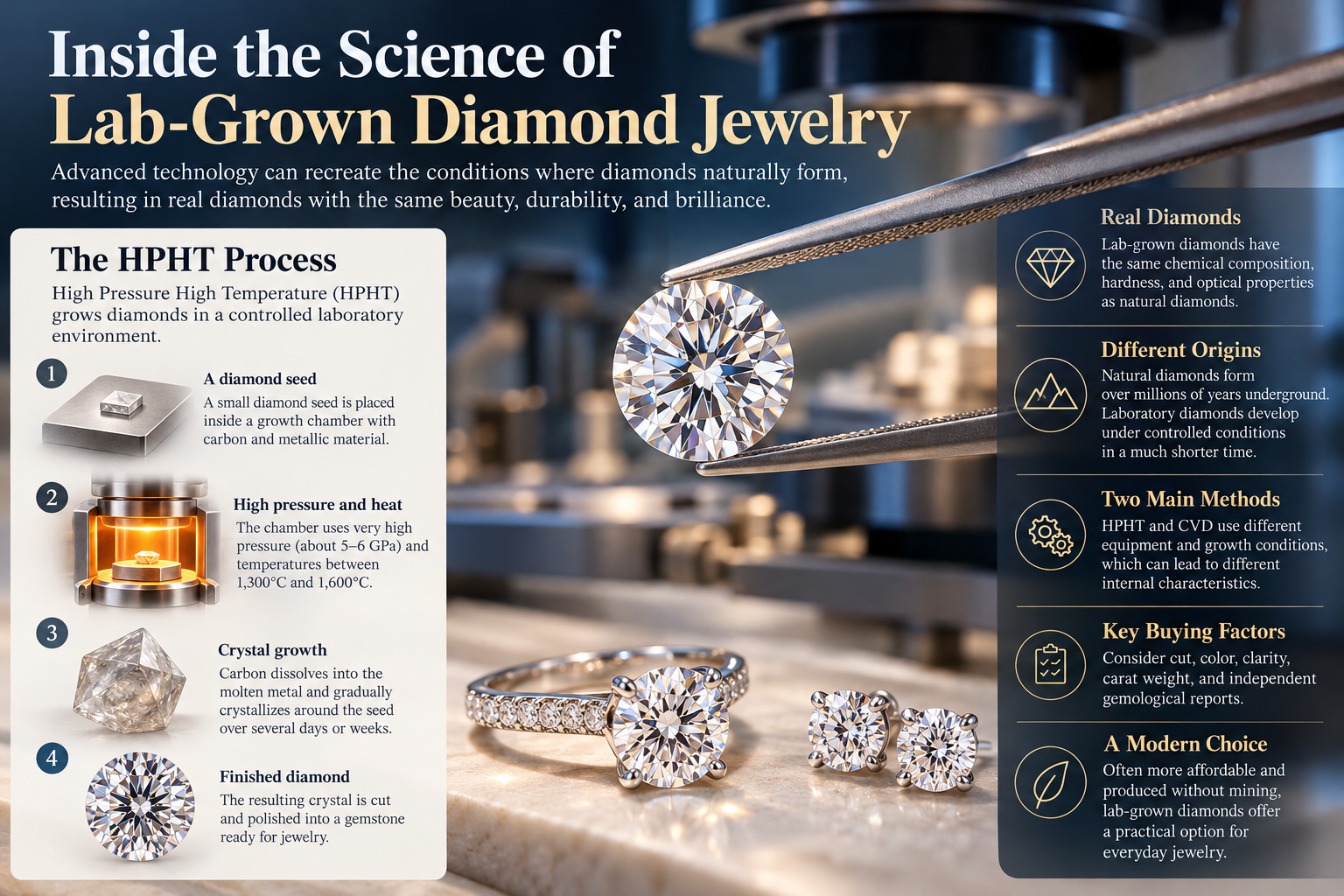
HPHT stands for High Pressure High Temperature. The process recreates some of the intense conditions associated with natural diamond formation.
Technicians place a small diamond seed inside a growth chamber containing a carbon source and metallic material. The equipment applies pressures of approximately 5 to 6 gigapascals and temperatures between 1,300°C and 1,600°C.
Under these conditions, carbon dissolves into the molten metal and gradually crystallizes around the seed. Over several days or weeks, the growing crystal becomes large enough for cutting and polishing.
According to the Gemological Institute of America (GIA), this method can produce both colorless and colored diamonds. Precise control over the growth environment helps determine the resulting crystal's characteristics.
Are Laboratory Diamonds Different From Natural Diamonds?
The main distinction lies in their origin, not their chemical composition.
Natural diamonds form through geological processes over extremely long periods. Laboratory-grown diamonds develop under controlled conditions in considerably less time.
Both consist of crystallized carbon and share a hardness of 10 on the Mohs scale. Their optical properties also allow them to produce the familiar brilliance associated with diamond jewelry.
Unlike cubic zirconia or moissanite, man made diamonds are genuine diamonds rather than imitation gemstones.
However, laboratory production can leave microscopic characteristics that differ from those found in natural stones. Gemologists use specialized instruments to identify these features and establish a diamond's origin.
HPHT and CVD: Two Different Production Methods
High-pressure growth is not the only technique used to create diamonds.
Chemical Vapor Deposition, commonly called CVD, grows diamond crystals inside a chamber filled with carbon-containing gas. Energy breaks down the gas molecules, allowing carbon to accumulate on a diamond seed.
The two methods differ in their equipment, growth conditions, and potential crystal characteristics.
Why Growth Methods Matter
HPHT-grown stones may contain tiny metallic inclusions originating from materials used during production. Some also exhibit distinctive fluorescence or phosphorescence under ultraviolet light.
CVD diamonds may display different internal growth patterns and occasionally require additional treatment to improve their color.
Neither technique automatically produces a better gemstone. Cut quality, clarity, color, and individual crystal characteristics remain more useful indicators of a diamond's suitability for jewelry.
What Buyers Should Examine Before Purchasing
Selecting hpht diamonds involves many of the same considerations as buying mined gemstones. A diamond's appearance depends on more than its production method.
Several details deserve attention:
-
Cut: Well-proportioned facets influence brilliance, sparkle, and light reflection.
-
Color: The grading scale helps buyers compare colorless and near-colorless stones.
-
Clarity: Internal inclusions and surface blemishes can affect appearance and grading.
-
Carat weight: Larger stones generally cost more, although quality also influences pricing.
-
Documentation: Independent gemological reports provide useful information about origin and characteristics.
For example, a well-cut 1-carat laboratory diamond may appear more brilliant than a poorly cut 1.5-carat stone.
Buyers should also distinguish between HPHT growth and HPHT treatment. The same technology can improve the color of an existing diamond, including one formed naturally.
These are separate processes, and reputable sellers should disclose relevant treatments.
Price, Sustainability, and Everyday Wear
Laboratory-grown diamonds often cost less than comparable natural diamonds at retail. Their production does not depend on extracting finished gemstones from geological deposits.
Still, laboratory manufacturing consumes electricity and requires specialized equipment. Environmental impacts vary depending on energy sources, production efficiency, and supply chains.
Claims about carbon neutrality or environmental superiority deserve supporting evidence rather than assumptions.
For everyday jewelry, durability is another practical consideration. Laboratory diamonds resist scratching just as natural diamonds do, although both can chip following a sufficiently hard impact.
Secure settings and routine inspections help protect rings, earrings, and pendants during regular use.
Choosing a Diamond That Fits Your Priorities
A thoughtful purchase starts with comparing actual stones instead of focusing exclusively on their origin. Examine the cut, review available grading information, and consider how the diamond looks under different lighting.
For shoppers interested in man made diamonds, the HPHT method offers a scientifically established alternative to mined gemstones. Its appeal comes from authentic diamond properties, controlled production, and a wider range of purchasing options.
Ultimately, the right choice is a well-documented stone that matches your budget, preferred design, and expectations for long-term wear.

 English
 Arabic
 French
 Spanish
 Portuguese
 Deutsch
 Dutch
Dutch
 Italiano
 Russian
 Romaian
 Portuguese (Brazil)
 Greek
Greek