


How Asia Pacific Is Supporting Natural Food Colors Market Expansion
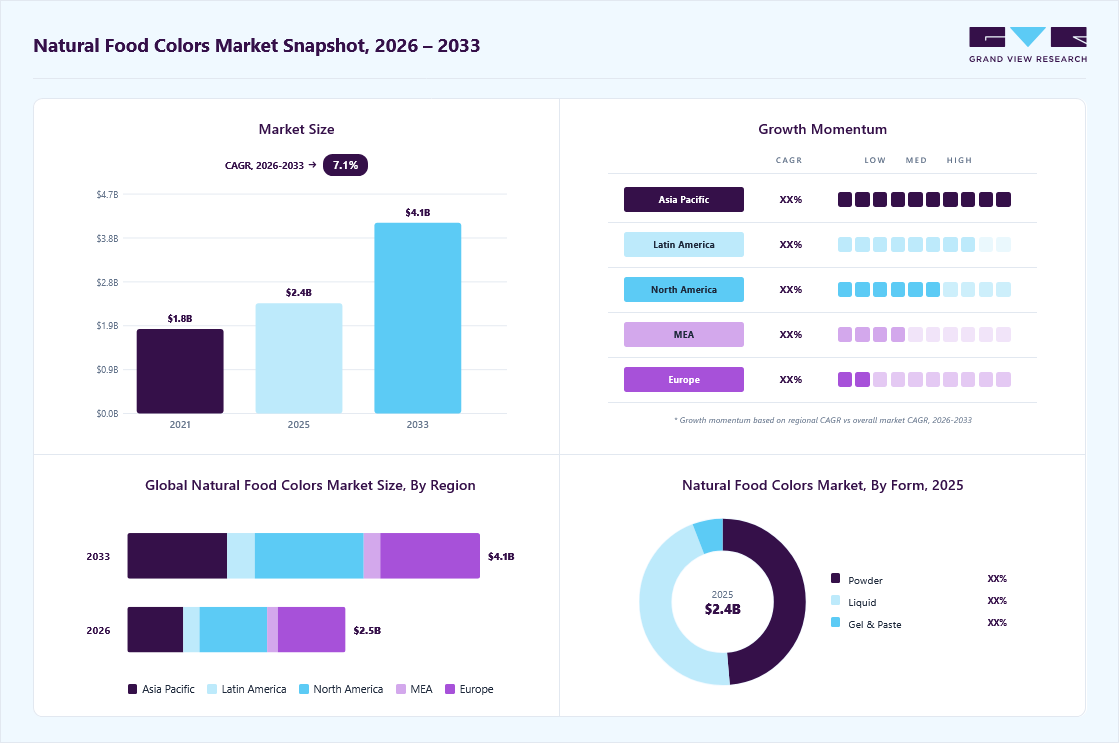
Food and beverage manufacturers are increasingly exploring naturally derived ingredients to meet changing consumer expectations around food quality, transparency, and product formulation. Natural food colors extracted from fruits, vegetables, plants, and other natural sources help create appealing products while supporting clean-label positioning. From beverages and confectionery to dairy products and snacks, these colorants are becoming an important part of food product development. The natural food colors market was valued at USD 2.3 billion in 2025 and is projected to grow from USD 2.5 billion in 2026 to USD 4.1 billion by 2033, registering a compound annual growth rate (CAGR) of 7.1% from 2026 to 2033.
Clean-Label Preferences Encourage Natural Alternatives
Growing consumer interest in recognizable ingredients is encouraging food manufacturers to reconsider the color additives used in their products. Concerns about synthetic dyes, alongside increased attention to health and wellness, are supporting demand for colorants derived from natural sources. Regulatory scrutiny of synthetic colors is also encouraging manufacturers to evaluate alternative ingredients.
Natural food colors are used to improve the appearance of products without relying exclusively on artificial colorants. However, selecting an appropriate ingredient requires manufacturers to consider color intensity, stability, processing conditions, and compatibility with the final product. Improvements in extraction and stabilization technologies are helping expand the applications of natural pigments across different food categories.
Beta Carotene Leads Ingredient Demand
Beta carotene accounted for 20.2% of market revenue in 2025, making it the leading ingredient segment. Its orange-yellow color makes it suitable for applications such as beverages, bakery products, and dairy products. Beta carotene also functions as a provitamin A carotenoid, giving it relevance in food formulations that emphasize nutritional value alongside appearance.
Blue spirulina is expected to be the fastest-growing ingredient segment, registering a CAGR of 8.9% from 2026 to 2033. Its distinctive blue color offers manufacturers an alternative to synthetic blue pigments, particularly in smoothies, confectionery, and visually distinctive food and beverage products. Its use in colorful and wellness-oriented products is creating additional opportunities for ingredient suppliers.
Powdered Colors Maintain Their Leading Position
Powdered natural food colors held 48.6% of market revenue in 2025. Their storage convenience, handling characteristics, and suitability for large-scale manufacturing make them attractive to food producers. Compared with liquid formats, powders can offer advantages in transportation and inventory management, depending on the formulation and application.
Gel and paste formats are projected to grow at a CAGR of 7.9% through 2033. These concentrated formats are particularly useful in bakery and confectionery products, where manufacturers need precise coloring and vibrant finishes. Their ability to deliver strong pigmentation with relatively small quantities can support detailed decoration and specialized product designs.
Beverages Lead Application Demand
The beverages segment accounted for 26.3% of market revenue in 2025, making it the leading application category. Natural colors help beverage producers develop attractive products across a range of formulations, including juices, flavored drinks, and other beverages. As consumers pay greater attention to ingredient lists, manufacturers are exploring natural color solutions that align with product positioning and formulation requirements.
Meat alternatives and plant-based meat applications are projected to grow at a CAGR of 8.0% from 2026 to 2033. Natural colors can help these products achieve appearances that resemble conventional meat or provide distinctive visual characteristics. This creates opportunities for color suppliers to develop ingredients tailored to emerging food categories.
Europe Leads While Asia Pacific Gains Momentum
Europe accounted for 31.4% of market revenue in 2025, supported by consumer interest in health and wellness and demand for products formulated without artificial colors. Food safety standards and retailer preferences for clean-label claims are encouraging manufacturers to consider colorants derived from fruits, vegetables, and spices.
Asia Pacific is projected to grow at a CAGR of 8.6% from 2026 to 2033. Agricultural resources, expanding food and beverage industries, and growing awareness of naturally sourced ingredients are supporting regional opportunities. China and India are important markets for botanical colorants, while manufacturers across the region are responding to changing product preferences.
Innovation Shapes Competitive Strategies
Natural food color manufacturers must manage challenges related to pigment stability, raw material availability, processing conditions, and production costs. Continued investment in extraction methods, formulation technology, and reliable sourcing can help suppliers address these requirements.
Overall, the natural food colors market is expected to expand as clean-label preferences and product innovation influence food manufacturing. Blue spirulina, specialized coloring formats, and emerging applications such as plant-based meat are likely to remain important areas of opportunity through 2033.
Frequently Asked Questions
1. How big is the natural food colors market?
The market was valued at USD 2.3 billion in 2025 and is projected to reach USD 4.1 billion by 2033, growing at a CAGR of 7.1% from 2026 to 2033.
2. Which ingredient segment is expected to grow fastest?
Blue spirulina is expected to be the fastest-growing ingredient segment, with a CAGR of 8.9% from 2026 to 2033.
Key Natural Food Colors Companies:
· BASF
· Archer Daniels Midland Company (ADM)
· San-Ei Gen F.F.I., Inc.
· GNT Group (EXBERRY)
About us:
Grand View Research, a market research and consulting company, provides syndicated research reports, customized research reports, and consulting services. Grand View Research database is used by the world's renowned academic institutions and Fortune 500 companies to understand the global and regional business environment. Our database features thousands of statistics and in-depth analysis on 46 industries in 25 major countries worldwide.

 English
 Arabic
 French
 Spanish
 Portuguese
 Turkish
 Dutch
Dutch
 Italiano
 Russian
 Romaian
 Portuguese (Brazil)
 Greek
Greek