


Permanent Magnet Motor Market Growth Forecast Targets USD 161.9 Billion by 2036, South Korea - CAGR 12.1%, United Kingdom - CAGR 11.8%, China - CAGR 11.1%
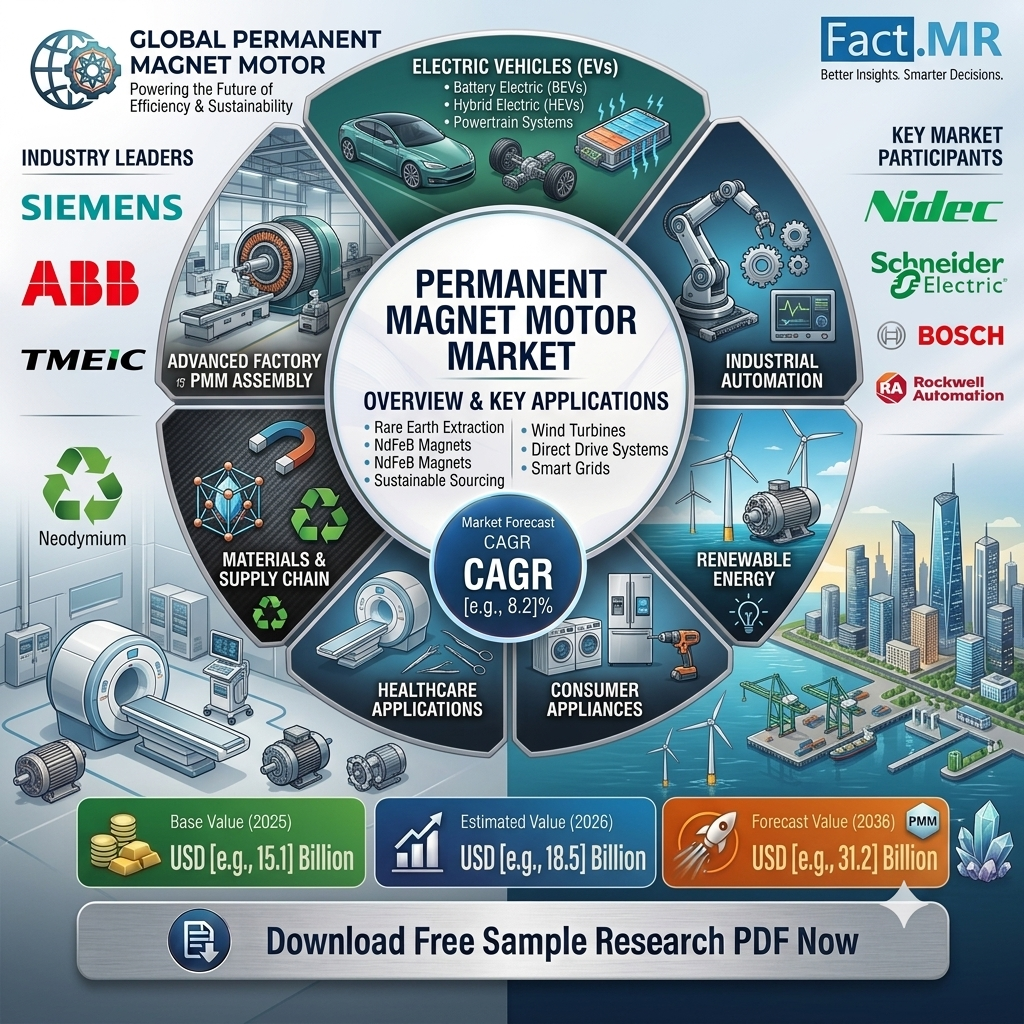
The permanent magnet motor market is forecast to expand from USD 60.2 billion in 2026 to USD 161.9 billion by 2036, registering a 10.4% CAGR over the forecast period. Fact.MR attributes this expansion to rising electric vehicle production, industrial energy-efficiency requirements, and increasing investments in renewable energy infrastructure. Permanent magnet motors are gaining importance across automotive, industrial automation, wind energy, HVAC systems, and precision motion control because of their efficiency, compact design, and power density.
Industrial electrification and stricter motor-efficiency requirements are creating additional demand across manufacturing, water management, mining, and logistics. The transition toward electric vehicles is also increasing requirements for traction motors that deliver high torque and efficient power conversion. Meanwhile, offshore wind projects and industrial automation investments are expanding the need for permanent magnet motor and generator technologies.
Get detailed market forecasts, competitive benchmarking, and pricing trends:
https://www.factmr.com/connectus/sample?flag=S&rep_id=14338
AC Permanent Magnet Motors Retain Leading Position
By motor type, alternating current (AC) motors are expected to account for 53.2% of the permanent magnet motor market in 2026. Their compatibility with variable-frequency drives, high efficiency, and suitability for continuous industrial operations support adoption across manufacturing, electric vehicle traction, and wind energy applications. Brushless operation and reduced maintenance requirements further strengthen their position in applications requiring dependable performance.
Direct current motors remain part of the market, serving applications that require specific speed-control and motion characteristics. However, AC permanent magnet synchronous motors are increasingly relevant in high-growth applications where energy efficiency, torque density, and integration with electronic drive systems influence purchasing decisions.
By magnetic material type, ferrite magnets are projected to hold a 36.2% share in 2026. Their comparatively low cost and reduced exposure to rare-earth supply fluctuations support demand in cost-sensitive applications, including HVAC fan drives, small appliances, and general industrial pumps. Neodymium and samarium cobalt magnets serve applications where higher magnetic performance or temperature resistance is important.
Automotive is the leading end-user vertical, accounting for 37.4% of market share in 2026. Electric vehicle traction systems are a major source of demand as manufacturers expand vehicle electrification and invest in motor production. Permanent magnet motors are also used in industrial equipment, energy systems, water and wastewater management, mining, oil and gas, and aerospace applications.
South Korea, United Kingdom, and China Show Strong Growth Potential
South Korea is projected to record a 12.1% CAGR from 2026 to 2036, the fastest growth among the countries assessed in the report. Expansion of electric vehicle platforms and vertically integrated automotive supply chains is supporting demand for permanent magnet motors. The country's automotive manufacturing capabilities and investment in electric vehicle components are strengthening its position in the global motor industry.
The United Kingdom is expected to advance at an 11.8% CAGR through 2036. Offshore wind development and electric vehicle manufacturing are important demand drivers. Permanent magnet generators are relevant to wind energy projects because they can support direct-drive configurations, while automotive electrification is creating additional requirements for high-performance traction motors. Investment in renewable energy infrastructure is expected to support further opportunities for motor manufacturers.
China is forecast to register an 11.1% CAGR during the same period. Its large electric vehicle market, established manufacturing base, and integration of rare-earth processing and magnet production support demand. Growing adoption of electric vehicles and industrial efficiency improvements are reinforcing the country's role in permanent magnet motor production and consumption.
The United States is projected to grow at a 10.7% CAGR through 2036. Domestic manufacturing incentives, electric vehicle supply-chain investments, and industrial electrification are supporting market development. Japan is expected to register an 8.8% CAGR, with demand linked to precision automation, robotics, advanced manufacturing, and industrial motor applications.
Competitive Landscape
Competition in the permanent magnet motor market includes established manufacturers with capabilities spanning motor design, drive systems, industrial automation, and electric vehicle applications. Key companies profiled by Fact.MR include ABB Limited, Siemens AG, Nidec Corporation, Yaskawa Electric Corporation, Mitsubishi Electric Corporation, Rockwell Automation, and WEG Electric Corp. Other companies covered include Franklin Electric Company Inc., Allied Motion Technologies Inc., NORD Drivesystems, Toshiba Corporation, Regal Beloit Corporation, Johnson Electric Holdings Limited, and Maxon Motor AG.
Competitive positioning is increasingly influenced by motor efficiency, product reliability, magnet sourcing, manufacturing scale, and integration with electronic drive systems. Automotive manufacturers and industrial buyers also evaluate operating costs, lifecycle performance, and supply-chain reliability. Access to permanent magnet materials is an important consideration because fluctuations in rare-earth prices can affect manufacturing costs and procurement strategies.
Technology and Regulatory Developments Shape the Market
The market is being influenced by industrial motor-efficiency requirements, electric vehicle policies, and renewable energy investment. European Ecodesign requirements are encouraging industrial users to assess higher-efficiency motor technologies, while electric vehicle manufacturing initiatives are supporting investment in traction motor capacity. Offshore wind development is creating further opportunities for permanent magnet generators designed for demanding operating conditions.
Supply-chain considerations remain important as manufacturers seek to manage exposure to rare-earth price volatility and material availability. Investment in alternative magnet designs, improved motor efficiency, and magnet recycling could help manufacturers address cost and sourcing challenges. Developments in drive electronics and motor design are also creating opportunities to improve performance while managing material requirements.
As electric mobility, industrial automation, and renewable energy infrastructure continue to develop, permanent magnet motors are expected to remain important to high-efficiency power and motion systems. Fact.MR's report provides detailed market forecasts, segment analysis, country-level growth projections, and competitive assessments through 2036.
Top Reports:
https://bolworld.com/blogs/65987/Classified-Platform-Market-Set-to-Grow-at-10-9-CAGR
https://gulfsena.com/blogs/105287/Classified-Platform-Market-Set-to-Hit-USD-48-3-Billion
https://mybuddis.com/read-blog/21498
https://ns2.skemsys.com/blogs/view/26229
About Fact.MR
Fact.MR is a market research and consulting company providing market intelligence, competitive analysis, and forecasting across global industries. Its research supports businesses with data-driven insights into emerging markets, technology trends, competitive dynamics, regional opportunities, and changing demand patterns.

 English
 French
 Spanish
 Portuguese
 Deutsch
 Turkish
 Dutch
Dutch
 Italiano
 Russian
 Romaian
 Portuguese (Brazil)
 Greek
Greek