


How Can an App Development Company in Dubai Turn Your MVP into a Full App? | DeviceBee Technologies
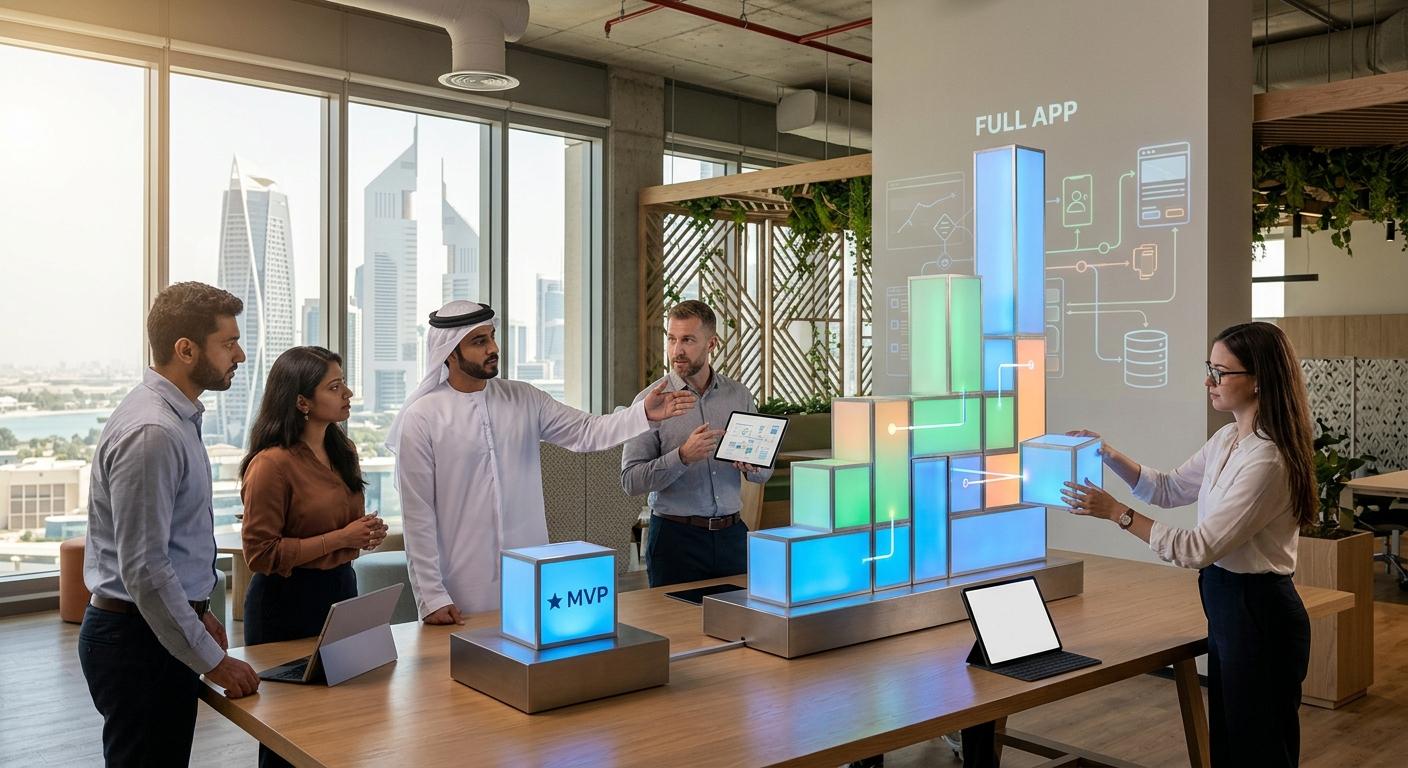
Launching a Minimum Viable Product (MVP) allows businesses to test an idea, gather customer feedback, and validate market demand before committing to a complete application. However, once users begin relying on the product, their expectations change. They may need faster performance, more convenient payment options, better navigation, stronger security, and features that support their everyday activities.
This is the stage where an App Development Company in Dubai can help transform an early-stage product into a scalable, full-featured mobile application. Instead of adding features without a clear plan, businesses need to understand user behaviour, evaluate the existing technology, and invest in improvements that support measurable goals.
For startups, retailers, property businesses, logistics providers, and service companies across Dubai, this transition can create opportunities to improve customer retention and operational efficiency. DeviceBee Technologies provides mobile app development services covering product strategy, UI/UX design, development, testing, deployment, and ongoing support.
1. Evaluate Your MVP Before Planning the Next Stage
Before expanding an MVP, businesses should understand how well the existing application performs. A product that attracts downloads but struggles to convert visitors into paying customers may need a better user journey rather than additional features.
A structured evaluation should examine:
- User behaviour: Identify the screens users visit most often and where they abandon important tasks.
- Customer feedback: Review support requests, app-store feedback, surveys, and recurring complaints.
- Technical performance: Investigate crashes, slow loading screens, API failures, and database bottlenecks.
- Business performance: Measure relevant indicators such as completed purchases, successful bookings, repeat usage, and customer acquisition costs.
- Development quality: Review the existing codebase, third-party integrations, documentation, and security controls.
Consider a Dubai-based property startup whose MVP allows customers to browse property listings. If users regularly view properties but rarely submit enquiries, the next development phase might prioritize better filters, saved listings, viewing appointments, and lead management rather than unrelated features.
This evidence-based approach helps businesses distinguish essential improvements from optional enhancements. It also provides a practical foundation for deciding whether the current application should be upgraded, partially rebuilt, or redeveloped.
2. Prioritize Features That Solve Real Customer Problems
A successful MVP-to-full-app transition does not mean adding every feature customers might request. It means identifying the functionality that makes the product more useful while keeping development costs and complexity manageable.
During mobile app development in Dubai, businesses can prioritize features according to user demand, business value, implementation effort, and technical dependencies.
User-side features
Depending on the application, useful additions may include:
- Secure registration and profiles: Simplify account creation and provide convenient profile management.
- Digital payments: Support appropriate payment methods, transaction confirmations, and payment-status updates.
- Smart search and filters: Help users find products, properties, services, or bookings more efficiently.
- Push notifications: Deliver relevant reminders, order updates, booking confirmations, and account alerts.
- Real-time tracking: Provide delivery, service, or booking progress where the business model requires it.
- Customer support: Introduce help centres, support tickets, or in-app chat.
- Personalized experiences: Use relevant preferences and consented behavioural data to improve recommendations.
Admin-side features
A full application also needs effective business management tools. An admin dashboard may provide:
- User, role, and permission management.
- Product, service, listing, or booking administration.
- Order and transaction monitoring.
- Content management and promotional controls.
- Customer support and issue tracking.
- Analytics for engagement, conversions, and retention.
- Audit logs and operational reports.
For example, an e-commerce business might need inventory synchronization and order management more urgently than an AI recommendation engine. A booking platform may benefit more from calendar management, automated reminders, and cancellation workflows.
An experienced development team can help define a feature roadmap that balances customer expectations with the business's available resources.
3. Strengthen Performance, Security, and Scalability
An MVP may function adequately with a small group of users but experience problems as traffic, transactions, and stored data increase. Adding features without addressing underlying technical limitations can make the application slower, more difficult to maintain, and more expensive to operate.
A scalable upgrade should begin with an architecture review covering the mobile frontend, backend services, database, APIs, hosting environment, and third-party dependencies.
Improve application performance
Depending on the assessment, developers may recommend:
- Optimizing database queries and indexes.
- Introducing caching for frequently requested data.
- Reducing unnecessary API calls and large network responses.
- Compressing and efficiently loading images and other assets.
- Using suitable cloud infrastructure and automated scaling.
- Monitoring response times, crashes, and resource consumption.
Load testing can help establish how the application behaves under expected and peak demand. The goal is to identify bottlenecks before they affect a larger customer base.
Make security part of the upgrade
Security should be reviewed alongside performance rather than postponed until after launch. Appropriate measures may include secure authentication, role-based access controls, encrypted data transmission, protected secrets, dependency updates, and regular vulnerability testing.
Businesses handling personal or financial information should also assess applicable UAE data-protection obligations, payment-security requirements, data retention, and access policies. The precise controls depend on the information being processed and the services involved.
A qualified App Development Company in Dubai can help determine whether the existing architecture can support growth or needs targeted restructuring. This creates a stronger foundation for future features without committing to a complete rebuild unnecessarily.
4. Improve the User Experience as Your Audience Grows
A full application should make important tasks easier, not simply give users more options. If users cannot understand the interface or complete a purchase quickly, additional functionality may increase confusion instead of improving engagement.
For businesses serving Dubai's diverse customer base, usability testing should consider different devices, screen sizes, language preferences, accessibility needs, and customer familiarity with digital services.
Practical improvements may include:
- Simplifying registration and onboarding.
- Reducing unnecessary checkout steps.
- Making primary actions easy to identify.
- Improving navigation and search.
- Providing clear error messages and recovery options.
- Supporting relevant Arabic and English experiences where required.
- Making booking, delivery, or payment status easy to understand.
For example, a food delivery MVP may initially support restaurant discovery and order placement. As the product develops, customers might benefit from saved addresses, clearer delivery estimates, order history, support options, and convenient repeat ordering.
These improvements should be tested with representative users. Usability sessions, prototypes, and controlled experiments can help teams understand whether a proposed change actually reduces friction.
5. Integrate the App with Your Existing Business Systems
An MVP often begins as a standalone product. As the business grows, the app may need to exchange information with other systems to reduce manual work and improve the customer experience.
Common integrations include:
- Payment gateways and transaction services.
- Customer relationship management (CRM) platforms.
- Inventory and order management systems.
- Delivery, mapping, and location services.
- Booking calendars and scheduling software.
- Analytics and customer support tools.
- Enterprise resource planning (ERP) platforms.
For a Dubai retailer, for example, synchronizing inventory between the mobile app and the existing stock-management system can reduce the risk of accepting orders for unavailable products. A service business may connect bookings to its CRM so staff can follow up with customers and track enquiries.
Integration planning should cover API authentication, data mapping, synchronization frequency, rate limits, error handling, and third-party service availability. Payment and order workflows should also handle interrupted requests and failed transactions safely.
The right integrations depend on how the business operates. A focused integration strategy can deliver practical benefits without introducing unnecessary complexity or ongoing maintenance costs.
6. Use AI and Automation Where They Add Measurable Value
Artificial intelligence can become a useful part of an app's next development phase, but it should address a defined business problem rather than be added simply because it is popular.
Depending on the product and available data, suitable capabilities may include:
- AI-assisted customer support for routine questions.
- Product or service recommendations.
- Intelligent search and content discovery.
- Demand forecasting and operational insights.
- Automated classification of support requests.
- Predictive alerts based on relevant usage patterns.
A retail application might use recommendations to help customers discover relevant products. A service platform could classify incoming enquiries and route them to the appropriate team.
Before implementing these features, businesses should evaluate data quality, integration costs, response times, privacy, model accuracy, and the need for human review. AI-generated responses should have appropriate safeguards, especially when they affect important customer decisions.
In many cases, improving the core app experience and analytics will provide more immediate value than introducing complex AI functionality. An incremental roadmap allows businesses to validate each improvement before expanding its scope.
7. Follow a Structured Development and Testing Process
Moving from an MVP to a full application requires a clear process that keeps product priorities, technical decisions, and delivery expectations aligned.
Step 1: Discovery and technical assessment
Review the current application, customer feedback, business objectives, code quality, infrastructure, and known limitations. Establish what should be retained, improved, or replaced.
Step 2: Product roadmap and feature prioritization
Rank proposed improvements according to business value, user needs, complexity, risk, and dependencies. Define the scope of the next release and identify features that can wait.
Step 3: UI/UX design and development
Create user flows and prototypes before implementing significant interface changes. Developers then improve the frontend, backend, database, integrations, and administrative functionality according to the agreed scope.
Step 4: Quality assurance
Test the application across relevant devices and operating systems. Validate usability, functional behaviour, accessibility, API integrations, performance, security, and recovery from errors.
Step 5: Controlled deployment
Release changes using an appropriate rollout strategy. Where supported, staged releases and feature flags can help teams identify problems before exposing every user to a major change.
Step 6: Monitoring and continuous improvement
Track crashes, performance, adoption, conversions, and customer feedback after release. Use the findings to prioritize subsequent updates.
A structured process makes progress more measurable and helps businesses manage the risks associated with changing an application that customers already use.
8. Understand the Cost and Timeline of Scaling an MVP
The cost of transforming an MVP depends on the application's current condition and the scope of the proposed improvements. There is no single price or timeline that applies to every project.
Important cost factors include:
- The quality and maintainability of the existing codebase.
- The number and complexity of new features.
- Whether iOS, Android, or both platforms require updates.
- Backend redevelopment and database migration requirements.
- Third-party integrations and licensing costs.
- Security testing, quality assurance, and deployment.
- Cloud hosting, monitoring, maintenance, and ongoing support.
A relatively stable MVP that needs a redesigned interface and a few new features may require substantially less work than a product with outdated technology, serious performance problems, or complex integrations.
Businesses should request an assessment before committing to a budget. A useful estimate should distinguish immediate development costs from recurring infrastructure, third-party service, and maintenance expenses.
For more details about available development capabilities, explore DeviceBee's mobile app development services. The development team can assess your existing product and help define a realistic roadmap, timeline, and project estimate.
9. Why Choose DeviceBee Technologies for Your App's Next Stage?
Selecting a development partner means looking beyond the initial launch. Businesses need a team that can evaluate an existing product, understand customer requirements, recommend suitable technology, and plan improvements without losing sight of commercial objectives.
DeviceBee Technologies offers mobile app development across iOS, Android, cross-platform solutions, and AI-powered applications, alongside design, testing, deployment, and ongoing support. Its portfolio includes projects across different business categories, including delivery platforms and digital services.
When evaluating a potential development partner, ask how the team will:
- Audit your existing codebase and infrastructure.
- Identify the highest-priority technical and product improvements.
- Explain the trade-offs between upgrading and rebuilding.
- Estimate costs, timelines, and third-party expenses.
- Test performance, security, and usability.
- Document the solution and support future maintenance.
DeviceBee's app development portfolio and case studies can help you explore examples of its project work.
If your MVP is attracting interest but struggling with performance, missing features, or limited scalability, the next step is a focused technical and product assessment. DeviceBee Technologies to discuss your application, business goals, and requirements for the next development phase.
Conclusion
Turning an MVP into a complete mobile application requires more than adding features. Businesses must understand customer behaviour, prioritize meaningful improvements, strengthen the technical foundation, and build an experience that can support growing demand.
An App Development Company in Dubai can help guide this transition through technical assessment, product planning, UX improvements, integrations, security testing, and ongoing optimization. For businesses across Dubai and the UAE, the right approach is to invest in improvements that solve validated problems and support measurable business outcomes.
DeviceBee Technologies can help you evaluate the next stage of your mobile app journey. Whether you need better performance, new functionality, improved integrations, or a more scalable architecture, start with a clear roadmap.
Ready to take your MVP further? Contact now Discuss your app development project with DeviceBee Technologies and explore a practical path from early validation to a more capable digital product.
Frequently Asked Questions
1. How long does it take to turn an MVP into a full mobile app?
The timeline depends on the existing codebase, required features, integrations, platform requirements, and testing scope. A focused upgrade may take several weeks, while a complex transformation can take several months. A technical assessment helps establish a realistic delivery plan.
2. How much does it cost to scale an MVP in Dubai?
The cost depends on the application's current condition, feature requirements, design changes, backend improvements, and integrations. Businesses should request a project assessment that separates development costs from ongoing hosting, licensing, and maintenance expenses.
3. Should I rebuild my MVP or improve the existing application?
Improving the existing application may be appropriate when its architecture is maintainable and secure. A partial or complete rebuild may be necessary if major technical limitations make future development risky or unnecessarily expensive. A codebase audit helps determine the most practical option.
4. Which features should I add when upgrading my MVP?
Prioritize features based on customer feedback and business objectives. Common options include secure authentication, payments, notifications, advanced search, analytics, customer support, and admin dashboards. Not every application needs all these features.
5. Can DeviceBee Technologies upgrade an existing mobile application?
DeviceBee offers mobile app development and ongoing application support services. Discuss your existing application, technical challenges, source code, platform requirements, and desired improvements with the team to determine the appropriate scope.
6. How can I make my app scalable as the number of users grows?
Start by reviewing backend architecture, database performance, APIs, infrastructure, and security. Load testing, monitoring, caching, and suitable cloud resources can help address bottlenecks. The right approach depends on the application's architecture and expected workload.
7. Is AI necessary when turning an MVP into a full app?
No. AI is useful when it addresses a specific need, such as customer support automation, personalized recommendations, or predictive insights. Businesses should first ensure that the core application is reliable, secure, and useful to customers.
8. How do I get started with DeviceBee Technologies?
Prepare your existing app details, user feedback, current technical challenges, desired features, and budget range. Then contact now to discuss an assessment, development roadmap, and project estimate.

 English
 Arabic
 French
 Spanish
 Portuguese
 Deutsch
 Dutch
Dutch
 Italiano
 Russian
 Romaian
 Portuguese (Brazil)
 Greek
Greek