


Insulated Tools vs. Standard Tools: What Should Electricians Choose?
Choosing the right tools is an important part of electrical work. From tightening terminal screws to cutting wires and preparing cables, electricians rely on hand tools throughout the day. But when working around electrical systems, the type of tool matters just as much as its function.
This is where insulated tools make a difference. Designed with protective insulation, these tools provide an additional layer of protection against electrical hazards when used correctly. They are especially important for professionals who work on electrical installations, maintenance, and repair tasks.
However, not every job requires the same equipment. Should you choose standard hand tools or insulated electrical tools? Is an insulated screwdriver enough, or is an insulated screwdriver set a better investment?
Let's compare the options and explore how electricians can choose tools that suit their work.
1. Insulated Tools vs. Standard Tools: Understanding the Difference
At first glance, insulated and standard hand tools may look similar. Both can tighten screws, grip wires, cut conductors, and perform everyday installation tasks. The main difference is their construction and intended safety application.
Standard tools are designed primarily to perform mechanical tasks. Insulated tools intended for electrical work have specialized insulating coverings and are manufactured and tested to applicable safety standards.
|
Feature |
Standard hand tools |
Insulated electrical tools |
|
Main purpose |
General mechanical work |
Electrical work requiring appropriately rated tools |
|
Handle construction |
May have ordinary plastic or rubber grips |
Designed with electrical insulation and protective features |
|
Safety certification |
Depends on the product |
Should meet applicable insulated-tool standards |
|
Typical applications |
General repairs and assembly |
Electrical installation, maintenance, and service |
|
Selection priority |
Fit, strength, and function |
Fit, function, insulation rating, and condition |
The important point is that a rubber handle does not automatically make a tool suitable for electrical work. Look for the appropriate ratings and certifications, such as IEC 60900, where applicable.
Insulated tools also do not make every energized task safe. De-energizing equipment and verifying the absence of voltage remain essential whenever required by the work procedure.
2. Insulated Screwdrivers vs. an Insulated Screwdriver Set
Screwdrivers are among the most frequently used tools in electrical installations. They help technicians secure terminal connections, tighten mounting screws, and assemble electrical equipment.
An individual insulated screwdriver can be a practical choice when you regularly work with a particular screw type or size. For example, a technician who frequently handles a specific terminal may need one compatible slotted or Phillips screwdriver.
An insulated screwdriver set, on the other hand, provides several sizes and tip types in one package. This makes it easier to handle different fasteners without repeatedly switching between tools that may not be suitable for the task.
Consider the following comparison:
-
Individual insulated screwdriver: Best when you need a specific size or want to replace one frequently used tool.
-
Insulated screwdriver set: Useful when a job involves multiple screw sizes and different terminal designs.
-
Complete insulated tool kit: More suitable when you also need pliers, wire strippers, or other compatible insulated hand tools.
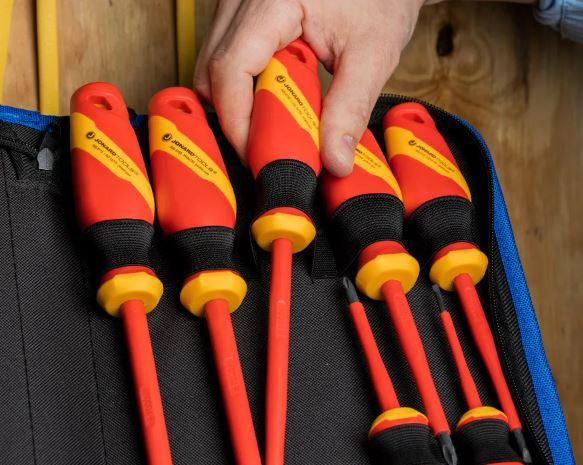
Jonard Tools offers a 7 piece insulated screwdriver set, the TK-70INS, with a selection of Phillips and slotted screwdrivers. It can be a useful option for electricians who want several commonly used screwdriver sizes together.
The best choice depends on the work you perform most often. Check the tip sizes and lengths before purchasing, since a set is only useful when its contents match your applications.
3. Insulated Screwdrivers vs. Insulated Pliers: Which Do You Need?
Screwdrivers and pliers serve different purposes, so one cannot replace the other. The right combination depends on the task.
Insulated screwdrivers are used for compatible fasteners, such as screws on electrical terminals and equipment enclosures.
Insulated pliers help grip, bend, position, and manipulate compatible wires or components. Depending on their design, they may include cutting edges for specific wire applications.
For example, an electrician installing a control panel may need a screwdriver to secure terminals and pliers to position conductors. A maintenance technician may also need diagonal pliers for suitable cutting tasks.
When comparing these tools, consider the work rather than simply counting how many tools you own.
-
Choose screwdrivers based on tip style, size, shaft length, and fastener access.
-
Choose pliers based on jaw design, cutting capacity, and the task they are intended to perform.
-
Check the insulation rating and inspect the protective covering before every use.
A combination of correctly selected tools is usually more practical than relying on one multipurpose tool for every job.
4. Individual Insulated Tools vs. Complete Electrician Tool Kits
Buying tools individually gives you control over every item in your collection. You can select the exact sizes and designs required for your regular work and replace only the tools that become worn or damaged.
A complete kit offers a different advantage: convenience. It brings together commonly used tools and usually includes a dedicated storage case.
For electricians who travel between job sites, an organized kit can make it easier to carry equipment and locate the right tool quickly.
Jonard Tools offers the TK-110INS, an 11 piece insulated tool kit that includes seven screwdrivers, three pliers, and a wire stripper. Compared with a screwdriver only set, it covers a broader range of common hand tool tasks.
|
Consideration |
Individual tools |
Complete insulated kit |
|
Customization |
High |
Depends on included tools |
|
Initial convenience |
Requires selecting each item |
Tools are grouped together |
|
Replacing one tool |
Usually straightforward |
Individual replacement may be needed |
|
Best suited for |
Specialized or established tool collections |
Technicians building a general-purpose kit |
A kit is not automatically the best option for every electrician. Check the contents carefully and make sure the tools suit your work. You may still need specialized equipment for particular installations.
5. How to Compare Insulated Tools Before Buying
Price and appearance alone are not reliable ways to select insulated electrical tools. Several practical details deserve attention before you make a purchase.
Safety standards and voltage rating: Check the manufacturer's documentation for the relevant standard, intended use, and voltage rating. A 1,000 V rating applies only within the tool's specified conditions of use.
Tool material and construction: Strong steel components help support mechanical performance, while properly designed insulation provides the intended protective barrier.
Handle comfort: Ergonomic handles can improve grip and control, especially during repetitive tasks. However, comfort should never take priority over the correct safety rating.
Tool dimensions: Shaft length, tip size, jaw design, and overall dimensions affect how easily you can reach the work area.
Storage and portability: A suitable case helps keep tools organized and can protect them during transport.
Maintenance and inspection: Insulated tools need regular inspection. Damaged, cracked, contaminated, or worn insulation can compromise protection, so affected tools should be removed from service.
Comparing these features helps you select tools based on actual work requirements rather than marketing claims alone.
6. Why Insulated Tools Matter for Electricians and Contractors
Electricians, electrical contractors, and maintenance technicians often work across different environments, including commercial buildings, industrial facilities, electrical panels, and service locations.
Having appropriately rated insulated tools available can help them prepare for tasks where electrical hazards must be considered. A well planned toolkit also reduces the need to search for suitable equipment during a job.
For contractors managing several technicians, standardized tool kits can help make equipment selection and inspection more consistent across the team.
Still, insulated tools are only one part of an overall safety plan. Appropriate training, safe isolation procedures, personal protective equipment, and suitable test instruments remain important. No insulated hand tool should be treated as permission to work on energized equipment without the required qualifications and procedures.
7. Which Insulated Tools Are Right for Your Work?
The best setup depends on the type of electrical work you perform and the tools you use every day.
If most of your work involves tightening terminal screws, an insulated screwdriver or a suitable screwdriver set may be sufficient for your immediate needs. If you regularly prepare wires, grip conductors, and perform general electrical installation tasks, a broader selection of insulated pliers and wire strippers may be more practical.
For technicians building a toolkit from scratch, a complete insulated tool kit can provide a convenient starting point. Experienced professionals may prefer to purchase individual tools that fill gaps in an existing collection.
Jonard Tools offers insulated screwdrivers, pliers, wire strippers, fuse pullers, and insulated tool kits for electricians and electrical contractors.
Explore the Jonard insulated tools collection to compare available products, review specifications, and identify tools suited to your applications.
Conclusion
Choosing between standard tools, individual insulated screwdrivers, and complete insulated tool kits comes down to the work you need to perform and the safety requirements involved.
Standard tools remain useful for general mechanical tasks, while properly rated insulated tools provide an additional layer of protection for appropriate electrical work. An insulated screwdrivers offers flexibility across different fasteners, whereas a complete kit can cover a wider range of everyday tasks.
Before purchasing, compare the tool specifications, safety ratings, comfort, and intended applications. With the right equipment, regular inspection, and established electrical safety procedures, electricians can build a practical toolkit that supports consistent and reliable workmanship.


 English
 French
 Spanish
 Portuguese
 Deutsch
 Turkish
 Dutch
 Italiano
 Russian
 Romaian
 Portuguese (Brazil)
 Greek