


Anti-Venom Market Forecast: India Leads at 9.7% CAGR as Market Reaches USD 3.2 Billion by 2036
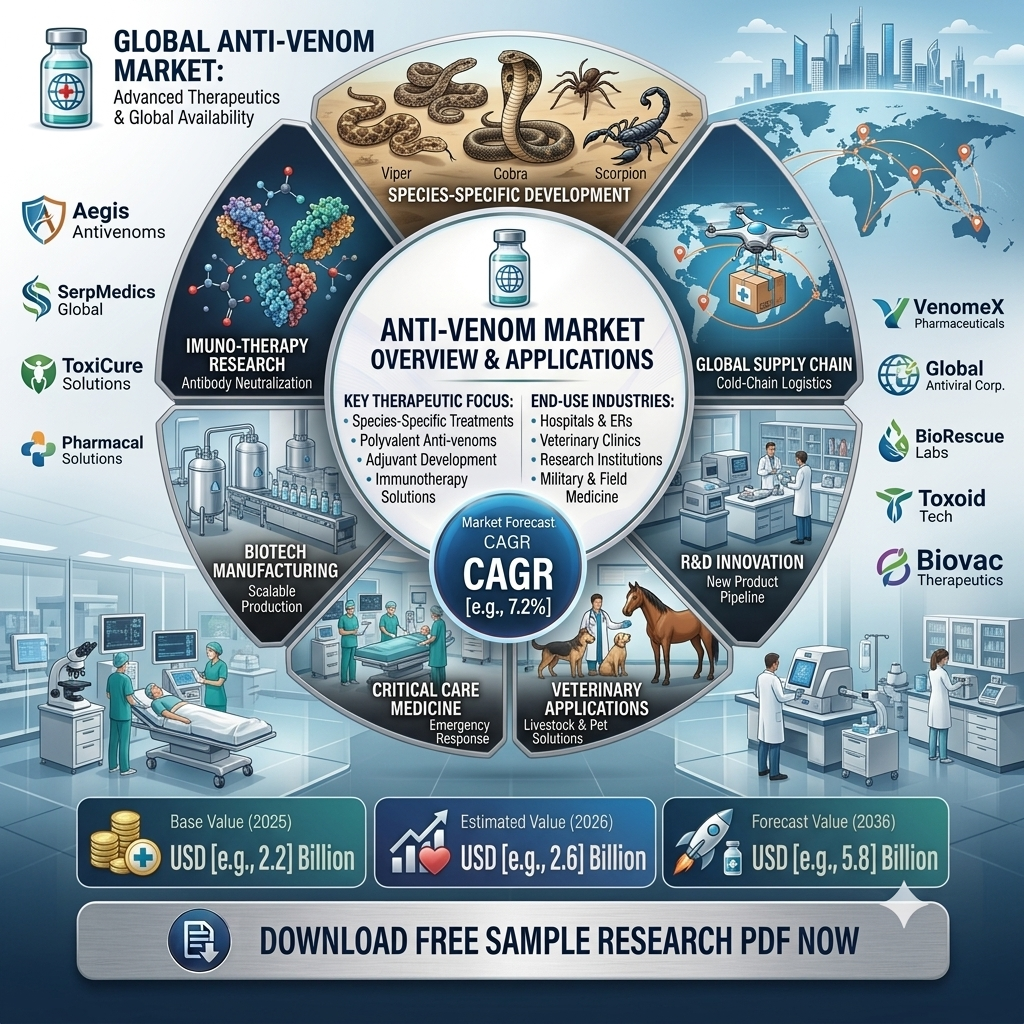
The anti-venom market is forecast to expand from USD 1.5 billion in 2026 to USD 3.2 billion by 2036, registering an 8.2% CAGR over the forecast period. Fact.MR attributes this expansion to the persistent global burden of snakebites and other venomous bites, alongside government procurement programs and efforts to improve access to emergency treatment. The market is expected to create an absolute dollar opportunity of USD 1.8 billion between 2026 and 2036.
Snakebite envenomation remains a major public health concern, particularly in tropical and subtropical regions where access to timely medical treatment can be limited. Fact.MR identifies expanding government anti-venom stockpiles, increased attention to snakebite as a neglected tropical disease, and improvements in emergency distribution as important factors supporting market development. Better cold-chain logistics are also helping extend the availability of anti-venom products to rural healthcare facilities.
Get detailed market forecasts, competitive benchmarking, and pricing trends:
https://www.factmr.com/connectus/sample?flag=S&rep_id=11680
Snake Anti-Venom Retains Leading Position
By product type, snake anti-venom is expected to account for 44.8% of the market in 2026. Its leading position reflects the substantial global burden of snake envenomation and the need for treatments capable of neutralizing venom toxins. Monovalent and polyvalent formulations serve different treatment requirements, with polyvalent products providing coverage against multiple snake species relevant to particular regions.
By application, snakebite envenomation is projected to represent 52.3% of the market in 2026. Hospitals remain the principal treatment setting, accounting for 61.7% of end-use demand. Emergency departments and intensive care units require access to appropriate anti-venom products for patients experiencing serious envenomation. Clinics, ambulance services, and emergency response units also form part of the distribution and treatment network, particularly in areas where travel to larger hospitals can delay care.
Product availability remains an important consideration for healthcare providers. Anti-venom must be matched to the venom involved, while storage and transportation conditions can affect distribution to remote locations. These requirements are encouraging manufacturers and public health authorities to strengthen procurement planning, inventory management, and delivery systems.
India, China, and Germany Show Growth Potential
India is projected to record a 9.7% CAGR from 2026 to 2036, the highest among the countries assessed by Fact.MR. The country's substantial snakebite burden and expanding government procurement programs are supporting demand. Strengthening anti-venom availability, improving distribution beyond major urban hospitals, and maintaining dependable supplies are important priorities for healthcare providers.
China is expected to register a 9.2% CAGR through 2036. Fact.MR links the country's growth outlook to developments in anti-venom supply infrastructure and hospital emergency capacity. Improving access to treatment and strengthening the availability of products for emergency care are expected to support market development during the forecast period.
Germany is projected to advance at an 8.1% CAGR over the same period. Its growth outlook reflects demand within an established healthcare system for specialized treatment and reliable emergency medical supplies. Regulatory requirements, product quality, and dependable distribution remain relevant considerations for manufacturers serving healthcare institutions.
The United States is forecast to grow at a 7.8% CAGR through 2036. Demand is supported by specialized anti-venom products for regional venomous species and emergency stockpile procurement. Brazil is expected to record an 8.6% CAGR, supported by established manufacturing capabilities and national anti-venom distribution programs.
Competitive Landscape
Competition in the anti-venom market includes manufacturers with specialized biological production capabilities, regulatory expertise, and relationships with government procurement agencies. Key companies identified by Fact.MR include Bharat Serums and Vaccines, CSL Limited, Instituto Butantan, MicroPharm Limited, Incepta Pharmaceuticals, and Haffkine Bio-Pharma.
Manufacturing reliability and distribution capability are important competitive factors. Suppliers must maintain product quality while meeting procurement requirements across regions with differing venom profiles and healthcare infrastructure. Cold-chain management, regulatory approvals, production capacity, and dependable delivery are also relevant when healthcare authorities evaluate suppliers for emergency stockpiles and routine hospital requirements.
Technology and Supply Chain Developments Shape the Market
The market is also being influenced by research into recombinant anti-venoms and broadly neutralizing antibody platforms. These approaches are being explored for their potential to improve manufacturing scalability and broaden protection against different venom types. Conventional animal-derived anti-venoms remain important, but limitations involving production capacity, product availability, and distribution create opportunities for further technological development.
Supply chain improvements are equally important. Anti-venom products may require controlled storage and careful handling, making distribution difficult in remote areas with limited healthcare infrastructure. Investments in cold-chain logistics, emergency inventory planning, and government procurement programs can help address availability gaps. However, manufacturing constraints and the cost of plasma-derived products remain challenges in some markets.
As governments and healthcare providers work to improve access to timely treatment, demand for dependable anti-venom supplies is expected to remain an important market driver. Fact.MR's report provides further analysis of market forecasts, product segments, country-level growth, competitive positioning, and opportunities through 2036.
Top Reports:
https://adamaamresearch.blogspot.com/2026/10/tissue-diagnostics-market-to-expand-to.html
https://net-pals.com/blogs/52990/Tissue-Diagnostics-Market-Expansion-Through-2036-Led-by-China-at
https://acmingle.com/blogs/29990/Tissue-Diagnostics-Market-Eyes-USD-23-3-Billion-by-2036
https://facehun.com/blogs/297495/Tissue-Diagnostics-Market-Forecast-at-USD-23-3-Billion-by
About Fact.MR
Fact.MR is a market research and consulting company providing market intelligence, competitive analysis, and forecasting across global industries. Its research supports businesses with data-driven insights into emerging markets, technology trends, competitive dynamics, regional opportunities, and changing demand patterns.

 English
 Arabic
 Spanish
 Portuguese
 Deutsch
 Turkish
 Dutch
 Italiano
 Russian
 Romaian
 Portuguese (Brazil)
 Greek