


How an Invoice Moves Through a UAE Peppol E-Invoicing Solution
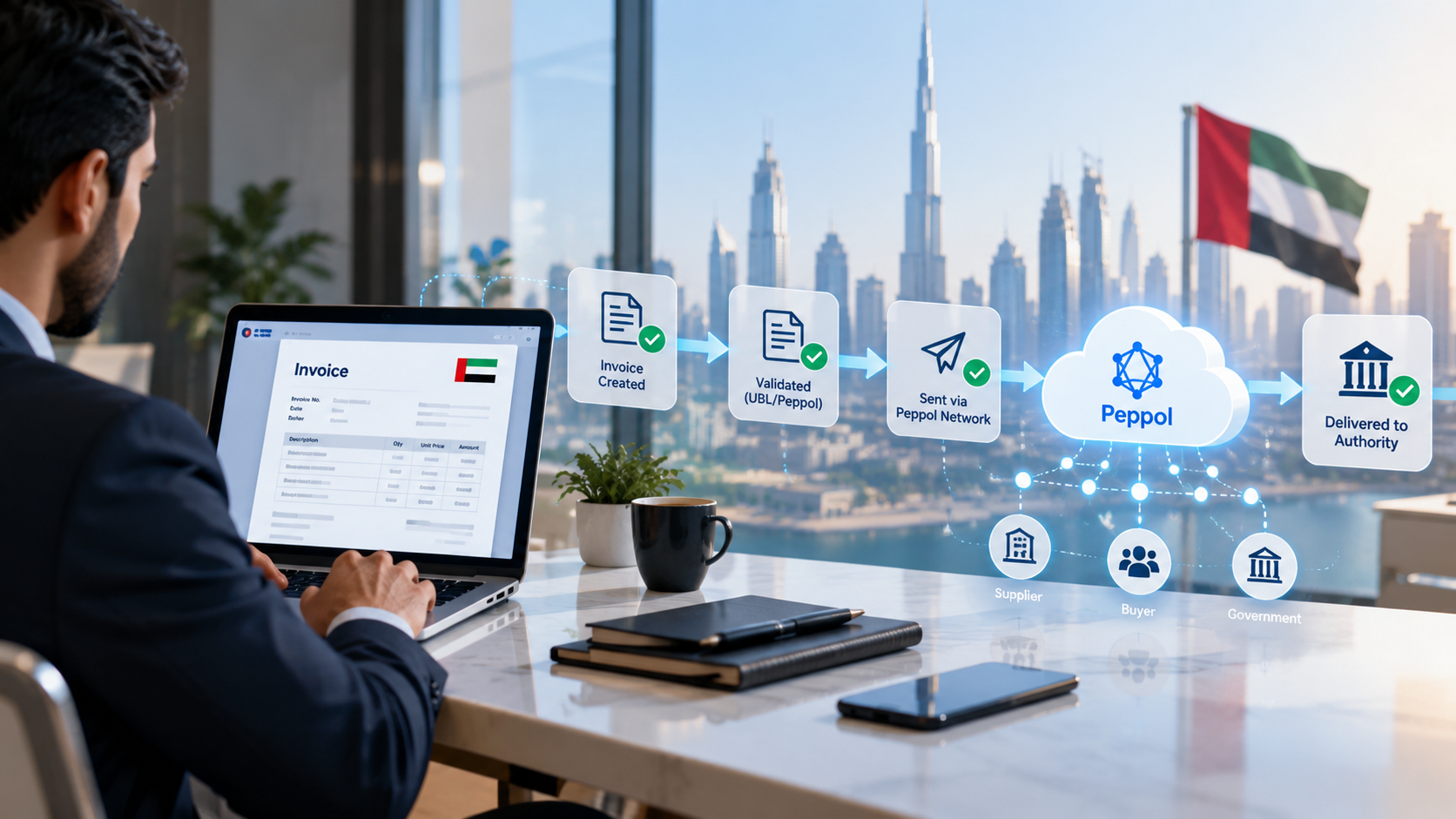
Finance teams hear terms like “Peppol”, “five-corner model” and “PINT AE” and tend to file them under technical background that the provider will handle. That is a risky assumption. A UAE Peppol e-invoicing solution is a chain of handoffs, and each handoff is a place where an invoice can be delayed, rejected or sent with the wrong data. Knowing where those handoffs sit makes it much easier to spot problems early.
The context is moving fast. As of October 2026, businesses with annual revenue of AED 50 million or more must appoint an Accredited Service Provider (ASP) by 30 October 2026 and issue e-invoices from 1 January 2027, while other in-scope businesses follow with appointment by 31 March 2027 and issuing from 1 July 2027. The UAE has built its system on the Peppol network, using a decentralised model with a national invoice format called PINT AE.
Understanding what a UAE Peppol e-invoicing solution does at each stage helps you ask better questions when you evaluate providers, test your setup or troubleshoot a rejected invoice. This article follows a single invoice from creation to delivery.
Quick answer: in the UAE, an invoice passes through five parties: your business, your ASP, your customer’s ASP, your customer, and the Federal Tax Authority. Your solution sits at the second corner and is responsible for converting, validating and routing the invoice.
Why the UAE Uses Five Corners Instead of Four
The standard Peppol model
Peppol, used in many countries for exchanging business documents, is normally described as a four-corner network. The supplier sends a document to its access point, that access point passes it to the buyer’s access point, and the buyer receives it. The supplier and buyer never need a direct connection to each other, only to a provider on the network.
What the fifth corner adds
The UAE keeps that structure and adds the Federal Tax Authority (FTA) as a fifth corner. Required tax data from each invoice reaches the authority through the provider, alongside the exchange between trading partners. This design is known as Decentralised Continuous Transaction Control and Exchange. The authority gets visibility without every business uploading invoices to a central portal by hand. Because the provider validates each invoice, rules about mandatory fields and how VAT must be shown are enforced at the second corner, before the invoice is routed to your customer.
Follow One Invoice, Corner by Corner
Take a simple example. A Dubai distributor sells goods to a retailer for AED 10,000 plus 5% VAT. Here is what happens to that invoice:
- Corner 1, the supplier. The distributor’s ERP or billing system creates the invoice data: parties, tax registration details, line items and VAT amounts. The quality of this data decides everything that follows.
- Corner 2, the supplier’s ASP. The provider converts the data into the PINT AE format, which is XML based on UBL 2.1. It validates the fields and tax information, and only then routes the invoice onward.
- Corner 3, the buyer’s ASP. The retailer’s provider receives the invoice over the Peppol network and checks that it can be delivered to the retailer’s system.
- Corner 4, the buyer. The retailer receives the structured invoice and records it in its own system, ready for matching and payment.
- Corner 5, the Federal Tax Authority. The supplier’s provider reports the tax data from the invoice to the authority as part of the same flow.
If the invoice fails at step 2, nothing reaches the buyer. That is why the first two corners deserve most of your attention.
What Each Corner Needs From You
Corner 1: clean, complete source data
Most ERPs do not produce PINT AE output on their own, so a mapping or connector layer is usually needed between the ERP and the provider. Every manual export or re-keying step in that path is another chance for a missing tax number or inconsistent tax category to slip in. This is why many businesses prefer ERP-integrated e-invoicing for the UAE, where the connection to platforms such as SAP, Oracle or Microsoft Dynamics 365 is built in rather than assembled from spreadsheets.
Corner 2: a provider you can verify
Businesses connect to the system only through an Accredited Service Provider approved by the Ministry of Finance. Before signing, check the provider against the Ministry’s published list rather than relying on a sales claim. Accreditation is the minimum, and it says little about how well the provider handles your volumes, your ERP or your rejections.
Corner 4: the receiving side
Both issuers and recipients need a provider, so your customers must be reachable on the network and you must be able to receive their invoices. Many teams test sending carefully and treat receiving as an afterthought. Incoming supplier invoices need to be matched, approved and archived in the same structured form.
Common Mistakes at Each Handoff
Most problems follow a few repeating patterns:
- Treating a PDF as the invoice. A PDF emailed to a customer is not an e-invoice. The structured file is the invoice.
- Testing only clean invoices. Credit notes, mixed tax rates and zero-rated sales are where mapping errors tend to appear.
- Expecting the provider to fix bad data. A provider can validate and reject an invoice, but it cannot know the correct tax registration number of your customer.
- Leaving the receiving side until last. Incoming invoices need the same attention as outgoing ones.
Questions to Ask Any UAE Peppol E-Invoicing Solution Provider
A short list of practical questions separates a sound setup from a risky one:
- Is the provider on the Ministry of Finance’s list of accredited providers?
- Which ERP versions does it connect to, and who builds and maintains the mapping?
- What does a rejected invoice look like, and how quickly can your team correct and resend it?
- How are incoming invoices received, matched and stored?
- How are regulatory changes applied to your setup, and who tests them?
- How long are invoices archived, and how are they retrieved for an audit?
Ask for answers in writing, and ask to see them demonstrated on your own invoices rather than a polished sample.
Treat the Five Corners as a Checklist
The five-corner model can sound abstract, yet it works well as a practical checklist. Corner 1 asks whether your data is clean. Corner 2 asks whether your provider is accredited and capable. Corners 3 and 4 ask whether you can exchange and receive invoices reliably, and corner 5 reminds you that the tax authority sees the data your system produces.
Walk through your own invoice process using the five steps above. Wherever you cannot say who is responsible or what happens when something fails, you have found the gap to close before your deadline.

 English
 Arabic
 French
 Spanish
 Portuguese
 Deutsch
 Turkish
 Dutch
 Italiano
 Russian
 Portuguese (Brazil)
 Greek