


Biopreservation Market Trends Connect Laboratory Automation With Sample Safety
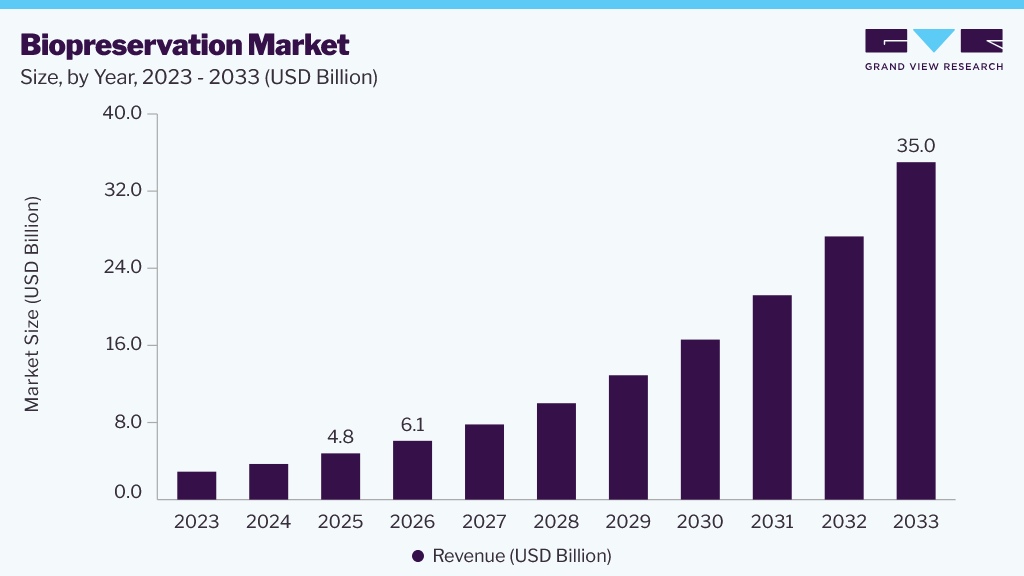
The biopreservation market is becoming increasingly important as healthcare and biotechnology organizations seek reliable ways to preserve biological materials for research, diagnostics, and therapeutic applications. Stem cells, tissues, DNA, and other biological specimens require carefully controlled storage conditions to maintain their integrity and functionality. Growing investment in regenerative medicine, cell and gene therapies, and biological research is increasing demand for specialized preservation technologies. The market was valued at USD 4.8 billion in 2025 and is projected to reach USD 35.0 billion by 2033, growing at a CAGR of 28.3% from 2026 to 2033.
Biobanking Creates a Strong Foundation for Market Expansion
Biobanking plays a central role in preserving biological samples for medical research, clinical studies, and future therapeutic development. Hospitals, research institutions, and pharmaceutical companies depend on properly stored specimens to investigate diseases, evaluate treatments, and support scientific discoveries.
The biobanking application accounted for over 70.0% of market revenue in 2025, making it the leading application segment. Growing interest in stem cell preservation, fertility preservation, and biological sample management is supporting demand for reliable storage systems. Biobanks also help research organizations maintain valuable specimens over extended periods, supporting studies that require consistent sample quality.
Biopreservation Market: Key Developments to Watch
· Market expansion: Revenue is projected to rise from USD 6.1 billion in 2026 to USD 35.0 billion by 2033.
· Equipment leadership: Equipment accounted for over 75.0% of market revenue in 2025.
· Biobanking demand: Biobanking represented over 70.0% of market revenue in 2025.
· Regenerative medicine: This application segment is expected to grow at the fastest rate during the forecast period.
· Regional opportunities: North America led the market in 2025, while Asia Pacific is expected to register the fastest regional growth.
Advanced Equipment Supports Reliable Biological Storage
Equipment represents the largest product category in the biopreservation market, accounting for over 75.0% of revenue in 2025. Freezers, refrigerators, liquid nitrogen systems, and specialized storage equipment help maintain biological specimens under controlled conditions. These technologies are essential for institutions that manage large collections of cells, tissues, and other biological materials.
Demand for advanced equipment is increasing as research organizations require reliable storage capacity, temperature stability, and consistent preservation performance. Ultra-low-temperature freezers and cryogenic storage systems support applications that require biological materials to remain viable over extended periods.
Manufacturers are also focusing on energy efficiency, automation, and improved storage management. These developments can help laboratories maintain appropriate storage conditions while managing operational costs. As biological research becomes more complex, equipment reliability and monitoring capabilities are becoming increasingly important purchasing considerations.
Regenerative Medicine Opens New Growth Opportunities
Regenerative medicine is expected to register the fastest growth among application segments during the forecast period. Cell and gene therapies, stem cell research, and other advanced treatments depend on biological materials that must be preserved without compromising their quality or therapeutic potential.
Biopreservation technologies help maintain the stability of sensitive cells and tissues during storage and transportation. Cryopreservation media, controlled-rate freezers, and specialized storage systems support the handling of biological materials used in research and treatment development.
The expansion of personalized medicine is also increasing the importance of reliable preservation. As therapies become more individualized, healthcare providers and biotechnology companies need dependable processes for managing biological specimens throughout development and clinical use. These requirements are creating opportunities for providers of preservation equipment, media, and associated technologies.
Preservation Media and Digital Systems Improve Research Workflows
Biopreservation media are important for maintaining biological materials under suitable storage conditions. Pre-formulated and home-brew media offer different approaches to preservation, depending on research requirements and laboratory practices. The media segment is expected to experience significant growth from 2026 to 2033 as demand for specialized preservation solutions increases.
Laboratory information management systems also support the organization and tracking of biological samples. Digital records can help laboratories manage specimen information, improve traceability, and coordinate research workflows. However, effective implementation requires appropriate software standardization, cybersecurity measures, and trained personnel.
These considerations are particularly important for institutions managing large sample collections or collaborating across multiple research facilities.
Regional Investment Shapes Biopreservation Market Development
North America accounted for over 45.0% of market revenue in 2025, supported by biomedical research, advanced therapy development, and established biobanking infrastructure. Government support and investment from private organizations also contribute to research activities that require specialized preservation technologies.
Asia Pacific is expected to experience the fastest regional growth during the forecast period. Increasing investment in biobanking, growing research capabilities, and partnerships between pharmaceutical companies, hospitals, and research institutions are supporting regional opportunities. Greater emphasis on precision medicine and translational research is also increasing the need for reliable biological sample storage.
FAQs
How big is the biopreservation market?
The biopreservation market was valued at USD 4.8 billion in 2025 and is projected to reach USD 35.0 billion by 2033, growing at a CAGR of 28.3% from 2026 to 2033.
What trends are shaping the biopreservation market?
Major trends include increasing demand for biobanking, advances in cryogenic storage equipment, growing adoption of cell and gene therapies, improvements in preservation media, and the integration of digital sample management systems.
Key Biopreservation Companies:
· Azenta US, Inc.
· LUMITOS AG
· BioLife Solutions Inc.
· MVE Biological Solutions
About us:
Grand View Research, a market research and consulting company, provides syndicated research reports, customized research reports, and consulting services. Grand View Research database is used by the world's renowned academic institutions and Fortune 500 companies to understand the global and regional business environment. Our database features thousands of statistics and in-depth analysis on 46 industries in 25 major countries worldwide.

 Arabic
 French
 Spanish
 Portuguese
 Deutsch
 Turkish
 Dutch
 Italiano
 Russian
 Romaian
 Portuguese (Brazil)
 Greek