


3D Printing Medical Devices Market Set for USD 18.2 Billion Valuation by 2036, China Leads Growth
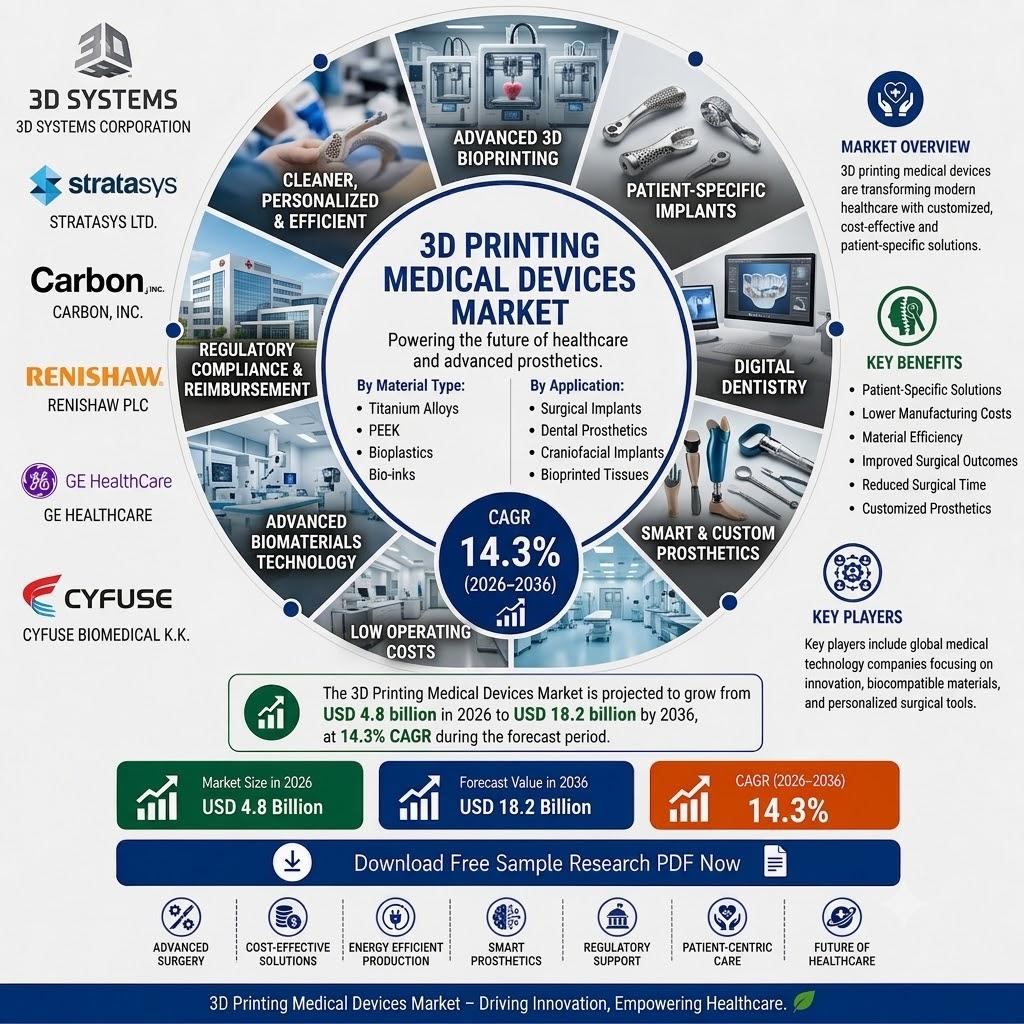
The global 3D printing medical devices market is projected to reach USD 4.8 billion in 2026 and expand to USD 18.2 billion by 2036, registering a compound annual growth rate (CAGR) of 14.3%, according to Fact.MR. Growing demand for personalized healthcare, advances in additive manufacturing, and increasing investment in medical technology are creating opportunities for device manufacturers and healthcare providers. <Cite refs={["turn241410search0"]}/>
3D printing enables the production of customized implants, prosthetics, surgical guides, and other medical devices. Its ability to create complex geometries and patient-specific designs is supporting adoption across hospitals, research institutions, and medical device manufacturing facilities.
Get detailed market forecasts, competitive benchmarking, and pricing trends: https://www.factmr.com/connectus/sample?flag=S&rep_id=15097
Personalized Implants Drive Market Demand
Materials are projected to account for 40% of the market by product in 2026, supported by recurring demand for medical-grade printing materials. Standard prosthetics and implants are expected to represent 30% of the application segment as healthcare providers increasingly adopt customized solutions.
Hospitals are also expanding their use of 3D-printed anatomical models and surgical guides to support preoperative planning. However, regulatory approvals, material qualification, and manufacturing costs remain important considerations for broader adoption.
Advanced Printing Technologies Expand Applications
Laser beam melting is projected to account for 33% of the technology segment in 2026. Its ability to produce complex structures with precision supports applications in orthopedic implants and other medical devices.
Polymers are expected to hold a 45% share of the material-type segment, reflecting their versatility across medical applications. Continued progress in printing accuracy, material performance, and production efficiency is expected to broaden the range of devices suitable for additive manufacturing.
China Leads Country-Level Growth
China's 3D printing medical devices market is projected to grow at a CAGR of 16.2% through 2036, supported by expanding medical manufacturing and rising demand for customized devices. India follows with a projected CAGR of 15.8%, while South Korea is expected to register 15.1% growth.
The United States is forecast to grow at 13.4%, followed by Germany at 12.9% and Japan at 12.3%. Healthcare investment, precision manufacturing capabilities, and the adoption of personalized treatment solutions are expected to influence growth across these markets. <Cite refs={["turn241410search0"]}/>
Analyst Perspective
Shambhu Nath Jha, Principal Consultant at Fact.MR, observes, “Competitive advantage is shifting toward customization capability. Companies that strengthen design expertise and regulatory compliance will improve long-term positioning.” <Cite refs={["turn241410search0"]}/>
Competitive Landscape
Competition is shaped by printing precision, material quality, regulatory compliance, and the ability to support healthcare-specific requirements. Key companies profiled in the Fact.MR report include 3D Systems Corporation, Stratasys Ltd., Carbon Inc., Renishaw Plc, and GE HealthCare.
Manufacturers are investing in advanced materials, customized production capabilities, and collaborations with healthcare providers to strengthen their market positions.
Market Snapshot
- Estimated market value (2026): USD 4.8 billion
- Forecast market value (2036): USD 18.2 billion
- CAGR (2026–2036): 14.3%
- Leading product segment: Materials, with 40% share
- Leading technology segment: Laser beam melting, with 33% share
- Fastest-growing profiled country: China, at 16.2% CAGR
To View Top Reports
https://sportgalax.com/read-blog/25858
https://afgbfh.blogspot.com/2026/10/long-range-radar-sensor-components-for.html
About Fact.MR
Fact.MR is a market research and competitive intelligence provider delivering market intelligence, competitive analysis, and forecasting across global industries. Its research helps businesses evaluate market demand, understand competitive developments, and identify growth opportunities.

 English
 Arabic
 French
 Spanish
 Portuguese
 Deutsch
 Turkish
 Italiano
 Russian
 Romaian
 Portuguese (Brazil)
 Greek